
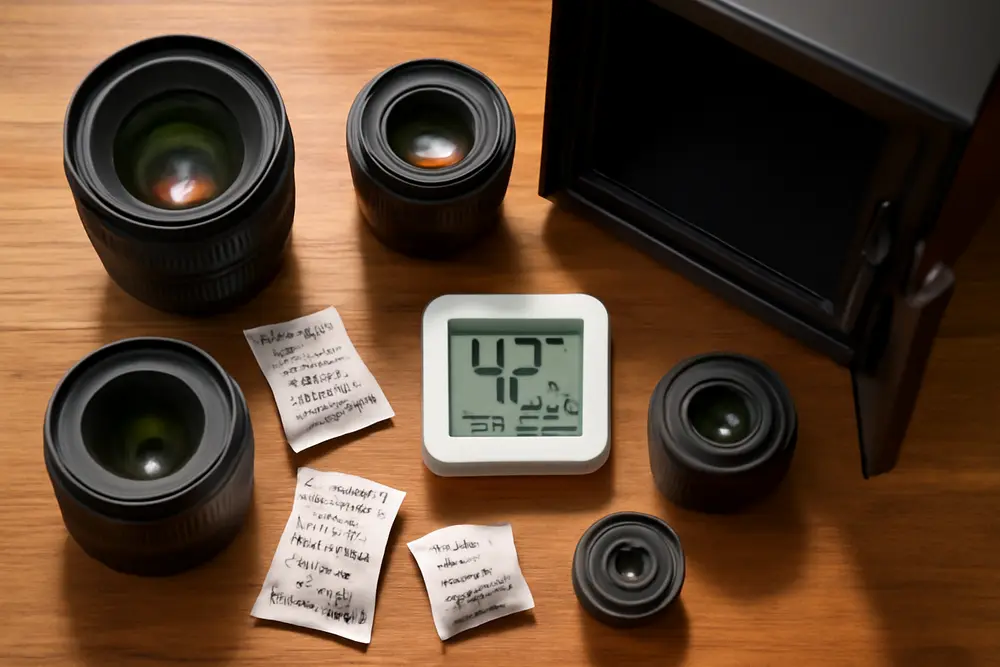
If you love your lenses, keep them out of the fungus spa. I’m a mold inspector by trade and a shameless gear nerd by night, which means I’ve seen both ruined drywall and ruined glass. Same villain every time: humidity. The spores that etch your precious coatings do not care how sharp your bokeh is. They care about moisture, darkness, dust, and warmth. Keep that combo apart and your kit lives to shoot another day. This quick-and-gritty guide gives you exact lens storage humidity targets, the real differences between dry cabinets and silica packs, how to get airflow inside camera bags, a sane post-shoot gear drying routine for sweaty climates, and the line where DIY stops and a pro cleaning team should step in.
Why Humidity Control Matters
Fungal spores are permanent plus-ones in our lives, but they only party when conditions help them. Give them dust to feed on, keep them in the dark, and raise relative humidity above the mid-50s, and they start knitting cobwebs inside your optics. Several sources note that risk ramps once RH hangs out above roughly 55 to 60 percent for days at a time. Once fungus gets going on glass coatings, it can permanently etch them, which means less contrast, weird flares, and that special kind of heartbreak no software preset can fix. Sony’s guidance points out that moisture plus dust plus darkness equals growth, which is why they advise controlled storage with desiccants or cabinets and good visibility so you notice issues early. If you like evidence over vibes, check out Sony’s overview and BeyondPhotoTips’ explainer on humidity and fungus growth patterns.
Here’s the part where my mold-inspector brain screams: condensation is the silent bouncer that lets fungus in the club. If your gear fogs after a cold-to-warm transition or you stash it while still a little damp, you just gave spores VIP access. Preventing condensation and regulating humidity is the whole game.
Lens Storage Humidity Targets
You want the Goldilocks zone, not the Sahara and not a steam room. Howard Environmental recommends keeping storage spaces in the 30 to 50 percent RH range to make mold miserable while avoiding condensation risks. For optical gear specifically, many camera folks prefer the narrower sweet spot of 40 to 45 percent RH, which offers a balance between fungus prevention and the health of lubricants, seals, and adhesives. Run much lower than 30 percent for long stretches and you can dry out grease and rubber components. Park above 50 to 60 percent for days and fungus books a room.
Pro tip from the humidity trenches: measure, do not guess. A cheap digital hygrometer in your cabinet, closet, or gear case beats magical thinking. Verify it every so often and move your kit if you keep getting readings north of 50 percent.
Dry Cabinets vs Silica Packs
Pick your fighter. Electronic dry cabinets give you set-and-forget precision with a display and control knob, while silica packs ride shotgun in your bags and hard cases. The honest truth is that most photographers do best with both: a cabinet for daily storage and indicating desiccants sprinkled through travel bags and lens pouches.
| Method | Pros | Cons |
|---|---|---|
| Dry cabinets | Stable 40 to 45 percent RH, fast recovery after opening, great for big kits and long-term storage | Costs money, needs power and a spot in your studio, seals and sensors should be checked |
| Silica gel packs or canisters | Cheap, portable, perfect inside bags and cases, works in dead-air pockets | Finite capacity, needs recharging, limited for large spaces without help from room dehumidification |
Howard Environmental’s rule of thumb for passive desiccants is one 10 to 20 gram silica pack per roughly 5 to 10 gallons of enclosed space, then adjust based on your readings. Use indicating silica and a humidity indicator card inside smaller boxes or cases, so you have eyes on saturation without guessing. Check monthly or seasonally depending on climate and use. If your packs have turned color or your card says 50 percent or higher, recharge or replace them and reassess the space.
Finally, desiccants do not replace room control. If the whole room is 70 percent RH, a single silica packet in a giant cabinet is bringing a spork to a sword fight. Pair passive desiccants in bags with a dehumidified room or an electronic cabinet for best results. For more container tips, see Howard Environmental’s guidance on container dehumidification.
Bag Airflow and Placement
Camera bags are cozy, dark, and full of dust. In other words, fungus heaven if you trap humidity inside. Give your bags a fighting chance by not sealing damp gear into them, by choosing materials that breathe, and by letting air circulate between the bag and the surfaces it sits on.
Pick bags with breathable linings and some venting instead of slick plastic interiors with zero airflow. At home, store bags slightly unzipped and off the floor, ideally on shelving with a small gap around them so air can move. Howard Environmental’s general storage guidance is to avoid cold floors and exterior walls since those surfaces get cooler and invite condensation, and to use shelving or spacers to let air flow. Tuck smaller indicating silica packs into multiple compartments rather than relying on one giant pack. If you keep your bag inside a hard case, treat that as a separate microclimate with its own indicating desiccant and a humidity card.
One more airflow detail that matters: do not overstuff. Packed foam plus dense fabric equals stagnant air, which means whatever moisture sneaks in takes days to leave. Your future self will thank you for the extra inch of breathing room you leave today.
Post-Shoot Gear Drying
Post-shoot gear drying is where many photographers either win or lose the fungus game. If you shoot in a humid climate or you do anything with rain, fog, surf, or sweaty event halls, build a routine that wrings moisture out of your kit before storage.
When you get back, pull everything out of the bag and open up crevices that love to trap moisture. Remove filters, loosen zoom and focus rings so air can move, pop the battery and memory card, and wipe obvious moisture with a clean lint-free cloth. Set the gear on a clean rack or mesh shelf in a room that is kept between 30 and 50 percent RH. If you have a dry cabinet, this is its time to shine. Aim a small fan across the room so you create gentle airflow, not a wind tunnel pointed straight at your mount threads.
If the outdoor air is dry that day, a quick window-open session can help. If it is monsoon season, trust the AC or a dehumidifier. Avoid hair dryers, space heaters, or ovens. Heat can warp plastics and coax lubricants to migrate exactly where you do not want them. Give gear a solid 12 to 24 hours to normalize at your target humidity before it goes back into a sealed bag or case.
Was it a true soaker? Power off immediately and pull the battery. Do a careful towel blot, then set items at an angle so any collected water can drain away from ports. Use more airflow and more desiccant while you monitor. Skip the rice. Rice is for burritos, not cameras. If moisture obviously got inside a lens or body, or if you see fog between elements that lingers, you have moved into professional inspection territory.
Fighting Condensation
Condensation is humidity’s sneaky side mission. It shows up whenever gear is colder than the surrounding air and that air is humid enough to deposit water on your glass and inside your body. Prevent it by changing environments slowly and by storing gear where surfaces are not cold sinks.
Use the zip-bag trick when moving from air conditioning to hot, humid outdoors and back again. Seal gear inside a clean plastic bag while it acclimates so moisture condenses on the bag, not the optics. Give it a few minutes to adjust before shooting. Back home, look for telltale wet spots on metal surfaces and lids. Howard Environmental advises keeping storage areas at 30 to 50 percent RH and watching for condensation on walls and metal hardware, then investing in climate control if you keep seeing it. A small room dehumidifier can be game changing if you store gear in a basement or closet that sits on an exterior wall.
How To Size and Place Desiccants
Right-size your desiccant like you right-size your tripod. Too small and you are wasting time, too big and you are still fine but wondering why it is not lasting long. As a starting point for enclosed containers, use one 10 to 20 gram silica packet per 5 to 10 gallons of volume, then let a humidity card tell you if you need more. Spread multiple small packs through the container so you are not drying one corner while the other stays swampy. In camera bags, stash a few small indicating packs in separate pockets and near the bottom where moisture tends to settle.
Recharge or replace on a schedule that matches your climate and use. Monthly in muggy seasons is reasonable, seasonally in drier climates can work. Indicating packs and cards are the cheats you want here, and Howard Environmental specifically recommends using them so you stop guessing. If your case keeps climbing over 50 percent RH even with fresh desiccant, either the seal is leaky or the room is too wet for passive packs to keep up. At that point, move the case to a drier room or commit to a dry cabinet. You can browse Howard’s tips on breathable gear storage and condensation control for general storage spaces that apply surprisingly well to camera closets.
Storage Setup That Just Works
Here is a setup I recommend to clients who want their cameras to outlive their urges to buy another 85 mm. Park a small electronic dry cabinet set between 40 and 45 percent RH in a room that already lives in the 40 to 50 percent range. That room gets an inexpensive digital hygrometer and, if needed, a compact dehumidifier. Lenses and bodies go in the cabinet for day-to-day storage. Travel bags live on a ventilated shelf, off the floor, partially unzipped with a couple of indicating silica packs per compartment. Keep a small desktop fan in the room to help with post-shoot gear drying on a wire rack for 12 to 24 hours before anything goes back in a sealed bag. Check indicator cards monthly and your cabinet’s display weekly. That rhythm beats spore life cycles and takes minimal brain cells once it becomes habit.
When To Call a Pro
If you see classic fungal webbing patterns inside a lens or a milky haze that does not match normal dust, it is time for professional cleaning. Same if you smell a persistent musty odor when you open a case, or if condensation formed inside elements and never fully cleared. Fungus can etch coatings, which no cleaning can reverse, so you want a tech to evaluate whether cleaning will restore performance or if you are looking at permanent damage. Sony explicitly suggests professional evaluation for suspected fungus or internal moisture. If the gear survived long periods in high humidity or an actual water incident, a pro can also assess corrosion risk, adhesive creep, and lubrication issues before something fails at the worst possible time.
One caveat from the mold world: if you had significant growth inside a lens and it sat for months, success rates drop. Cleaning can remove growth but not the etching, and spores can hide in places you cannot reach without a full teardown. Getting a quote and an honest opinion from a qualified technician is the smartest money you will spend this year that is not on backup batteries.
Quick Reference
Target 30 to 50 percent RH for storage spaces, and 40 to 45 percent inside a dry cabinet for lenses. Keep bags breathable, off cold floors, and gently open when not in use. Do post-shoot gear drying for 12 to 24 hours with airflow before sealing anything. Use indicating silica or canisters in all closed containers and check monthly, or seasonally if your climate is kind. If you see visible growth, etched patterns, persistent haze, or lingering musty smell, stop experimenting and book professional cleaning.
FAQs
Is Lower Always Better for Lens Storage Humidity?
No. Below roughly 30 percent for long stretches can dry lubricants and rubber parts. Aim for 40 to 45 percent RH in a dry cabinet for lenses, or keep the room at 30 to 50 percent if you are using passive desiccants and bags. Howard Environmental’s guidance puts most storage in the 30 to 50 percent zone, and BeyondPhotoTips highlights 40 to 45 percent as a sweet spot for lenses.
Can I Skip a Dry Cabinet if I Use Enough Silica?
If your room is already dry and you monitor with indicator cards, yes, many people do fine without a cabinet. But in humid climates, a cabinet is the most reliable way to hold 40 to 45 percent RH without constantly baking silica. Think of a cabinet as a humidity cruise control while silica is the manual stick shift. Use both if you move around a lot.
How Often Should I Recharge Silica Packs?
Check monthly at first. In wet seasons or if your cases are packed tight, every few weeks is normal. In dry winters, seasonally could be enough. Use indicating beads and humidity cards so you are reacting to real conditions, not superstition. Howard Environmental endorses indicating silica and scheduled checks so you do not run blind.
Should I Sun-Bathe My Lenses To Kill Fungus?
Please no. Sunlight has UV, which can suppress microbes, but high heat risks warping, outgassing, and lubrication issues. Control RH, encourage airflow, and use proper storage. If fungus is present, get a professional cleaning rather than cooking your glass like a rotisserie chicken.
What’s The Right Way To Handle Cold-To-Warm Transitions?
Seal your gear in a clean plastic bag before going indoors so condensation forms on the bag, not inside your lenses. Let the temperature equalize, then remove and dry the exterior. Inside your house or studio, keep the storage area between 30 and 50 percent RH and use a cabinet set to 40 to 45 percent for optics.
What Are Trusted Resources To Learn More?
For RH targets and storage practices, see Howard Environmental’s guides on silica gel use, breathable storage, container dehumidification, and condensation control. For camera-specific advice, Sony’s lens fungus overview and BeyondPhotoTips’ RH guidance are practical and aligned with what we see in the field.
Field-Tested Storage Checklist
I do not worship checklists, but I respect them. Here is a quick routine you can screenshot:
1) After each shoot, unload the bag, wipe down, and rest gear in a 30 to 50 percent RH room with gentle airflow for 12 to 24 hours.
2) Store daily kit in a dry cabinet at 40 to 45 percent RH. Keep travel bags partially unzipped on shelves, off floors and exterior walls.
3) Drop indicating silica in every closed container or bag and watch a humidity card. Recharge when indicators flip or RH hits 50 percent.
4) Use the zip-bag acclimation trick when moving between cold and humid environments.
5) At first whiff of must, or if you spot webbing or persistent haze inside glass, stop using that item and schedule professional cleaning.
If You Like Your Glass, Make It Boring
The most glamorous thing about good lens care is how uneventful it is. Keep the room between 30 and 50 percent RH, let airflow do its thing, hold the cabinet at 40 to 45 percent, and make post-shoot gear drying a habit. The spores will still be there, but they will be bored, broke, and very unemployed. Which is exactly how your coatings like it.