
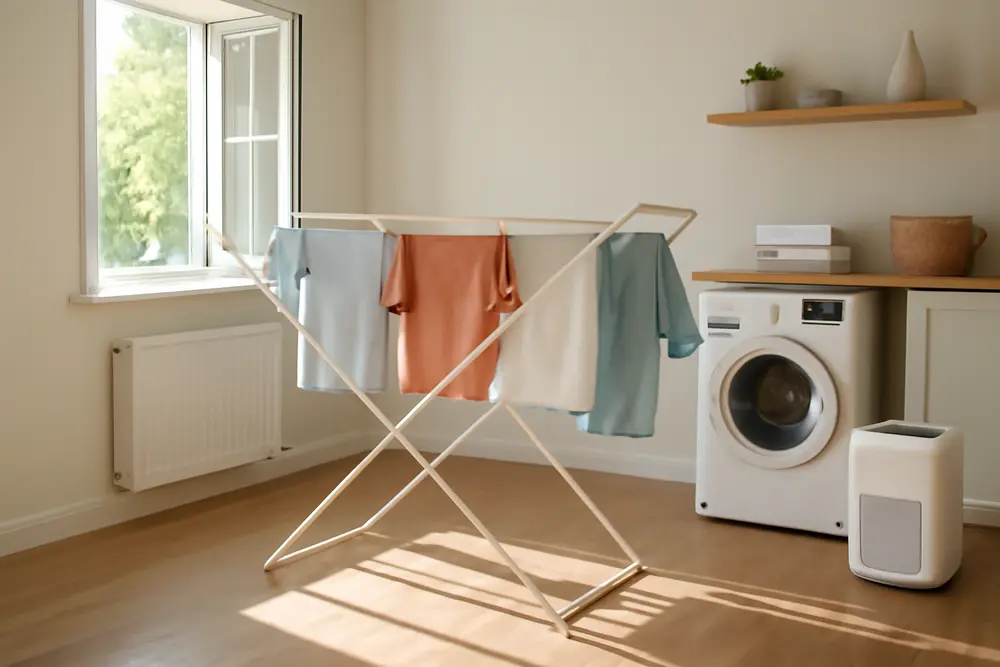
If the wet-dog smell is staging a coup in your living room, odds are your line-drying game needs a small makeover. Drying indoors is totally doable without turning your walls into a mushroom farm. The trick is smarter drying rack placement, predictable airflow, and humidity that behaves. I inspect mold problems for a living, and nothing makes me wince like a soggy window sill under a heroic tower of towels. Here’s a practical mini-guide for indoor clothesline setup that dries laundry fast without spiking RH, fogging your windows, or feeding mold on your trim.
Why Indoor Drying Needs A Game Plan
Every load you line dry releases cups of water into your room. If that moisture has nowhere to go, it hangs out on the coldest surfaces you own, like windows, exterior walls, and ceiling corners. Moisture plus cool surfaces equals condensation, and condensation plus dust equals mold. Howard Environmental’s guidance is simple: aim for indoor relative humidity around 30 to 50 percent, and keep it under 60 percent at all times to sidestep mold risk (source). The EPA backs that up and suggests staying under 60 percent, with 30 to 50 percent as the sweet spot for everyday comfort and mold prevention (source).
So yes, you absolutely can dry clothes inside. You just need to control three things: where you dry, how air moves, and what the hygrometer says. Do that, and your windows will stop crying every laundry day.
Best Rooms For Drying Racks
Pick a room that lets you manage moisture instead of gifting it to the entire house. You want a space that either has active ventilation or can be closed off with a dehumidifier running.
Laundry rooms are the obvious candidates, because they’re already moisture-forward. A spare bedroom with a door and a plug for a dehumidifier works too. A bathroom with a strong exhaust fan can be solid if you actually run the fan the whole time the rack is in use. Kitchens can work if you have a robust range hood that actually vents outdoors. What you don’t want is a tiny room with the door closed and zero fan, or a cavernous open-plan space that lets moisture drift to the coldest windows in the house.
In basements, be picky. Since basement surfaces run colder, they’re prime condensation hotspots. Keep your rack away from exterior walls and windows, elevate it off the floor, and use a dehumidifier set near the 30 to 40 percent RH range during drying cycles (source). If your basement has a door, close it to keep moisture from migrating upstairs, then mechanically remove it in that one room.
Wherever you land, leave breathing room. Keep the rack 2 to 3 feet off cold glass, 12 to 18 inches from exterior walls, and out of corners where air stalls. That spacing helps air skim over your laundry instead of saturating a cold surface and turning into droplets.
Airflow And Fan Placement
Air that does not move, does not dry. You want a consistent, gentle breeze that sweeps moisture off the fabric and toward either an exhaust point or a dehumidifier. Think of the fan as your laundry’s rideshare to Dryville.
Use an oscillating pedestal fan, a box fan on medium, or a ceiling fan on a moderate setting. Aim the flow across the rack rather than blasting one spot. If you can position a fan to draw air across the clothes and toward an open window or an exhaust fan, even better. Just avoid shooting a jet of warm, wet air straight at a cold window. That is how you manufacture glass tears.
If you’re drying in a room with a dehumidifier, angle the fan so air moves across the clothes and then passes within the dehumidifier’s intake zone. You’re basically herding moist air to the machine that can yank the water out of it. Leave space between items, too. Crowded racks trap tiny damp micro-climates. Keep 8 to 10 inches between bulky items, and use more hangers to spread things out if you have to. External tests also show that spacing plus a dehumidifier in a contained room dries faster with less whole-house humidity (source).
RH Targets And Monitoring
Your goal is mold-safe drying without turning your home into a sauna. That means knowing your RH, not guessing. Grab two or three budget digital hygrometers and park them in the drying room, near a window, and near an exterior wall. If RH spikes above the mid 50s and stays there, you need more airflow or stronger dehumidification. If you see condensation, RH is too high for the current surface temperature and you should adjust your approach (source).
| Situation | Target RH | What To Do | Why It Works |
|---|---|---|---|
| Normal indoor drying day | 40 to 50 percent | Run a fan across the rack and a dehumidifier set to ~45 percent | Keeps RH in the sweet spot while clothes dry quickly |
| Cold weather or basement | 30 to 40 percent | Use a closed room with a dehumidifier, keep rack off cold surfaces | Colder surfaces condense sooner, so go lower on RH (source) |
| No dehumidifier available | Under 50 percent | Open a window a crack, run an exhaust fan, and increase spacing | Ventilation removes moisture while airflow speeds evaporation |
| RH drifting above 55 percent | Bring back to 40 to 45 percent | Boost fan speed, close the door, and let the dehumidifier do the work | Isolating moisture and mechanical removal are faster than whole-house dilution |
EPA’s mold course says to keep indoor RH under 60 percent, and most homes feel best and grow less mold at 30 to 50 percent (source). That’s your guardrail for laundry day, too.
Condensation Checkpoints
Condensation is a tattletale. If you see sweating windows, damp drywall returns, or water on the sill, your air is holding more moisture than your cold surfaces can handle. Howard Environmental spells it out clearly: warm, moist indoor air meeting cold surfaces leads to water and then mold if it is not addressed (source).
Here’s how to keep those surfaces clean and dry while you operate your indoor clothesline setup:
Do a quick finger-swipe test on the coldest window 20 to 30 minutes into a drying session. If you see fog forming, you need either more airflow, lower RH, or a different room. Wipe down sills and trim after each drying session. Those flat horizontal surfaces collect drips and dust that feed mold. If your windows are single-pane or frosty just thinking about winter, add a low-cost window insulation film or consider storms or upgrades to bump up the interior surface temperature. That one change shrinks your condensation risk considerably. Also check window weep holes so any incidental moisture has an escape route, and repair failed caulk so water doesn’t sneak into the wall assembly behind the frame.
Dehumidifier Setup Made Simple
Think of the dehumidifier as your laundry bouncer. It keeps the party under control so nobody gets rowdy on the window sill.
Placement That Works
Put the dehumidifier in the same room and within a few feet of the drying rack so it is sipping the wettest air, but do not jam it into a corner. Leave at least a foot of clearance on all sides so intake and exhaust stay free, and keep it a small distance off very cold walls. Angle your fan so it nudges air across the clothes toward the dehumidifier intake. Howard Environmental advises maximizing airflow to and from the unit, not blocking intakes, and avoiding dead zones (source).
Smart Settings
Target about 45 percent during active drying in living areas. In basements or during cold snaps, aim for 30 to 40 percent to head off condensation on cold surfaces. If your unit has a laundry mode, use it, then switch back to normal once the load is dry. Howard’s guidance lands in the 30 to 50 percent window for most spaces, with the lower end preferred in cooler rooms.
Drainage Without Drama
Use a gravity drain hose if the layout allows it, and make sure the hose slopes continuously without loops that can trap slime. If gravity is not your friend, add a small condensate pump. Keep the run short and smooth, and route it to a floor drain, sink, or sump. Automatic drainage means you are not babysitting a bucket while socks drip. Howard’s dehumidifier tips emphasize proper slope and secure connections to avoid backups and bacteria growth (source).
Cleaning Schedule
Clean or replace the filter monthly during laundry season. Rinse the reservoir if you use it, and sanitize it every week or two when it is in steady rotation. Every few months, unplug the unit and clean the coils and the drain line to keep gunk and odors from hitching a ride. A dirty dehumidifier is basically a moist box that forgot its mission (source).
DIY Indoor Clothesline Setup
Your drying rack placement should be boringly efficient. Here are simple layouts that just work:
If you have a spare room with a door, park the rack in the center of the room so air can swirl around it. Place a dehumidifier 3 to 6 feet away with its intake facing the rack. Put a fan on the opposite side blowing across the clothes toward the dehumidifier. Keep the door closed so you are not humidifying the entire house. If you are using a bathroom with a real exhaust fan, set the rack where airflow from a pedestal fan moves across the clothes and toward the open bathroom door while the exhaust fan runs continuously. That setup gives moisture a straight shot out of the house. In a living room with a leaky window, avoid the temptation to set the rack right in the sun on the sill. Sun is nice, but that cold glass will still sweat if RH climbs. Keep the rack back a couple feet, and use a fan to skim air along the clothes and back into the room where the dehumidifier can work on it.
Two more speed boosters: run the washer’s highest spin speed and hang bulky items on hangers with shoulder space so air can reach more surface area. If you can flip items halfway through, do it. You are not cooking pancakes, but you will speed evaporation on thick fabrics.
Quick Room Scenarios
Studio apartment with one window: use a compact rack centered in the room, fan on medium sweeping across the rack, and a small dehumidifier set to 45 percent. Keep blinds up during drying so any minor moisture on the glass can evaporate, and crack the window only if RH spikes and outdoor air is drier.
Cold basement with painted masonry: set the rack on a mat or platform, 3 feet from exterior walls. Close the basement door. Run a mid-size dehumidifier set to 35 to 40 percent and angle a fan across the rack toward the unit. Check walls for cool spots and wipe any minor condensation after the first test run.
Bathroom with a strong exhaust fan: set the rack so air from a pedestal fan pushes moisture toward the exhaust grille. Keep the door just barely open at the bottom to supply makeup air. Leave the fan on for 20 to 30 minutes after the laundry is dry to finish clearing humidity.
Living room with big patio doors: keep the rack 2 to 3 feet back from the glass. Use a fan to create a sideways cross-breeze across the rack and away from the doors. If the doors fog even with airflow, lower RH via dehumidifier to 40 percent during drying.
Best Drying Rack Placement
The sweet spot is usually the center or slightly off-center of the chosen room, outside of corners and away from cold surfaces. That gives the air a clear path around fabric and avoids the condensation traps that happen along glass and exterior walls. When in doubt, test for 10 minutes, then check your hygrometer and your closest window. If RH is rising and the window is fogging, adjust your rack position a foot or two and redirect the fan so air exits toward the room center or a dehumidifier intake. Do not be afraid to experiment. The best indoor clothesline setup is the one that keeps RH under control and gives your laundry a steady breeze without drenching your windows.
Troubleshooting Without Panic
Musty smell after drying? That is fabric that lingered in the humid zone too long. Increase spacing, raise spin speed, and add a fan that actually crosses the fabric instead of tickling the air above it. Window sweat within 15 minutes? You are either too close to glass, too little airflow, or your RH target is set too high for the temperature. Drop RH toward 35 to 40 percent and move the rack farther from cold surfaces. RH stuck at 55 percent or higher? Close the door, stop venting moisture to the whole house, and let a properly sized dehumidifier do the heavy lifting. Slow drying times? Your airflow is weak, or the room is massive and swallowing your fan’s output. Upgrade the fan, confine the space, and retest.
FAQ: Indoor Drying Without Mold?
Can I dry clothes in a bedroom without a dehumidifier?
Yes, but monitor RH with a hygrometer and use a fan plus a cracked window if outdoor air is drier. Keep RH under 50 percent. If it keeps drifting up, add a dehumidifier or switch rooms.
Is it better to keep the door open or closed while drying?
Close the door when you are using a dehumidifier so it can remove moisture from that one room efficiently. If you do not have a dehumidifier, a slightly open door with an exhaust path can help, but watch RH.
How close can a rack be to a window?
Keep at least a couple of feet between wet fabric and cold glass. If you see fog on the window, back it up farther and aim airflow across the rack and away from the glass.
What RH should I set on the dehumidifier?
About 45 percent for regular rooms. In colder rooms or basements, 30 to 40 percent during drying cycles to keep surfaces above dew point (source).
Where should I place the dehumidifier in relation to the rack?
In the same room, a few feet away, with clear air paths. Do not wedge it in a corner. Face its intake toward the rack, and use a fan to steer moist air its way (source).
How do I know if I am risking mold on window sills?
Condensation is your early warning. If windows sweat during or after drying, RH is too high for the surface temperature. Lower RH, move the rack, or improve insulation. Howard Environmental goes deep on window condensation and mold risk here (source).
Does closing myself in a tiny room make drying faster?
Yes, if you also run a dehumidifier. Isolating the moisture and removing it mechanically is efficient. Closing yourself in without mechanical drying just turns the room into a sponge.
What maintenance keeps the dehumidifier from getting gross?
Clean filters monthly, sanitize the bucket every week or two in heavy use, and flush the drain hose and clean coils every few months (source).
Small Tweaks That Pay Off
Use more hangers and fewer folded-over bars so air reaches more fabric surface. Flip heavy garments midway. Wash at a higher spin speed to cut water load up front. Train a pedestal fan to sweep side to side, not stare at one sleeve for 30 minutes. Put cheap hygrometers where you will glance at them without effort. If your windows are constant crybabies, upgrade glazing or add window film and keep RH near the low end of the range during laundry days (source).
If you want a sanity check on a stubborn room, or you are seeing mold spots around windows even after you tame RH, schedule a professional inspection. Sometimes the problem is not the laundry at all but sneaky air leaks, hidden wet materials, or a cold bridge that needs fixing. Until then, keep the clothes spaced, the fan pointed, and the hygrometer honest. Your house will stay mold-free, your laundry will dry faster, and your windows can finally stop sobbing.