
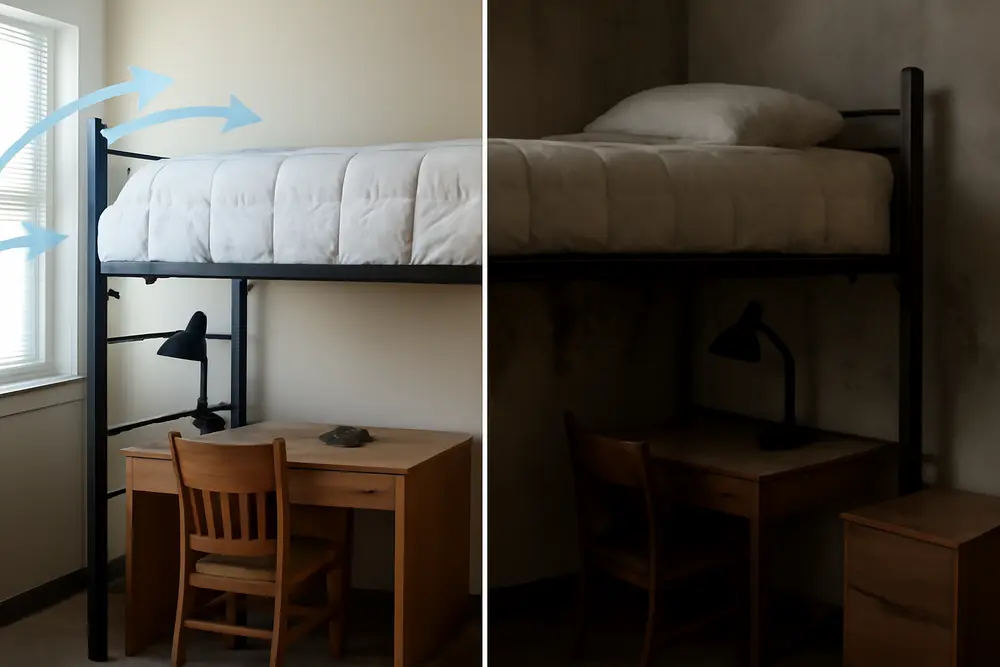
Meet the roommate you never swiped right on: dorm room mold. It sneaks in with your shower caddy, loves your window AC’s drip pan like it’s brunch, and throws house parties under your lofted bed where airflow went to die. The fix is not witchcraft. It’s airflow, smart placement, dry gear, and RA-friendly humidity control. Here’s a practical playbook, with just enough science to make you dangerous and just enough sass to keep you awake through it.
Why Dorm Rooms Grow Mold Fast
Dorms mash warm bodies, wet stuff, and cold surfaces into the tightest square footage possible. That combo makes microclimates where condensation and humidity spike. If damp things are not dried within 24 to 48 hours, mold treats it like an open buffet. Leaky window ACs, grimy drip pans, towels that never really dry, and mattresses parked against cold exterior walls are classic triggers. If you only wipe visible spots but ignore the moisture source or lousy airflow, the patches tend to come back like a bad sequel. That’s not me being dramatic. It’s exactly what you see when you clean the symptom and not the cause, which we cover in our guide on why mold keeps returning in the same spot at Howard Environmental.
Helpful background reads if you want receipts: our mattress mold prevention guide explains why airflow is a big deal under beds, and our window sill guide breaks down why cold surfaces collect condensation and turn into petri dishes.
Lofted Beds and Airflow
Lofted beds are the ultimate space hack, but they can secretly trap moisture under and around the mattress. You breathe out humidity all night, your mattress absorbs it, and if air cannot move, that moisture hangs around. Slatted bed bases are MVPs because they let air circulate under the mattress, which speeds up drying. A solid platform or, worse, a mattress straight on the floor is a moisture trap. Howard Environmental has tested and seen this play out again and again. Slatted base wins, solid base loses, and floor storage that blocks air turns the whole setup into a humid cave.
Quick tweaks that keep lofted bed airflow on your side:
Use a slatted base if your dorm bed frame allows it. If it’s a solid board, ask housing for an approved slat kit or use the factory frame with gaps intact. Don’t stack mattresses. Double thick equals double damp. Keep at least 2 to 4 inches between the mattress and the wall so the side edges can breathe. Skip vinyl mattress covers that seal in moisture. Choose a breathable protector. Don’t stuff bins under every inch of the loft. Leave open pathways so air can move from one side to the other. If you use underbed storage, go for shorter bins with gaps between them and rotate what’s underneath every week or two.
For the receipts and deeper mattress do’s and don’ts, see our mattress mold prevention guide at Howard Environmental: Mattress Mold Prevention: Clean vs Replace Guide.
Bed Placement By Cold Walls
Exterior walls and window walls are colder. That sets up a temperature mismatch that makes your warm, humid breath condense at the mattress edge or headboard. The seam on the wall side is a frequent mold hotspot. You can reduce that risk with a small gap, a breathable setup, and some smart rotation.
Here’s what helps without breaking housing rules:
Pull the bed 2 to 4 inches off the wall. That small gap lets air move and dries out the mattress edge. Keep the mattress on a breathable base. If the frame is solid, increase the gap and rotate the mattress regularly so the same edge is not pressed against the cold surface week after week. Use a breathable protector, not plastic. If your wall is consistently cold or sweaty, talk to housing. They may have solutions like resealing a window, fixing drafts, or adjusting the AC. We get into why exterior walls are high risk in our post on beds against cold walls: Bed Against Exterior Wall Mold Tips.
Mini-Fridge and Window AC Care
Mini-fridges and window ACs are the unsupervised toddlers of dorm appliances. They spill, drool, and grow things when nobody checks their trays. The drip pan in a window AC and the water catch areas around a mini-fridge are common places for mold and musty smells. When condensate sits, it breeds. When the unit is not tilted to drain right, water hangs around and things get gross. Several HVAC pros say to keep that AC pitched slightly to the outside and clean the pan regularly to avoid bio funk and smells. One explainer you can peek at for the why and how is here: Why Window ACs Smell and What To Do.
How to keep these little moisture machines from turning on you:
Window AC basics: Make sure the unit is slightly tilted toward the outdoors so condensate drains out. If it tilts the wrong way, it will back up and stagnate. Pop the front cover according to the manual, wipe the accessible pan and coils with a damp cloth, and clean the pan monthly during heavy use. A 1 to 3 vinegar to water solution is an easy anti-microbe rinse. Never flood electronics or spray harsh chemicals into the unit. If there is visible mold inside the AC or on the blower, stop and call maintenance. That’s not a DIY-for-students situation.
Mini-fridge basics: Elevate the fridge slightly so air can move under and around it. Leave a small gap behind it, not crammed against the wall. Defrost as needed and wipe any pooled water from the base and the door gasket. Clean the interior drain hole if your model has one, and fully dry the catch area after cleaning. If you’re away for break, empty it and prop the door open so stale moisture cannot stew inside.
Towels, Caddies, and Wet Gear
Nothing fuels dorm room mold faster than wet laundry piles, damp shower caddies, and towels draped in thirds that never dry. Fixing this costs almost nothing and blocks a huge chunk of daily moisture.
Set up a real drying spot where towels hang fully open. Over-the-door hooks with wide spacing are great if your RA allows them, and a freestanding rack works if they don’t. Wash towels at least weekly and dry them completely before they hit the hamper. Take the shampoo bottles out of solid-bottom caddies and let them air out. Perforated or mesh caddies dry faster. Don’t park a wet caddy under the lofted bed or in a closet. If you have a shared bathroom, use the exhaust fan and crack the door after showering if that aligns with dorm rules. For more on why small wet surfaces escalate fast, see our condensation guide that also covers sills and frames: Stop Mold on Window Sills: Control Condensation.
Humidity You Can Actually Control
Relative humidity is the big dial you can turn day to day. Most living spaces are happiest at 30 to 50 percent RH. Consistently higher than 50 to 60 percent raises the odds of condensation on cold surfaces and around your bed. That’s backed up across indoor air research and reflected in our Howard Environmental guides.
| Room RH | What It Means | Do This |
|---|---|---|
| Under 30 percent | Too dry. Static, dry throat. Mold risk is low, comfort may suffer. | Humidify a bit if allowed, or lower heat. Don’t steam the room. |
| 30 to 50 percent | Target zone. Materials and mattresses dry reasonably fast. | Keep airflow strong under the loft and keep wet items out in the open to dry. |
| Over 60 percent | High risk for condensation on windows, exterior walls, and mattress edges. | Ventilate, run AC on cool or dry mode if available, and remove moisture sources. |
Practical moves that usually pass RA review: keep the AC filter clean according to housing policy. Run a small desk fan on low pointed across the room, not into your face, to keep air mixing. Open the window only when outside air is drier than inside and security allows it. Batch moisture makers: shower, then hang towels, then ventilate. Avoid boiling-water humidifiers in a tiny room unless you’re monitoring RH and actually need moisture.
RA-Friendly Monitoring Moves
You cannot manage what you don’t measure. The cheapest win is a small digital hygrometer. Put it on a nightstand or shelf away from windows and vents so you get a real average, not the coldest or hottest spot. If you consistently see above 55 to 60 percent RH, act quickly. Lower the AC a notch, increase fan circulation, and get wet items out of enclosed spaces. If your dorm allows it, a small portable dehumidifier set to 50 percent can make a massive difference. If that’s not allowed, ask your RA about using desiccant packs in closets and under sinks. Some housing offices even loan dehumidifiers or will adjust AC tilt and drainage for you.
Zero-damage tricks matter because housing will side-eye holes in walls or hacked equipment. Use removable hooks for towel racks. Skip taping plastic over vents or windows. If condensation is chronic on a window or wall, submit a work order. Maintenance can seal gaps, verify AC slope, or check for hidden leaks. And if you want a quick refresher on moisture drivers, our overview of mold causes is a short read: What Causes Mold: Hidden Triggers.
When Mold Shows Up
Catching dorm room mold early is the difference between a 10-minute cleanup and a lost deposit. Small patches on hard, non-porous surfaces can usually be handled by students. Larger areas, growth inside the AC, or anything tied to a leak get reported to housing first.
Safe steps for small areas on non-porous surfaces like tile, metal, plastic, sealed furniture, and painted walls: wear gloves and a simple mask, preferably an N95 if you have one. Wipe the spot with a detergent and water solution, rinse lightly, then dry completely. Do not soak drywall. Follow cleaning by airing the area with a fan. Fabric and paper that have visible mold are usually better off discarded. If a mattress has spots on the underside, clean the cover if removable and breathable, air the mattress off the frame in sunlight if possible, and increase airflow under it. If growth returns on the same spot within days, that screams hidden moisture or airflow problems. We explain that ping-pong effect in our post on recurring mold: Mold Keeps Coming Back.
Do not attempt deep cleaning inside a window AC or a PTAC unit. Report it. If you see water where it should not be, like pooled under a fridge or dripping from a window AC, unplug what you can safely, put down a towel, and contact housing. Fast response is everything because 24 to 48 hours is the window when damp materials jump from clean to colonized. Our condensation guide covers why that time frame matters: Control Condensation.
Quick-Start Student Checklist
- Keep lofted bed airflow-friendly with a slatted base and a small gap from the wall.
- Leave breathing space under the loft and avoid wall-to-wall storage bins.
- Tilt window AC slightly outward and clean the drip pan monthly in humid seasons.
- Elevate mini-fridge, leave a rear gap, and dry its catch areas after defrosting.
- Hang towels wide, empty and dry shower caddies, and wash towels weekly.
- Keep RH around 30 to 50 percent with a hygrometer and room airflow.
- Clean small spots quickly and report leaks or AC mold to housing right away.
Dorm Room Mold FAQ
Is pushing my mattress flush to the wall a bad idea?
Yes, especially on an exterior wall. Cold surfaces cause more condensation at the mattress edge. Keep a 2 to 4 inch gap so the seam can breathe. Pair that with a slatted base and occasional mattress rotation. We explain the exterior wall risk here: Bed Against Exterior Wall Mold Tips.
What humidity number should I aim for?
Target 30 to 50 percent RH. If you routinely see 55 to 60 percent or higher, expect condensation on windows and cold walls, plus musty smells under the loft. Ventilate, run AC, and dry wet items in open air. See our quick primer on condensation control: Control Condensation.
Can I put storage bins under my lofted bed?
Yes, with strategy. Leave gaps between bins, choose shorter containers, and avoid blocking the entire underside. Air should be able to flow from one long side of the bed to the other. Overstuffed storage under a solid base is prime dorm room mold territory.
How often should I clean the window AC drip pan?
In peak season, check it monthly. Make sure the unit tilts slightly outward so water drains outside. Wipe accessible areas with a damp cloth and a mild cleaner. If you see growth inside the blower or cannot reach the pan without disassembly, submit a maintenance request. For background, see this AC smell and drip pan explainer: Window AC Has Bad Smells.
What’s the fastest way to dry towels in a small room?
Space them out on wide hooks or a freestanding rack, point a small fan across the room, and don’t fold or triple drape until they’re fully dry. If the bathroom has a fan, use it right after showering and leave the door cracked if your RA is cool with that.
When should I ask for professional help?
If mold keeps returning to the same spot within days, if you find growth inside the AC or around a known leak, or if a mattress is getting spotted repeatedly even after airflow fixes, involve housing. Off campus, reach out to a qualified mold inspection and testing company for a moisture and airflow assessment. We do this every day at Howard Environmental, and the fix is often a smart combination of airflow upgrades and moisture control.
One Last Nudge for Lofted Bed Airflow
Your loft is either a study nook or a fungal Airbnb. Airflow decides. Keep a slatted base, leave space by the wall, stop stuffing the underside, dry your gear, and watch that hygrometer like it’s your GPA. If you set the conditions right, dorm room mold does not stand a chance, and your mattress won’t smell like last semester’s gym bag. If you get stuck, our guides are built for situations exactly like yours: Mattress Mold Prevention, Bed Against Exterior Wall Tips, and Why Mold Keeps Coming Back. Keep it breathable and you’ll keep it clean.