
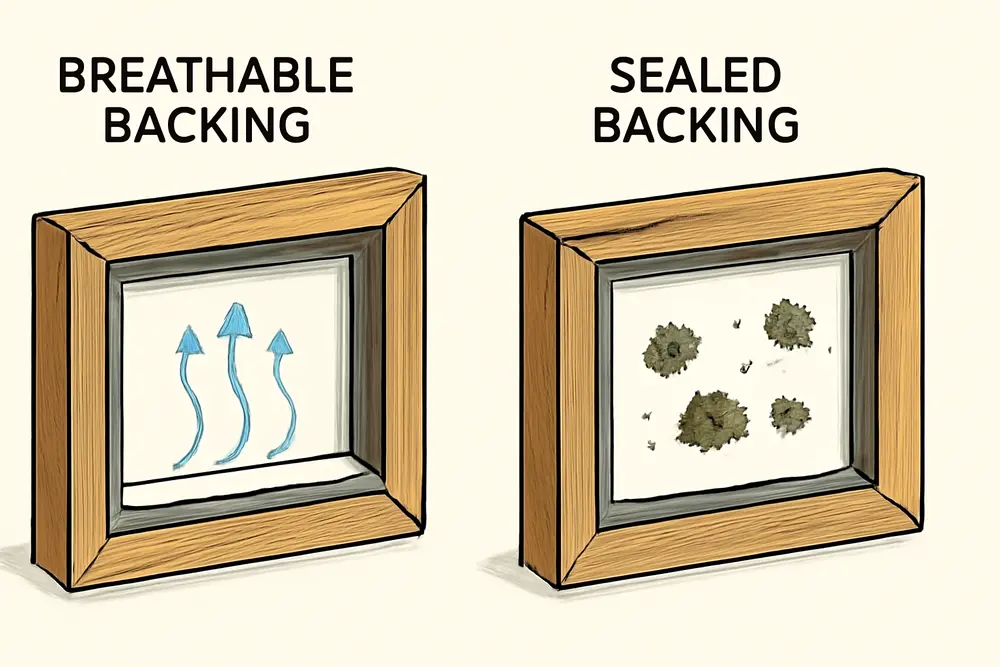
If one of your walls could talk, the exterior walls would be the ones whispering sweet nothings like hey, I’m freezing, please stop pressing shiny rectangles against my face. When you hang framed art or a big mirror tight to a cold exterior wall, you trap a pocket of moist indoor air back there. That air cools to the dew point, water condenses, and ta-da, mold throws a party where you never look. The fix is not burning your gallery wall down. It is simple gear and smarter mounting: picture frame standoffs to create a gap, breathable frame backing so moisture can diffuse, and a little humidity and insulation love so the wall is less like a popsicle. Let’s make your drywall and your art last longer than your latest design trend.
Why Mold Hides Behind Frames
Exterior walls often run several degrees cooler than the room, especially if insulation is skimpy or there are thermal bridges at studs, rim joists, and window headers. Warm indoor air carries moisture. When that air slips behind a frame and meets the cold wall surface, it cools and sheds water. If the frame sits flush, the pocket behind it acts like a mini terrarium with very little airflow. That is prime real estate for mold spores that were just waiting for a reason to unpack.
Howard Environmental has long flagged this same problem behind headboards, dressers, and even mattresses parked tight to exterior walls. Those spots cool down, humidity spikes against the surface, and bacteria and mold pull up a chair. If you have ever moved a piece of furniture and found ghostly soot lines or little peppery mold specks, it is the same physics happening behind frames and mirrors. The only difference is frames are easy to miss because they look innocent and weigh a lot less than your solid oak dresser.
The Condensation Domino
Condensation is not random. It is math plus airflow. When air with a given moisture content hits a colder surface, it cools to the dew point and drops moisture. That is why poorly insulated exterior walls and window frames grow black spots if indoor humidity is high. The second part of the domino is airflow. Still air lets boundary layers of cool, damp air cling to the wall. Press something against that layer and you have a stagnant microclimate. Howard Environmental’s window and bed-against-wall advice translates perfectly here: keep relative humidity in check, add airflow, and keep cold surfaces from being the coldest kid in class.
If your indoor relative humidity runs north of 60 percent, you are inviting condensation whenever a chilled surface shows up. If it runs a steady 30 to 50 percent, you dramatically cut the odds. That is the first lever. The second is breaking the flush contact so air can circulate behind your frames. The third is making the wall less cold with insulation improvements. When you hit all three, the domino chain never starts.
Picture Frame Standoffs: Small Gap, Big Win
Picture frame standoffs are little heroes. They are spacers, bumpers, cleats, or brackets that hold the frame off the wall so air can move behind it. You are not trying to turn your Monet into a ceiling fan. You are just creating a thin, continuous gap that blocks that stagnant, cold, muggy pocket from forming in the first place.
How much gap is enough? Conservation physics research suggests about 1 to 2 centimeters of stand-off depth helps a lot. I like a practical target of 0.5 to 1 inch because it works with most hangers and hardware. That tiny offset lets warmer room air mix with the cooler air behind the piece so the dew point is rarely hit. It also lets any small amount of moisture that does appear evaporate quickly instead of camping there all winter.
There are several easy ways to get that gap without turning your frame into a DIY project from the underworld:
- Stick-on rubber bumpers at the lower corners plus a slightly proud hanging hook so the top sits out from the wall too. Simple, cheap, effective.
- A French cleat that naturally pushes the top of the frame off the wall. Pair it with small rear bumpers for a uniform gap.
- Short nylon or aluminum spacers on the mounting screws for metal frames or mirrors with proper hardware.
Keep the gap even. If the top sits tight and the bottom floats, you can still trap a dead air pocket up high where condensation loves to hide. For heavier mirrors, use rated anchors and safety cables. Gravity is undefeated and mirror glass does not negotiate.
Choose Breathable Frame Backing
If you seal the back of a frame with plastic film or tape it shut like a Tupperware, you trap moisture inside the frame cavity. That moisture will then kiss the glazing or the artwork and leave you wondering why your mat board has freckles. Breathable frame backing lets tiny humidity shifts diffuse instead of accumulating.
Good choices include acid-free cotton rag boards, museum-grade mount boards, or an open-weave fabric panel backed by a rigid, conservation-grade board. These materials buffer short humidity spikes and do not off-gas nasties that can stain art. If your framer insists on some dust protection, ask for a vented approach that leaves subtle gaps at the edges or uses a backing with tiny perforations so the cavity can breathe.
Things to avoid behind a cold exterior wall: sealed plastic back panels, foil-backed foam boards with taped edges, and cheap cardboard or MDF that soaks up moisture unpredictably and can support mold if it gets damp. If you already own frames with non-breathable backs, you can retrofit by adding small vent slots near the top and bottom and adding picture frame standoffs so air can actually move through those vents.
The same logic applies to canvas art. Canvas breathes more than a fully glazed frame, which helps, but a canvas jammed flat against a cold wall still risks condensation on the wall side of the fabric. Give it that 0.5 to 1 inch stand-off and it can breathe like it was meant to.
Mirrors On Exterior Walls
Mirrors love to fog up and they love to telegraph cold temperatures. Hang one tight to an exterior wall and you are basically begging for condensation back there. The mirror glass chills, the wall chills, and the air pocket between them stays damp. Here is how to keep the sparkle without the spores:
Use heavy-duty standoffs or a cleat system that creates a uniform gap. For big mirrors, mix a cleat at the top with spacer pads at the bottom so the whole perimeter sits off the wall evenly. Avoid sealing the back with plastic film. If the mirror has a factory backer, confirm it is not an impermeable barrier glued tight to the wall. A breathable backer with tiny vent paths does better on cold walls.
Pay attention to mirror mastic. If you glue a mirror directly to an exterior masonry wall, you lose the ability to ventilate the back surface. That can trap condensation and stain the silvering. If you want a glued look, consider mounting to a thin, insulated backer panel that is then mechanically hung with a stand-off gap. It looks the same from the front but behaves way better on the physics side.
Humidity And Airflow Targets
Keep indoor relative humidity in the 30 to 50 percent range most of the year. That is the sweet spot that keeps people comfortable and walls out of trouble. Use a digital hygrometer and actually look at it. If you see 60 percent and higher for days on end, you are rolling dice with every cold surface in the house.
Practical ways to hit the range without turning your living room into a wind tunnel:
- Run bath fans during and 20 minutes after showers. Vent outside, not into the attic.
- Use your kitchen range hood when boiling or searing. Again, vent outside.
- If you dry clothes inside, stop. Indoor drying dumps a ton of moisture.
- In basements or tight homes, a small dehumidifier can be the difference between okay and eww.
- In winter, do not swamp the house with humidifiers. If you need one for comfort, dial it back when outdoor temps plunge so you do not ice your windows and walls.
Airflow along exterior walls matters too. Leave a little breathing room behind big furniture. Do not let floor vents blow straight up behind thick drapes that block circulation along a cold wall. If you are rocking blackout curtains, pull them off the wall slightly or open them daily so the wall surface can warm up and dry out. On the art front, those picture frame standoffs do the airflow job for you without you having to rearrange the room every season.
Fix The Wall, Not Just The Frame
If the exterior wall is dramatically colder than the room, condensation will look for a way to happen. Insulation upgrades are the durable fix. You can reduce cold spots and increase the interior surface temperature so moist indoor air never reaches the dew point there, even behind a frame.
Options depend on your house:
- Dense-pack cellulose or blown-in fiberglass in empty stud cavities can help if you have older walls without insulation.
- Exterior continuous insulation is the gold standard during siding projects. It breaks thermal bridges at studs and evens out interior surface temperatures.
- Air sealing around electrical boxes, baseboards, top plates, and window trim cuts cold air leaks that chill local wall sections.
- Upgrade or tune up windows. Low-E glass and tight frames reduce cold downdrafts and radiant cooling of adjacent wall surfaces.
If you are considering interior foam panels or vapor-retarder paints, get the moisture profile right. Trapping interior moisture is not your goal. The right stack-up depends on climate zone and wall materials. When in doubt, ask a building science-minded contractor rather than slapping impermeable layers everywhere and hoping for the best.
Inspect And Clean Without Wrecking The Art
Check behind frames on exterior walls at least twice a year. Pop the frame off the hook, look for ghosting or black specks on the wall and on the back of the frame, and take a cautious sniff. If the wall looks clean and dry, you are winning. If you see spotting, take it seriously and adjust your setup.
For small areas on painted, non-porous trim or metal, a mild detergent and water wipe is fine. For drywall with visible mold, cleaning the paint film is a band-aid if moisture keeps hitting the paper below. Fix the moisture source first. If staining or growth returns, the affected drywall may need to be replaced and the source eliminated. Do not scrub valuable art or delicate backings. If mold has kissed your artwork or mat board, stop, bag it to isolate spores, and talk to a professional conservator who can treat it without turning a keepsake into compost.
Wear common sense protective gear if you are cleaning: gloves and a simple respirator rated for particulates if growth is visible. If you uncover a broad, furry surprise bigger than a few magazine pages, that is already in the professional cleanup zone.
Quick Scenarios
Brick exterior wall in a living room stacked with frames. Winter hits, the house runs at 55 to 60 percent RH because the humidifier is set to rainforest, and the frames are mounted flat. You pull one down in spring and find leopard-print dots. Fix: drop the humidifier setpoint so average RH sits near 40 to 45 percent, add picture frame standoffs to each frame, switch the cheap cardboard backers to breathable frame backing, and plan exterior insulation the next time you re-side. Next winter, no spots.
Bathroom vanity mirror on an exterior wall. Morning showers fog it daily, the mirror sits tight to the wall, and the back paint is starting to fail near the bottom. Fix: upgrade to a cleat with a uniform 0.75 inch gap, install a real bath fan that actually vents outside, run it during showers and for 20 minutes after, and avoid sealing the mirror back with plastic film. If the silvering is damaged, replace the mirror after you solve the moisture.
Basement gallery wall on a foundation knee wall. You dehumidify the open space but the wall chills every night and the frames are sealed tight. Fix: maintain basement RH near 45 to 50 percent, add standoffs, use breathable backings, and consider adding rigid foam and drywall to the foundation wall to warm the interior surface. The art survives and so do your nostrils.
FAQs
Will Moving My Art To An Interior Wall Solve Mold Risk?
It usually helps a lot because interior walls sit warmer. But if indoor humidity is high, you can still get condensation on any cold surface. Control RH and use picture frame standoffs anyway. The gap improves airflow and reduces surprise dust shadows on all walls, not just exterior ones.
How Big Should My Stand-Off Gap Be?
A consistent 0.5 to 1 inch is a reliable target. Conservation research puts roughly 2 centimeters in the sweet spot for reducing dew-point trouble while keeping the frame close to the wall visually. The bigger the frame and the colder the wall, the more that upper end helps.
Do I Still Need Standoffs If I Use Glass Or Acrylic Glazing?
Yes. Glazing protects the front of the art from fingerprints and UV, but the back still needs airflow. Standoffs reduce condensation risk on the wall side and help any backing materials stay dry.
What Counts As Breathable Frame Backing?
Acid-free rag or museum boards that are not sealed edge-to-edge, or a rigid board paired with an open-weave dust cover. The goal is controlled buffering and diffusion, not a plastic bag. Avoid fully sealed plastic backers on cold exterior walls.
Can I Just Tape The Back Closed And Throw In A Desiccant Pack?
Desiccants help in sealed containers, but a sealed frame on a cold wall is asking for trouble if moisture sneaks in or the pack saturates. You end up with a humid microclimate that cannot vent. Use breathable frame backing and standoffs so moisture has a path out.
Is 60 Percent Indoor Humidity Too High?
For cold-climate winters and cold exterior walls, yes. Aim for 30 to 50 percent. The lower end in winter reduces condensation on windows and exterior walls. In summer, 50 percent is fine if surfaces are not chilling below the dew point.
Can I Paint Over Mold Behind A Frame?
No. Painting over active growth just hides it for a while. Fix the moisture source, dry the area, clean or replace damaged materials, then repaint. Otherwise the spots return and now they have primer for dinner.
How Do I Know If Insulation Is The Problem?
Tell-tales include walls that feel cold to the touch compared to adjacent interior walls, repeating cold stripes that match stud spacing, or wintertime condensation and ghosting behind any object placed near the wall. An infrared camera on a chilly day makes the thermal bridges obvious. Air leakage that chills sections of the wall can look the same. Air sealing plus insulation is the duo you want.
Will Command Strips Or Wire Hangers Provide Enough Gap?
Not reliably. Some leave a tiny offset, but it is often uneven and collapses over time. Add real picture frame standoffs or a cleat system so the gap is consistent along the whole frame.
Helpful References
Want to see the building science side and similar scenarios called out? Start here:
Soot Ghosting or Mold? Fix the Cause explains how cold surfaces and trapped air create streaks and spots behind objects tight to walls.
Bed Against Exterior Wall Mold Tips lines up the same physics and fixes that apply to framed art.
For art-specific physics, this conservation piece spells out how a little distance helps: How To Protect Glazed Pictures On Cold Walls. For backing boards and condensation notes from a framing perspective, see Condensation Inside Picture Frames.
When To Call In Testing
If you keep finding fresh spots behind frames, or you catch a musty odor that lingers after you make the stand-off and humidity fixes, it is time for a deeper look. We can inspect the wall for hidden moisture, check insulation continuity with thermal imaging, and take air or surface samples when it makes sense. If growth covers an area larger than a few square feet, or if you suspect the mold has crept into the wall cavity, professional remediation and building corrections protect both your finishes and your lungs. We are here to solve the moisture pattern so you are not rehanging mold magnets every season.
Your Game Plan
Take a hygrometer reading. If your RH is high, bring it down. Pull a few frames off exterior walls and inspect the backs and drywall. Add picture frame standoffs to create a consistent 0.5 to 1 inch gap. Swap sealed or cardboard backs for breathable frame backing. Rehang and schedule a six-week check. If the wall is still a popsicle, plan insulation or air-sealing improvements. And if anything smells funky after you make these changes, call us. Your gallery wall deserves applause, not spores.