
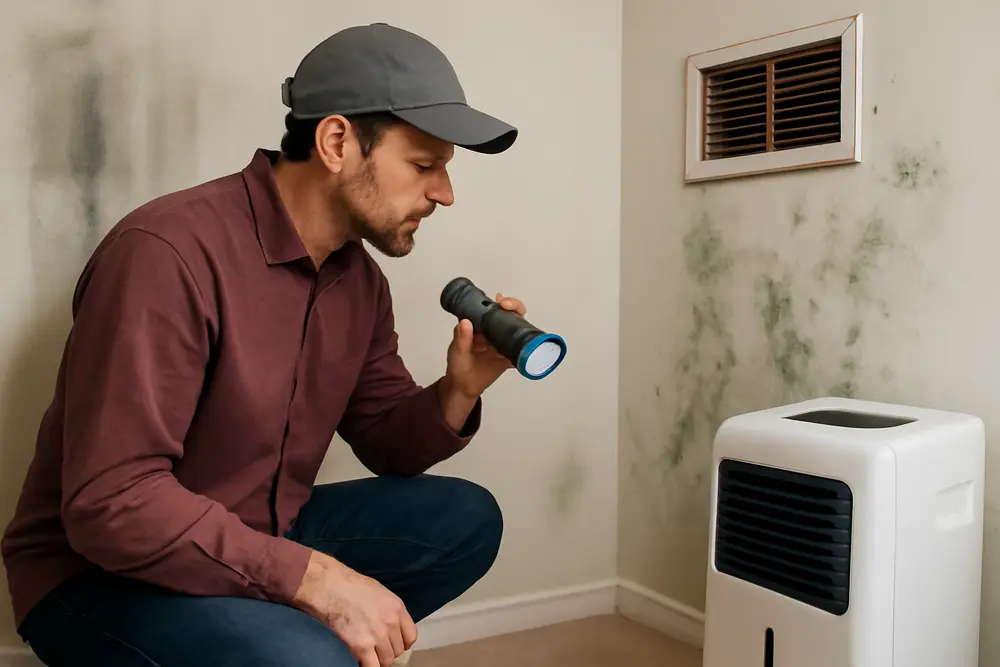
You spot black streaks crawling up the wall like your house is trying to cosplay as a haunted Victorian. Is it mold? Is it soot? Is your home sending cryptic messages in smudge code? Relax. What you’re probably seeing is soot ghosting or filtration soiling, not a fungal uprising. As a mold inspector who’s seen more suspicious wall art than a home flipper marathon, I’ll teach you how to tell the difference, when testing is worth it, and how to stop the stains at the source so they don’t keep coming back.
What You’re Looking At
Let’s set the scene. You notice straight, dingy lines along studs or rafters, or along the edges of a room, baseboards, and under doors. It looks like dust chose one very dramatic path and stuck with it. That effect is called soot ghosting, sometimes called thermal tracking. It happens when super-fine soot and dust particles ride the indoor air currents and stick to colder spots on ceilings and walls. Cold surfaces get a micro-layer of moisture. Particles love moisture. The result is a shadowy line right where your framing members sit behind the drywall or where air sneaks through cracks.
Mold, on the other hand, is a living thing. It needs moisture that lasts, not just a chilly surface. Mold will look patchy or fuzzy. It can be slimy, textured, or blotchy with colors like black, green, brown, or white. It often comes with a musty odor and can trigger symptoms like sneezing or itchy eyes. If the discoloration looks like soot or dust and follows the bones of your house or the edges of the room, you’re probably dealing with soot ghosting or its floor-hugging cousin, filtration soiling.
Fast Visual Clues
If you put ghosting and mold under good lighting, they practically introduce themselves. Ghosting tends to be flat and evenly dirty, like the wall rolled in ash. Mold has texture and personality, and not the endearing kind. Ghosting usually doesn’t smell like much. Mold can smell like an old locker room that lost the key. Ghosting often lines up in straight lines with wall studs, ceiling joists, or HVAC patterns. Mold prefers irregular patches that spread where moisture lingers.
| Feature | Soot Ghosting or Filtration Soiling | Mold |
|---|---|---|
| Pattern | Linear streaks along studs or rafters, edges of rooms, baseboards, door thresholds, above supply vents | Irregular patches or spots, often expanding in splotches |
| Texture | Flat, dusty, smudgy when wiped | Fuzzy, slimy, or velvety; may damage paint or drywall paper |
| Smell | Usually none; maybe a faint smoky or dusty odor if recent | Often musty or earthy |
| Cause | Cold surfaces plus airborne soot and dust; air leakage and poor filtration pull particles to edges | Sustained moisture from leaks, humidity, or condensation that lingers |
| Common Locations | Exterior walls, ceilings, near fireplaces, candles, baseboards, under doors, around vents | Bathrooms, basements, near leaks, behind furniture, window sills, cold corners with high humidity |
Why Ghosting Targets Cold Spots
Ghosting behaves like a heat-seeking missile, except backwards. It hunts the cold. Framing members, uninsulated corners, and metal fasteners transfer outdoor cold into the drywall. That creates cooler stripes. Cool air can’t hold as much moisture, so it condenses a tiny film on the surface. Then along comes soot from candles, fireplaces, cooking, tobacco, or a dusty attic and bam, the wall wears a soot mustache.
The bigger the temperature difference between indoors and outdoors, the more those cold stripes stand out. Poor insulation or gaps in the air barrier make the effect worse. Add in weak HVAC filtration or a never-changed filter, and you’ve got a nonstop particle parade looking for a cold dance floor.
Filtration Soiling On Floors
Filtration soiling is the wall’s ground-level accomplice. You’ll see dark lines along the edge of carpet where it meets the baseboard, under closed doors, or around supply and return vents. Air seeks the path of least resistance. If the HVAC is running and there are little gaps under baseboards or around stairs, the carpet fibers become a filter trapping dust, soot, and oils. Over time those fibers stain dark and can be stubborn to remove. That’s not mold in your carpet line. That’s your home’s airflow leaving skid marks.
When Should You Test?
Testing is smart when the picture isn’t clear or there’s a legit moisture story behind the discoloration. If you see fuzzy growth, if the wall is soft, if there’s a musty odor, or if there was a recent leak, testing is worth it. We use moisture meters to check how wet the materials are, infrared cameras to spot cold or wet patterns, and air or surface sampling to confirm what we’re looking at. Air samples can tell us if elevated spore counts are riding around in the room, and tape lifts can confirm if the black stuff is soot or mold growth.
Also consider testing if occupants have allergies, asthma, or unexplained symptoms that improve when they leave the house. If the discoloration spans multiple rooms or returns quickly after cleaning, that’s another nudge. And if you suspect something is brewing behind walls, in insulation, or in the HVAC system, professional inspection with the right tools beats guesswork every time.
Cleaning Without Making A Soot Smoothie
Soot is the toddler of stains. Rub it the wrong way and it smears everywhere. Start dry before you go wet. Use a dry-cleaning sponge, sometimes called a soot sponge, and dab gently to lift the particles. A HEPA vacuum with a soft brush can lift loose dust without grinding it into the paint.
After the dry pass, a mild detergent solution and a soft cloth can help with remaining residue. Skip harsh scrubbing that polishes the soot deeper into the paint. Skip bleach on drywall for soot. It will discolor, it smells awful, and it won’t do anything to carbon. For glossy trim, a gentle degreaser might help, but test in a corner first. Once you’ve cleaned, lock in any residual staining with a quality stain-blocking primer. Shellac-based or oil-based primers are the heavy hitters for stubborn soot. Then repaint with a good acrylic paint. If you skip primer, the gray can ghost right back through the new coat and make you question your life choices.
For carpet filtration soiling, use a crevice tool to vacuum edges deeply and often. A professional hot water extraction can help, but those lines can be tenacious because the particles are oily and electrostatically bound to fibers. There are spotters and solvents that can reduce the appearance, but the real win is fixing the airflow leaks that feed the problem so you’re not cleaning the same outline every year.
Fix The Root Cause
If you want ghosting to stay gone, you’ve got to cut off its fuel and its favorite landing pads. That means fewer airborne particles, better filtration, less cold surface area, and reduced air leakage that pulls dirty air through cracks.
Improve insulation and break thermal bridges. Exterior walls and attic hatches are common culprits. Make sure wall cavities and attic areas are insulated to current standards. Address top plates and rim joists that act like cold rails. If you can add a continuous insulation layer during a remodel, even better. Air seal before you insulate so you aren’t trapping air leaks under fluffy stuff. Caulk or gasket the top and bottom plates, seal around electrical penetrations, and foam around plumbing and wire holes.
Seal the gaps where air love-letters your carpets and baseboards. A neat bead of caulk at the baseboard-to-wall joint, foam in larger gaps, and a proper door sweep under interior doors can slow the particle freight train. Check around stairs, under cabinets, and along built-ins. If your return air is undersized or leaky, a duct evaluation is worthwhile. A leaky return will pull dusty attic or wall-cavity air and redecorate your house for you.
Upgrade filtration and airflow. Use a properly sized HVAC filter with a MERV rating in the 11 to 13 range if your system can handle it. Change filters on schedule, usually every 60 to 90 days, more often if you run the fan constantly, have pets, or love candles a little too much. Consider running the fan during times of higher activity to keep air mixing, which reduces cold corners and helps capture particles.
Cut down particle sources. Candles, incense, fireplaces, and unvented gas appliances create fine soot that floats forever. If you must have candles, go for clean-burning options like unscented soy or beeswax with trimmed wicks and keep them away from supply vents that shoot soot onto cold surfaces. Make sure fireplaces draft correctly and are serviced. Use range hoods that actually vent outside when cooking. High-heat frying creates ultrafine particles that love drywall like bees love flowers.
Control humidity. Keep indoor relative humidity under roughly 50 to 55 percent to avoid condensation and to keep mold from auditioning for a comeback. Use bathroom and kitchen exhaust fans and run them long enough to do their job. In humid climates, a dehumidifier or a well-tuned HVAC system with adequate run time will help. If you’re always foggy on windows or you can write your name in the sheen on exterior walls, you’ve got a humidity control problem to solve.
Mold Happens Too
Sometimes you find ghosting and mold living uncomfortably close. For example, a poorly insulated exterior wall can get cold enough to condense moisture behind furniture. That same spot can collect soot and grow mold if the moisture lingers. If there’s visible fuzzy growth, active leaks, soft drywall, or a musty smell, treat it as a moisture and mold issue first. You cannot paint over mold and call it a day. Clean-up of minor surface mold on non-porous materials can be a homeowner project, but porous materials like drywall and insulation often need removal if they are colonized. The key is to fix the water source before any cleaning or you’ll be remodeling your regrets later.
When we inspect suspected mold, we pair visual assessment with moisture measurement and targeted sampling. Air sampling can document spore levels and types in the breathing zone. Surface sampling confirms whether a stain is mold, soot, or just dirt with a PR problem. Thermal imaging helps find cold patterns tied to ghosting and hidden wet spots where mold can bloom. That combination tells you if you need remediation, building upgrades, or both.
Quick Decision Guide
Ask yourself a few questions while staring down the black streaks. Are the marks straight and aligned with studs or along room edges? Do they wipe off as gray smudges without a musty odor? Have you been using candles, a fireplace, or have a filter that might be older than your last vacation? That points to soot ghosting or filtration soiling. Do the stains look fuzzy or spotty, expand in irregular shapes, feel slimy, or smell musty? Was there a recent leak or ongoing dampness? That leans mold. Not sure? That’s what inspections are for. It’s a lot cheaper to test once than to repaint twice.
Safe Products And Methods
For walls and ceilings with soot ghosting, start with dry-cleaning sponges and a HEPA vacuum. Follow with mild detergent in warm water and a microfiber cloth. Avoid abrasive pads that burnish the paint and grind soot into the surface. Once clean and dry, use a shellac-based or oil-based stain-blocking primer, then repaint. If stains keep coming back without any repainting, your root cause is still alive and well.
For baseboards and trim, a light degreaser or diluted all-purpose cleaner can help. Rinse and dry thoroughly. For carpet edges, vacuum regularly with a crevice tool. If you hire a professional cleaner, ask if they have products specifically for filtration soiling. Some lines are permanent, especially on lighter carpets and older fibers, but you can usually improve them.
What Causes Ghosting In New Homes?
New builds are not immune. In fact, tighter homes can exaggerate ghosting if filtration and ventilation aren’t dialed in. Fresh paint is slightly tacky on a microscopic level and loves fine particles. If your HVAC system was used heavily during construction, it may have collected drywall dust and kicked it back into the house. Combine that with a few candlelit dinners and a few cold snaps, and you’ll think your home came pre-haunted.
Why Does It Show Up Around Vents?
Vents push or pull air aggressively. When supply air blasts across a ceiling, it can carry soot particles to nearby cold surfaces and outline the framing. Return vents pull dusty air through nearby gaps or across the ceiling surface, leaving a gray halo. If your filter is clogged or undersized, the problem intensifies. Balancing airflow and keeping filters clean goes a long way toward preventing those soot rings.
How Insulation And Air Sealing Team Up
Insulation slows heat flow, but air sealing stops the sneaky drafts that carry dirt and moisture. If you only add insulation without sealing, ghosting can still happen because the air is still moving dust to cold surfaces. Focus on sealing top plates in the attic, rim joists in the basement or crawlspace, and penetrations around pipes, wires, and vents. Think of insulation as the sweater and air sealing as the windbreaker. You want both if you’re sick of the black stripes.
Are Scented Candles Really That Bad?
Scented candles can be heavy particle makers. Wicks that mushroom and soot, strongly dyed wax, and drafts that flicker the flame all increase soot. If candles are your personality trait, keep wicks trimmed short, burn cleaner candles, place them away from vents and returns, and limit burn time. Or switch to LED candles and save the romance while your walls breathe a sigh of relief.
What About Fireplaces And Space Heaters?
Fireplaces need to draft correctly. If they backdraft or smolder, you’re basically aerosolizing carbon and painting your house with it. Get chimneys cleaned and inspected. Space heaters, especially unvented ones, can throw particles and water vapor into the air. That combo feeds ghosting and can encourage mold if humidity spikes. Use vented units and keep clearance and maintenance on point.
Humidity Control Without Overkill
If your humidity hangs above the mid 50s, you’re setting the stage for condensation and possible mold. Use bath fans for at least 20 minutes after a shower. Make sure kitchen exhausts actually vent outside and not back into the room. In damp basements or humid climates, a dehumidifier can be your new best friend. Don’t oversize your HVAC system. Short run times can leave humidity high and cold spots uneven, which is prime ghosting territory.
Painting Tips That Actually Work
Clean first, then prime, then paint. If you’re painting over ghosting without a stain-blocking primer, you might as well be whispering at your wall to behave. Use a high-hide primer designed for smoke and stain blocking. Let it cure properly. Use a quality acrylic top coat with a washable finish so future cleaning is easier. And paint last, after you’ve tackled filtration, insulation, and source control, or you’ll be repainting with a familiar sense of deja vu.
FAQ
Is soot ghosting dangerous?
By itself, soot ghosting is mostly a cosmetic air quality scoreboard. That said, soot and ultrafine particles are not great for lungs, especially for kids, seniors, or anyone with asthma. Treat it as a hint that your filtration, ventilation, or combustion sources need attention.
Can ghosting turn into mold?
Ghosting doesn’t morph into mold. But the cold, sometimes damp surfaces that collect soot can also be places where mold grows if humidity stays high. If the area is chronically damp or you see fuzzy growth, treat it as a moisture problem and consider testing.
Will repainting fix ghosting for good?
Repainting without fixing the root cause is like washing your car in a dust storm. It will look great for a week. Solve the airflow, filtration, and insulation issues first. Then clean, prime, and paint.
Why do the lines follow studs and nails?
Studs, joists, and fasteners conduct cold from outdoors, creating cooler stripes. Soot sticks to cold. The framing is basically drawing a map on your ceiling and handing soot the marker.
Are some candles worse than others?
Yes. Soot output changes with wax type, wick quality, dyes, scent load, and draft. Cleaner-burning options with trimmed wicks and minimal additives help. Candles near HVAC vents are guaranteed soot cannons.
Why are the worst stains on exterior walls?
Exterior walls are colder. Thermal bridging, missing insulation at corners, and leaky top plates all make those surfaces the preferred landing spot for particles.
How often should I change HVAC filters?
A good starting point is every 60 to 90 days with MERV 11 to 13, sooner if you have pets, heavy candle use, construction dust, or run the fan continuously. If you pull a filter and it looks like a shag rug, you waited too long.
Can carpet filtration soiling be removed completely?
Sometimes. Professional cleaners can usually improve it, but older stains on light carpets can be stubborn. The far bigger win is sealing gaps and balancing airflow so you stop collecting new lines.
Ready For A Pro Checkup?
If your walls are wearing smoky eyeliner and your carpet’s rocking charcoal contouring, we can tell you exactly why and what to do next. We’ll sort soot ghosting from mold, check for hidden moisture, and test when it makes sense. Then we’ll give you a clear plan to clean it up and shut it down at the source with the right mix of insulation, air sealing, filtration, and smarter habits. Your house is not haunted. It’s just telling you how it breathes. Let’s make it breathe cleaner.