
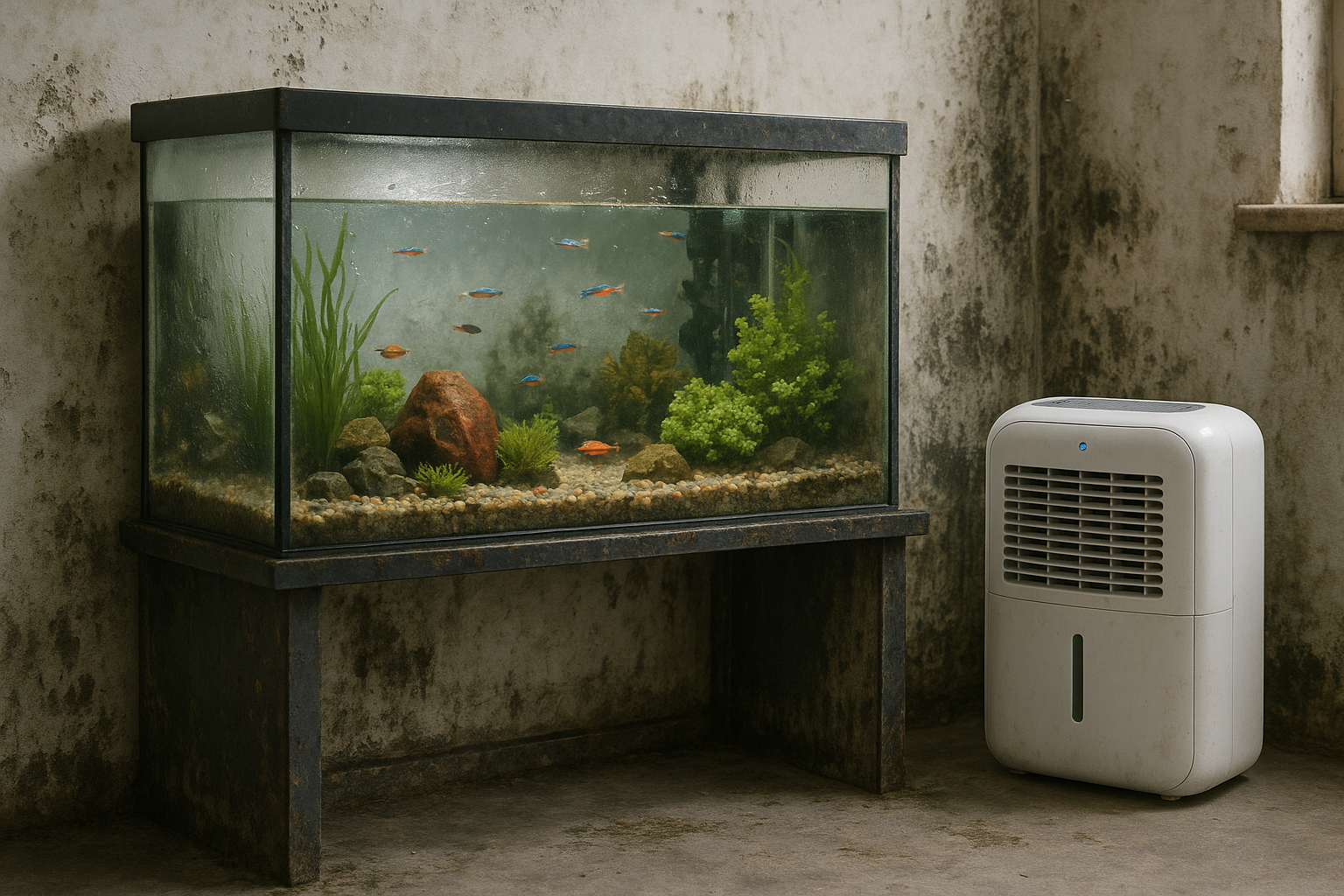
If you run an aquarium or a full blown fish room, you are basically running a small indoor ocean with a built in fog machine. That extra moisture does not just vanish. It parks on walls, creeps under stands, kisses your outlets, and feeds mold like a buffet. This guide takes fish room humidity control from mystery to manageable and gives you aquarium mold prevention that actually works. We will cover lids that stop evaporation, smart ventilation without turning your tank into a desert, real world dehumidifier sizing, what to put on your walls and floors so they do not become petri dishes, and how to monitor everything without babysitting your hygrometer 24 seven.
Fish room humidity control
Let us call it what it is. Evaporation is the villain. Any open or vented aquarium constantly adds moisture to the air. Once indoor relative humidity drifts above about 50 percent, condensation and surface wetting jump, and that is when mold taps you on the shoulder. We recommend keeping your fish room between roughly 30 to 50 percent relative humidity. That range is friendly to people and extremely unfriendly to mold. Mold loves moisture. Keep fish rooms between 30 to 50 percent RH to prevent condensation and surface wetting. We cover that target and the reasoning in our guide to dehumidifier sizing.
Signs that your room humidity is out of bounds are not subtle once you know what to look for. Condensation on windows or the tank rim in the morning. Cool outside walls getting damp while the room air feels sticky. Musty odor near the stand or in the cabinet. Dark spotting on drywall paper or raw wood edges. If you run a saltwater system, add salt creep to the mix. That white crust on the rim, canopy, cords, and nearby gear is not snow. Salt residues hold moisture, corrode metals, and make it harder to read what is just salty and what might be mold. Hobby resources consistently point to lids and routine wipe downs as the two best salt creep controls, and we agree. See Aquifarm’s notes on salt creep and humidity in their paludarium guidance for a solid primer at Aquifarm.
The physics behind the mess is simple. Warm wet air meets a cooler surface, that surface drops air temperature at the boundary, and water falls out. That shows up first on glass, metal, unsealed wood edges, and the paper face of drywall. If you keep the air a little drier and keep air moving near those surfaces, you sidestep the whole mess.
Lids and canopy tricks
Before you buy a giant appliance, start at the water line. A good lid is the cheapest dehumidifier you will ever own. A tight fitting glass or acrylic cover dramatically reduces evaporation and salt creep. If you are keeping corals or certain plants that get grumpy when gas exchange is limited, you still have options. Use a vented lid or a mesh insert and pair it with a small fan that pulls air out at low speed. That keeps the exchange you need without turning the room into a steam bath. Aquifarm has a straight ahead canopy build that is easy to adapt and modify for vents and small fans. If you tinker, you will like their guide at Aquifarm.
Lighting is another leak point. Add an acrylic splash shield under the lights. It stops salt mist from baking onto fixtures and electronics. Make it removable so you can wipe it weekly with fresh water. While you are in there, wipe the inside of the canopy and the tank rim. Catch salt before it crusts over and turns every surface into a damp sponge.
When should you skip a full lid. If your livestock absolutely demands maximum gas exchange or if temperature management needs heavy evaporative cooling. In those cases, consider a partial cover that blocks direct splash and a pair of low speed lid fans that run on a humidity control. You are trading some evaporation for better air control, and that is fine if you balance it with ventilation and a dehumidifier.
Ventilation and fans
Local airflow is cheaper than turning your fish room into a wind tunnel. Small USB or computer fans are perfect inside stands, canopies, and tight corners where air tends to sit and saturate. The goal is to break up those pockets of damp air at the surfaces where condensation forms. Cut simple vents in the back of the stand and let fans pull air through. Keep controllers and power strips on risers so air can move underneath. For a big box style stand, a couple of quiet fans moving a gentle stream through the cabinet works wonders. Top Fin’s stand care notes support adding ventilation and moisture control inside cabinets. You can reference their stand maintenance tips at Top Fin.
One caution. Fans can increase evaporation. Reef keepers use that trick for cooling which is great for coral but not great for your drywall if you do not control room humidity. After adding fans, keep an eye on relative humidity and temperature for a week and top off accordingly. HackersReef and other hobby guides explain how airflow ramps up evaporation. Take a look at HackersReef for a hobby angle on that tradeoff.
If you go bigger than cabinet fans, a humidity controlled exhaust fan in the fish room is a strong move. Pick one with a variable setpoint and let it pull air to the outdoors when RH rises above your target. This works especially well in basements or small rooms with lots of tanks where opening windows is not realistic in winter or summer.
Dehumidifier sizing and placement
There is a point where lids and fans do all they can and you still see RH above 50 percent. That is when you add a dehumidifier. Size it for the room and for the evaporation load. We publish straight forward guidance for finished spaces and fish rooms. You can read the full details on dehumidifier sizing. The short version is below.
| Space size and condition | Typical capacity per day | Notes |
|---|---|---|
| Small room up to about 500 sq ft | 20 to 30 pints when slightly damp. 30 to 50 pints when very damp. | Good starter range for single tank rooms |
| Medium area 500 to 1500 sq ft | 30 to 50 pints when slightly damp. 40 to 60 pints when very damp. | Often right for two to four tanks |
| Large area above 1500 sq ft or dedicated fish rooms | 50 plus pints per day | Consider ducted or whole home units for continuous loads |
A practical rule for fish rooms. Start with the room area and conditions, then bump capacity if you have multiple large tanks or high evaporation setups. Add capacity in real life if your RH hangs above 50 percent. It is common to test with a portable unit and then move to a ducted system if the portable runs non stop. Bigger systems, including whole home dehumidifiers, pull steady moisture at lower energy cost per pint, and they are quieter. Details on whole home options live in our dehumidifier sizing article as well.
Placement matters. Put the unit in the fish room, not trapped inside a stand. Give it open space to pull and push air. Elevate it a couple inches so the intake does not sip the stuff at floor level only. If there is a drain, use a hose or a condensate pump so you are not emptying a bucket twice a day. Clean the filter monthly. If you want to save energy, pair the unit with a humidity controller and read our tips for energy conscious prevention in eco friendly mold prevention.
Target settings. In warm months 40 to 50 percent is realistic. In cold months you may run lower if you are comfortable because cold exterior walls condense faster. Do not chase the absolute lowest number just to win a number game. Chase a stable number that does not produce wet walls in the morning.
Protect walls and gear
Give mold nothing to eat and nowhere to hide. Around tanks and sumps, use finishes that do not soak up moisture. Sealed cement board with tile, moisture tolerant paints, sealed wood, and PVC trims are all kinder than raw paper faced drywall. If you must use drywall, choose a moisture resistant product and seal all cut edges. We talk about finishes, vapor control, and humidity targets in our guidance for finished spaces at dehumidifier sizing.
Stands and floors take a beating. Raise stands slightly with rubber feet so air can move under them and so they do not sit in the occasional drip. Use a shallow tray or mat under sumps and auto top off reservoirs to catch small spills. That way small drips do not find the wall base and wick into framing. For cabinets, cut ventilation slots in low back corners and high on the opposite side to create a gentle cross flow. Top Fin notes that ventilation and moisture control extend cabinet life, and that matches what we see out in the field. Their stand guidance is a helpful reference at Top Fin.
Electronics and salt are not friends. Move controllers and power strips off the floor and away from splash lines. Keep two to four inches of clearance between gear and walls for airflow. Always use GFCI protected circuits and set drip loops. For saltwater tanks, expect salt creep and treat it like the weekly vacuum. Wipe the rim, canopy, and cords with fresh water to remove salt before it cakes and starts corrosion. Aquifarm’s paludarium resource spells out salt creep behavior and cleaning basics at Aquifarm.
One last protection tip. If you run other water devices in the same space such as an ultrasonic humidifier for plants in a paludarium, clean those often and use distilled water. Ultrasonic devices can spread minerals and microbes if neglected. We maintain a care guide that covers cleaning and safe humidity targets at humidifier maintenance and mold.
Monitoring and alerts
You cannot manage what you do not measure. Place at least two hygrometers in the fish room. Put one near the tank or sump and one across the room near an outside wall or a cool surface. Log RH morning and evening for a week after any big change like adding a lid, switching fans, or buying a dehumidifier. We recommend digital meters you can read at a glance. We talk about placement and targets in our dehumidifier sizing guide.
If you like data, go for sensors that record hourly readings and push alerts to your phone when RH climbs. Pair them with smart plugs so a fan or a portable dehumidifier can kick on automatically. Keep a simple journal of changes and readings so you can see what actually helps. If meters disagree, calibrate or replace the odd one out. Humidity meters are like fish. Most are fine. A few are absolute liars.
Seasonal checks pay off. As outside weather changes, your indoor setpoints and equipment will need tweaks. Our spring cleaning mold checklist is a quick way to catch the little stuff before it blooms into the big stuff.
Why aquariums raise mold risk
Evaporation drives moisture into the room air, which pushes RH higher. When RH hangs out above 50 to 60 percent, the risk of condensation and mold jumps. In finished basements and small bedrooms with tanks, this can happen even when the house is fine overall. A fish room acts like its own climate zone. The solution is the same everywhere. Keep RH near 40 to 50 percent, keep air moving near cool surfaces, and do not let salt residues hang around. Learn more about targets and sizing at our dehumidifier sizing page.
When in doubt, do a sniff and look test. That funky odor is not your fish. It is microbial activity. White crust near a saltwater rim is usually salt, not mold, but it can hide mold underneath when it gets wet. Clean it and see what comes back. If discoloration spreads, it is time to escalate.
When to call a pro
There is a big difference between a tiny patch of surface growth near a sump and a room that never drops below 60 percent RH with visible staining on walls or trim. If your fish room smells musty most days, if you see spots that keep returning, or if RH stays high despite lids, fans, and a correctly sized dehumidifier, it is time to bring in an inspector. Our mold inspection service looks for hidden moisture, maps out source problems, and collects samples when needed. If you have already done cleanup or hired remediation, a mold clearance test confirms that the space is back to normal conditions. Independent clearance protects you by separating the cleanup crew from the testing.
Quick checklist and next steps
You do not need to turn your home into a laboratory to win this fight. A few smart moves add up fast.
- Install a tight lid or a vented cover with splash guards and keep up with weekly wipe downs.
- Add small cabinet and canopy fans for local airflow. Watch RH for a week and adjust speed if evaporation spikes.
- Pick the right dehumidifier size for the room and evaporation load. Start portable, then go ducted if it runs all day.
- Use sealed finishes near the tank and raise stands on rubber feet. Add trays under sumps and top off containers.
- Protect electronics with risers, drip loops, and GFCI protected circuits. Keep a few inches of clearance for airflow.
- Place two hygrometers and log readings after any changes. Add smart alerts and automation if you like.
- Keep seasonal maintenance on your calendar. Our spring cleaning mold checklist makes that easy.
If you are doing all the above and the room still feels like an Amazon rainforest, we should talk. If mold or damp problems persist in your fish room, schedule a mold inspection or book a mold clearance test. We are happy to help you keep the reef in the tank and the mold out of the room.
Aquarium mold FAQs
What RH should I keep my fish room at?
Target about 30 to 50 percent RH. Many homes land near 40 to 50 percent in summer and slightly lower in winter if comfortable. We explain the why and the numbers in our dehumidifier sizing guide.
How big a dehumidifier do I need?
Use room size as a starting point and add capacity if you have multiple tanks or high evaporation. Small rooms often do well with 20 to 30 pints per day. Medium rooms often use 30 to 60 pints. Large rooms and dedicated fish spaces often need 50 plus pints or even a whole home system. We break that down in our dehumidifier sizing article.
Will a lid stop mold?
A tight lid cuts evaporation which lowers room humidity and reduces mold risk. Pair it with airflow and a correctly sized dehumidifier for best results. See canopy and lid tips at Aquifarm.
Do fans help or hurt?
Fans help by breaking up damp air pockets and drying surfaces, especially inside stands and canopies. They can also increase evaporation. Start slow, then check RH and top off rates for a week and adjust. Hobby sources like HackersReef explain that tradeoff well.
Can I clean small mold spots myself?
Small surface growth on non porous materials can often be cleaned safely. If spots return, if the area is large, or if you suspect hidden moisture, schedule a professional mold inspection. We can also verify success with a mold clearance test.
What is salt creep and why does it matter?
Salt creep is the dried salt residue left by splashes and evaporated spray from saltwater tanks. It holds moisture, hides mold, and corrodes gear. Wipe it weekly with fresh water and use splash guards and lids. See Aquifarm for hobby level details.
Any eco friendly tips for humidity control?
Yes. Start with lids and airflow which cost very little. Then use a right sized dehumidifier with a drain and a humidity controller. Seal and paint with moisture tolerant products so surfaces do not feed mold. Our energy and materials suggestions live in eco friendly mold prevention.