
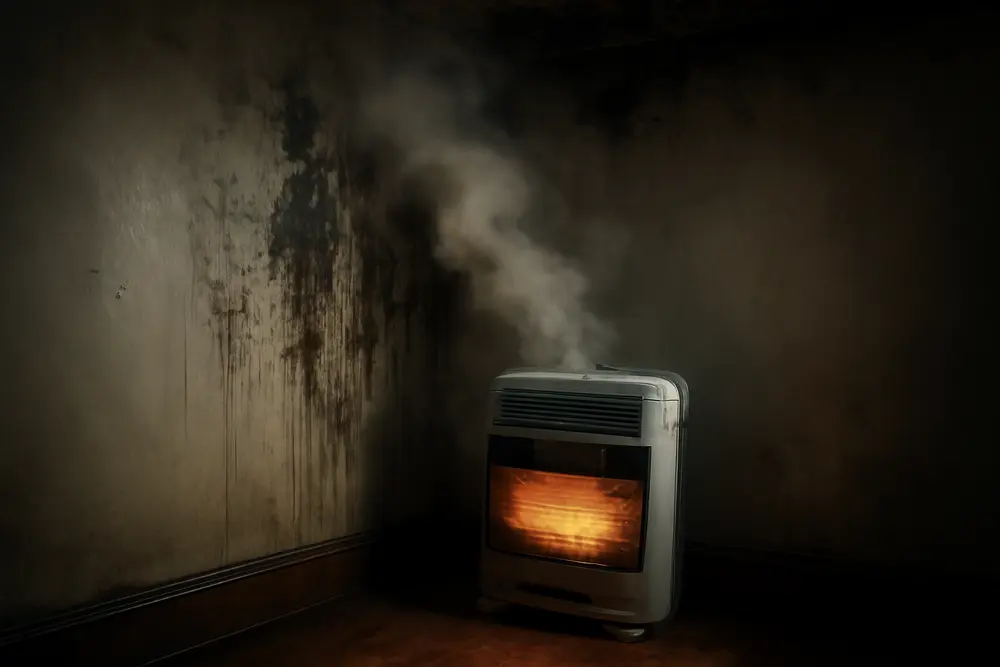
If your ventless gas heater is making the living room toasty while your windows weep like they just watched a sad dog movie, you’ve met the moist side of combustion. Ventless gas heaters and unvented fireplaces are marketed as efficient, simple, and clean. They’re also champion indoor humidifiers… with flames. That extra moisture lands on your coldest surfaces, drives condensation, and sets the table for mold. I run a mold inspection and testing company, and I can’t tell you how many winter mold calls start with this line: “We only use the ventless logs when it’s chilly.” If you want heat without the indoor rainforest, let’s talk about how these heaters load your air with water vapor, what to watch for, the short-term triage that actually helps, and the long game that stops the moisture at the source.
What Are Ventless Gas Heaters?
Ventless, vent-free, or unvented gas heaters burn natural gas or propane inside your living space and send the exhaust right back into the room. There’s no chimney, no flue, and no dedicated exhaust pipe. The burners pull oxygen from your room air, produce heat, and release the byproducts of combustion straight into that same space. That includes heat, a bit of carbon monoxide, nitrogen dioxide, and a whole lot of water vapor. InterNACHI labels these as unvented combustion appliances and recommends strict limits on how they’re used, if they’re used at all source.
You’ll see them as sleek wall units, decorative fireplaces with vent-free gas logs, or portable space heaters. The sales pitch is simple: no vent stack to install and almost all the heat stays indoors. That part is true. The catch is that all the combustion moisture also stays indoors, and your drywall, windows, closets, and sinuses get to deal with it. Some jurisdictions restrict or ban these appliances in bedrooms and bathrooms because of air quality and moisture concerns source. If your home is newer or tighter, the risk goes up because there’s less natural air leakage to flush out moisture.
How Burning Gas Makes Humidity
Combustion is chemistry, not magic. Burn methane or propane and you get heat, carbon dioxide, and water. The water forms as vapor and drifts into your room air. A common rule of thumb: a ventless gas heater releases about 1 gallon of water vapor for every 100,000 BTU of gas burned source. The Maine Indoor Air Quality Council puts it this way: every pound of fuel burned can put roughly two pounds of water into your indoor air source.
Let’s translate that into real life. A typical ventless fireplace is around 30,000 BTU per hour. Run it for three hours and you’ve burned about 90,000 BTU. You’ve also added close to a gallon of water vapor into your living room. That’s like running a mid-size humidifier at full blast, except this one has flames and produces combustion byproducts. On a cold night, that sudden humidity spike hits your coldest surfaces first: single-pane or aluminum-framed windows, exterior wall corners, rim joists, and uninsulated spots where framing bridges cold right into the room. Water condenses there, the surface stays wet, and mold says thanks for dinner.
Researchers have modeled this in real homes and found that vent-free products can push indoor relative humidity up fast, sometimes into high-risk territory depending on run-time and ventilation study. And while today we’re talking about mold and moisture, it’s worth knowing unvented units also release nitrogen dioxide and small amounts of carbon monoxide, which is why serious ventilation is non-negotiable if you insist on running one source.
Mold Risks and Early Clues
Mold never needs much to move in. Give it a damp surface and some household dust and it’s Airbnb time. Ventless gas heaters feed this by pushing indoor humidity up, often in short, heavy bursts. Here’s what that looks like in a house we get called to inspect:
Your windows sweat and then streak. Water beads along the bottom sash. You wipe them and they fog up again the next evening when the heater runs. Corners where ceilings meet exterior walls darken or show scattered dots. Closet walls behind furniture feel cool and clammy. And there’s the smell. A musty or earthy odor usually shows up before you see anything. You might also notice a faint sour or burning odor near the unit itself because trace impurities and moisture can carry odors and leave light residues on nearby surfaces. Retailers admit this odor is a known ventless quirk for some users source.
Health-wise, higher humidity boosts dust mites and encourages mold fragments and spores to hang around. People with asthma and allergies feel it first. If your breathing gets worse when the ventless unit is on and eases when it’s off, pay attention to that pattern. For more on common moisture-driven mold triggers, our guide breaks down the usual suspects, from condensation to hidden leaks read more. If you smell mold but can’t find it, we also cover where it hides and how to check the right places without tearing your house apart details here.
Short-Term Tactics That Actually Help
If you’re using a ventless gas heater this season and replacing it right now is a no-go, you can lower your mold risk by managing moisture ruthlessly. The goal is simple: keep indoor relative humidity between 30 and 50 percent and avoid long stretches above 60 percent. That target keeps most building materials out of the mold comfort zone.
First, limit run-time. You want heat, not a steam bath. InterNACHI suggests avoiding long continuous runs and keeping sessions under roughly 4 hours at a time source. Second, ventilate on purpose. Crack a nearby window to create make-up air while the unit operates, or run a mechanical fan that exhausts outdoors. Fresh air in and moist air out are your friends here source. Yes, you will lose a bit of heat. It still beats growing fuzz on your windowsills.
Third, run a dehumidifier near the space that’s being heated. In cold climates, the air outside can be very dry, but your indoor humidity may still spike locally when the heater runs. A capable dehumidifier will shave off those peaks and keep the average lower. Aim for 45 to 50 percent on the display, then fine-tune. Fourth, monitor aggressively. A basic digital hygrometer costs less than a pizza and tells you the truth every day. Put one in the room with the heater and another in a colder, far corner room. If you see the heater room hit 55 to 60 percent RH during operation, that’s your cue to cut run-time or increase ventilation. This is exactly the kind of simple monitoring we recommend in our guide to checking for mold before it’s too late how to monitor.
Finally, keep the unit tuned. A clean blue flame with minimal yellow tips is what you want. A lazy yellow flame, soot, or staining around the heater signals incomplete combustion. That usually means more byproducts, more odor, and often more moisture lingering. Follow your manufacturer’s maintenance schedule, and if in doubt, have a qualified tech inspect it. None of these steps turn a ventless heater into a dry, sealed system, but they’ll keep it from turning your living room into a mold buffet while you plan an upgrade.
Safer Long-Term Alternatives
The best fix is to stop dumping combustion moisture into your living space. That means switching to sealed or vented equipment that brings outside air in for combustion and sends exhaust outside. Good options include direct-vent gas fireplaces, power-vented heaters, sealed-combustion furnaces, and high-efficiency gas water heaters with dedicated intake and exhaust. These designs cut indoor humidity rise because the water vapor in the exhaust never enters your room air in the first place source.
If you want heat without combustion at all, modern heat pumps and electric space heaters avoid combustion moisture entirely. Heat pumps in particular are efficient, work year-round for cooling, and keep your air cleaner in tight homes. That’s a triple win if you’re battling recurring winter condensation. In rooms where codes already prohibit unvented heaters, like bedrooms and bathrooms in many areas, go electric or choose a properly vented gas model source.
Beyond the heater swap, make your building less friendly to condensation. Add insulation where thermal bridges keep surfaces cold. Upgrade leaky or single-pane windows or at least cut conductive losses with interior storms. When glass and wall surfaces run warmer, moist air is less likely to cross the dew point and condense. For whole-house moisture control, a mechanical ventilation system like an HRV or ERV brings in fresh air while reclaiming most of the heat, so you are not trading comfort for dryness source.
Pair the upgrade with always-on monitoring. Keep a hygrometer on each level and glance at it the way you check the weather. If your winter RH lives above 50 percent for days on end, something is feeding moisture. If it spikes only when a specific appliance runs, you found the culprit. We can help you confirm with moisture mapping and air or surface mold testing if you suspect growth has already started.
Ventless vs Vented at a Glance
| Feature | Ventless Gas Heater | Direct-Vent or Sealed Unit |
|---|---|---|
| Where Exhaust Goes | Into the room | Outdoors |
| Combustion Moisture In Room | Yes, significant | No, minimal to none |
| Typical RH Impact | Spikes during run-time | Stable, easier to manage |
| Mold Risk From Use | Higher, especially in tight homes | Lower, if sized and vented right |
| Vent Requirements | None by design | Sealed intake and exhaust |
What Should You Do Now?
Start with truth and a timer. Identify if your heater is ventless. If it is, track humidity with a simple hygrometer for a week while you use it the way you normally do. Note RH peaks, condensation, and odor. If your RH crosses 55 to 60 percent or windows get wet when the unit runs, cut run-time, add a dehumidifier, and crack a window during operation. If winter still looks soggy, you are not imagining things. That is combustion moisture doing laps around your living room.
Next, price out sealed options. Direct-vent fireplaces are a big quality-of-life upgrade if you love the look of flames. For space heating, compare a mini-split heat pump against a power-vented or sealed-combustion gas furnace. Toss an HRV or ERV into the long-term plan if your home is tight or you struggle with winter odors and stale air. Finally, keep an eye on the usual mold hideouts. If you see spotting on exterior wall corners, window frames, or behind large furniture, it is time for a targeted inspection. We can test suspicious areas, scan for hidden moisture, and map the patterns that point back to a moisture source. Spoiler: in winter, ventless gas heaters are repeat offenders.
FAQ: Common Heater Questions
Can a dehumidifier make a ventless heater safe for mold risk?
It can help, but it does not erase the source. A dehumidifier lowers indoor RH, which reduces condensation and mold risk, but the heater is still dumping combustion moisture and byproducts into your air. If you rely on the heater a lot, you may need a big unit running often. That gets noisy and power-hungry fast. The safer long-term answer is a sealed or vented appliance.
Is cracking a window while the heater runs really worth it?
Yes. You are letting in dry outdoor air and giving moisture and combustion gases a path out. On cold days, that outside air often has very low absolute humidity, so it dilutes indoor moisture quickly. You lose some heat, but you get better air and fewer wet windows in return.
Why are my windows wet but my hygrometer says 45 percent?
Because surfaces matter. Your average room RH can be fine while a cold surface drops below its dew point and collects water locally. That is common on single-pane glass, aluminum frames, and poorly insulated corners. Upgrade those cold spots or reduce the local moisture spikes from ventless use.
Are ventless heaters ever OK?
They exist because they are cheap to install and deliver instant heat. If you must use one, limit run-time, ventilate on purpose, monitor moisture, and skip them in small or tight rooms. Many codes already ban them in bedrooms and bathrooms. For health and mold control, sealed or electric options are the smarter pick.
How do I know if the smell is mold or combustion byproducts?
Mold odors lean musty or earthy and often linger in specific damp zones like corners or behind furniture. Combustion odors can smell metallic, oily, or slightly chemical and are strongest near the heater while it runs. If you are unsure, a moisture survey and targeted sampling can tell you fast. Start with our guide on what to do if you smell mold but cannot see it check this.
Field Notes From The Mold Front
Every winter I meet a family that swears the only thing that changed is they started using the ventless fireplace more. Their glass sweats, the kid’s closet smells funky, and there are ghostly dots along the top of the outside wall. We meter the air at 58 percent RH on cold nights while the flames are rolling. The fix that works every time is the one that gets the exhaust outdoors or removes combustion altogether. Direct-vent unit goes in, mini-split gets added, or the old space heater retires. Windows stop crying. Corners dry out. If you want the cozy without the condensation, stop steam-cooking your drywall.
If you suspect your ventless setup is fueling mold right now, we can help you confirm it and build a practical path out of the moisture loop. We test, we measure, and we speak fluent condensation. When your heater acts like a humidifier with a marketing budget, it is time to change the script.
Sources: InterNACHI, Maine Indoor Air Quality Council, Building and Environment journal, Natural Resources Canada, PNNL Building America Solutions Center, Embers Fireplaces & Outdoor Living