
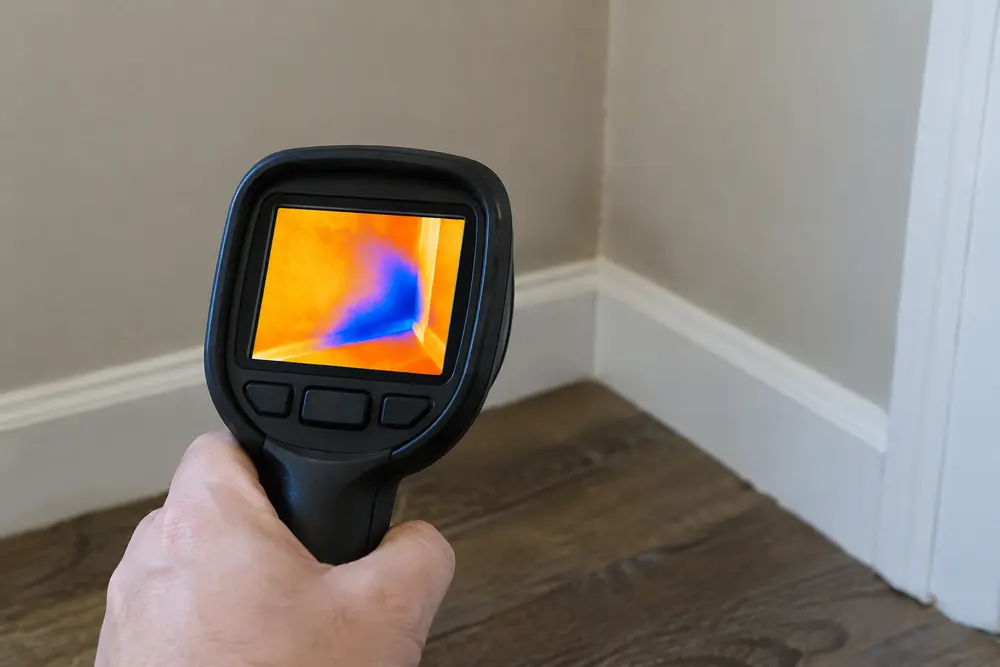
Autumn rain has passed through Austin, and now you’re looking at a discolored patch near a window or a ceiling corner. An infrared camera shows a dramatic blue shape over the same area. It’s tempting to treat that image as confirmation, especially when thermal imaging for mold is advertised as though the camera can spot growth through drywall.
What the camera found is a surface-temperature pattern that differs from the surrounding material, not mold. Hidden moisture might be affecting that pattern, but air leakage or uneven insulation can produce a similar image.
That distinction matters because an overconfident interpretation can send you in either bad direction. You could pay to open a dry wall based on a colorful picture, or you could overlook a concealed moisture problem because the surface looked normal during one scan. The thermal pattern is evidence to investigate, not a diagnosis.
What the Camera Actually Sees
A thermal camera detects infrared radiation coming from a visible surface and converts it into an apparent-temperature image. The U.S. Department of Energy’s thermography guidance explains that these inspections show surface-temperature variations. The camera doesn’t detect spores, fungal colonies, or water molecules.
Drywall receives the same treatment as every other visible material. A concealed condition can influence the drywall’s surface temperature, but the camera isn’t producing an X-ray view of the wall cavity. FLIR’s explanation of infrared cameras and walls makes this limit clear: the instrument reads the surface facing it.
The colors require just as much skepticism because blue doesn’t mean wet and red doesn’t mean dangerous. The operator selects a palette and temperature scale, so a small temperature difference can look spectacular on the screen. Spectacular isn’t the same as conclusive.
Why Can Damp Material Look Different?
Moisture can change how building materials gain and lose heat. Water held in drywall may affect heat capacity, while evaporation can cool the surface. If wet insulation stops performing normally, the pattern may also differ from nearby dry sections.
A moisture-related area won’t always appear cold because indoor temperature, outdoor conditions, and HVAC operation all affect the image. Sunlight on an exterior wall can reverse or overwhelm a pattern that was visible earlier in the day.
Timing matters after rain because materials change as they dry. Active evaporation may create a stronger thermal difference during one visit, then that contrast can fade after temperatures equalize. A dry-looking surface still doesn’t establish that the middle of the assembly is dry.
Useful thermography depends on comparing the suspicious patch with nearby surfaces built from the same material. Comparing drywall with wood trim tells you very little because those materials respond differently to temperature and moisture.
What Commonly Imitates Moisture
A thermal anomaly can have several ordinary causes that don’t involve water or mold. These are some of the more common troublemakers:
- Missing or compressed insulation behind the surface
- Air leakage around a window or wall penetration
- A supply duct or plumbing line inside the cavity
- Metal framing that conducts heat differently
- Afternoon sun heating an exterior wall
- A glossy surface reflecting infrared energy
Furniture can also restrict airflow and leave a recognizable shape on a wall. Recently repaired material may behave differently from the original surface. This is why identifying a blue patch as “hidden mold” from the image alone is guesswork dressed up with expensive equipment.
Verifying a Pattern After Austin Rain
At Howard Environmental, we approach a mold inspection in Austin by starting with what happened around the building. We ask when you noticed the stain and whether wind-driven rain hit that side of your home. We also look at roof or window history because a thermal pattern doesn’t tell us which storm caused the condition.
During the visual survey that comes next, bubbling paint or material deterioration can support concern about water intrusion. We compare the thermal area with adjacent surfaces and consider known duct routes before deciding where instrument readings belong.
An infrared mold inspection needs moisture verification to support a moisture-related conclusion. A pinless meter can scan a broader area without puncturing the finish. A pin-type meter uses probes for a localized reading and leaves small holes.
Neither type of meter is infallible because metal behind drywall can distort a pinless reading, while salts can affect electrical resistance measured by pins. We compare the suspect location with an apparently dry reference area made from the same material. One isolated number with no reference is weak evidence.
If the thermal pattern and moisture comparison point to a concealed problem, we may examine an accessible reverse side or use an existing opening. A borescope or limited material opening may be justified when it will answer a defined question. Random wall demolition is usually overkill, and it gets expensive when the original water pathway still hasn’t been identified.
When Mold Sampling Earns Its Keep
Sampling has value when it resolves something your visual and moisture findings can’t. A targeted surface sample can help characterize suspicious material. Bulk-material analysis may be useful when the condition of a specific building component is disputed, while air sampling captures particles present at that location during the sampling period.
More samples don’t automatically produce a better answer, so the sampling plan needs a specific purpose. The EPA’s mold sampling guidance says sampling is generally unnecessary when visible mold is already present, and there are no federal mold-spore limits that serve as universal pass-or-fail standards. You get more value when each sample addresses a defined question through properly selected mold testing in Austin.
How the Investigation Tools Differ
By mapping apparent surface-temperature differences, thermal imaging helps your inspector scan a large area and choose better places for direct measurements. By itself, it can’t establish moisture content or explain the source of an anomaly.
A moisture meter provides stronger support for a damp-material finding, especially when the reading is compared with a suitable dry reference. It still can’t tell you whether fungal growth is present. Moisture supports the conditions that can allow growth, but the meter doesn’t identify biology.
Visual inspection can document visible growth and water damage. Its weakness is concealment. Your inspector can’t see through an intact wall any more than the thermal camera can, which is why accessible reverse sides and focused cavity checks may matter.
Sampling examines collected material or airborne particles. It can characterize what was captured, but it doesn’t reveal the condition of every closed cavity. Thermal imaging and sampling aren’t rival technologies. They answer different questions, and using the wrong one wastes money through repeat testing or needless repairs.
What a Defensible Finding Sounds Like
A responsible report shouldn’t say “mold detected by infrared.” A defensible finding sounds more like this: “A surface-temperature anomaly was observed near the window, and comparative moisture readings were elevated in the corresponding drywall.” That language tells you what the instruments actually supported.
The report should pair the thermal image with a standard photograph of the same location. It should record the moisture findings and explain the next verification step. Indoor conditions belong in the record when they affect interpretation.
Your next step depends on the combined evidence. Moisture control remains central because the EPA’s homeowner guidance ties mold prevention and remediation to correcting moisture problems. If the work involves regulated mold assessment or remediation in Texas, current requirements should be checked through the Texas Department of Licensing and Regulation.
Common Questions About Thermal Imaging
Can a Thermal Camera Find Mold Behind Drywall?
No. It can reveal a temperature difference on the drywall that may be influenced by a concealed condition. Mold can also remain after an old leak has dried, leaving no useful thermal signature at all.
How Soon After Rain Should You Schedule a Scan?
There’s no universal waiting period. Active drying may make a moisture-related pattern easier to observe, while waiting too long can reduce thermal contrast. If you have active leaking or worsening material damage, delaying solely to improve the camera image makes little sense.
Can a Phone Thermal Attachment Detect Mold?
A phone attachment follows the same basic infrared principle as a dedicated camera, so it still can’t detect mold. Resolution and measurement controls may also be limited. It can flag an area worth examining, but you still need visual context and moisture verification.
Do Thermal Colors Show How Dangerous Mold Is?
No. Palette colors represent apparent temperatures within the selected scale. They don’t identify mold species or indicate toxicity, and the size of the colored patch can’t determine your health risk.
References
- Mold Testing or Sampling (epa.gov)
- A Brief Guide to Mold, Moisture and Your Home (epa.gov)
- Mold Assessors and Remediators Homepage (tdlr.texas.gov)