
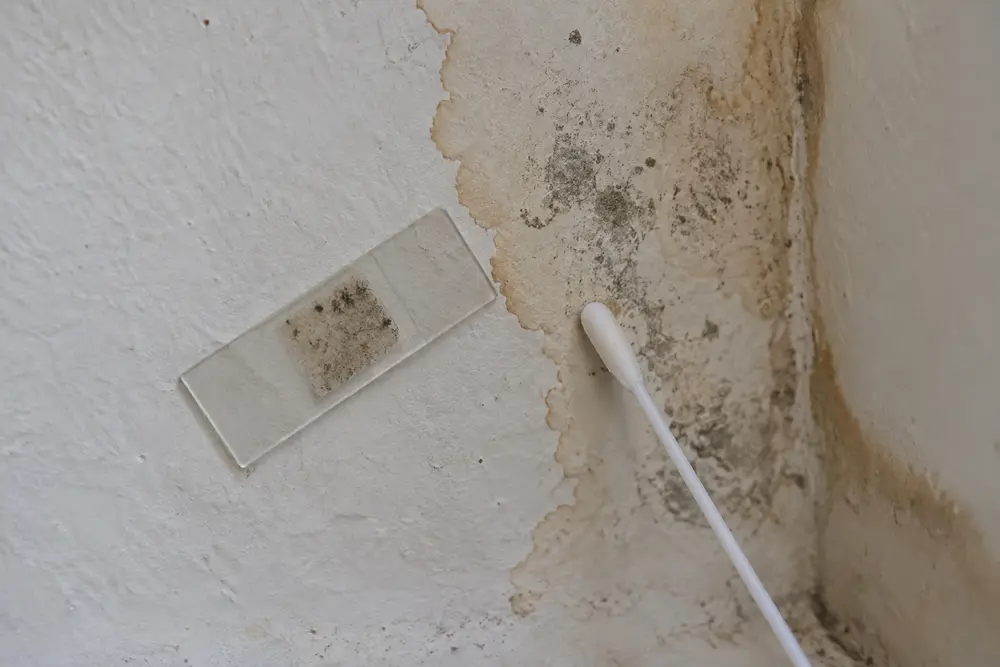
Is a tape lift mold test better than a mold swab test when you can already see suspicious growth? No. The better test is the one that can collect useful material from your specific surface and support the laboratory analysis you actually need.
A smooth painted wall and a rough framing member shouldn’t automatically receive the same sample. Adhesive makes good contact with one. On the other, it may touch only the high points and leave most of the suspect material behind.
Choosing poorly can produce a weak transfer or an inconclusive result. You still pay the laboratory fee, and someone may need to return for another sample. That’s avoidable when the collection method is chosen before the sampling kit comes out.
Surface texture narrows your options, but it doesn’t make the whole decision. Accessibility matters, and so does the question you’re asking. The receiving laboratory may also require a specific collection device for its analytical method.
That distinction shapes how we approach surface sampling at Howard Environmental. We don’t treat tape and swabs as rival products. They’re tools with different strengths, and sometimes neither one deserves the job.
How Tape Lifts Collect Surface Evidence
A tape lift uses clear adhesive to remove material sitting on or growing from a surface. The laboratory generally examines that material under a microscope. ASTM’s tape-lift microscopy method specifically addresses fungal structures collected on tape.
Good contact may preserve the arrangement of fungal material. A laboratory could see spores associated with hyphae or intact reproductive structures, which can provide stronger evidence of growth at that spot than a few loose spores alone. Deposited spores can land on a surface without growing there.
Smooth, accessible material gives tape its best chance. Too much dust can obscure the microscopic field, while rough texture creates incomplete contact. Fibers may cover the preparation so heavily that the target material becomes difficult to examine. Direct microscopy also doesn’t tell you whether observed fungal structures are alive.
How Swabs Collect Surface Material
A mold swab test collects surface material as the swab is rubbed or rolled across the target. Its narrow shape can reach corners and small recesses where tape can’t lie flat.
A swab may support direct microscopy or culture, depending on the laboratory’s protocol. The required swab material and transport medium can change with the requested analysis. Using whatever cotton swab happens to be nearby is a shortcut, not a sampling plan.
Culture can recover viable organisms that grow under the laboratory’s selected conditions. It won’t recover every organism originally present. Some material may be nonviable or fail to grow on the chosen medium.
Swabbing also removes fungal structures from their original arrangement. Pressure and sampled area affect recovery, as does the surface itself. A swab may be easier to apply to rough wood, but that doesn’t mean it efficiently retrieves material trapped inside every grain or split.
Why Neither Test Always Wins
The useful comparison isn’t which method sounds more technical. You need to compare surface contact with the inspection question. One method may be physically easier while producing less useful information for the analysis you requested.
| Decision Point | Tape Lift | Swab |
|---|---|---|
| Typical surface | Flat and relatively smooth | Uneven or recessed |
| Common use | Direct microscopic examination | Direct microscopy or culture, as approved by the laboratory |
| Main strength | May preserve the arrangement of fungal structures | Can reach targets unsuitable for uniform adhesive contact |
| Common failure | Weak transfer from uneven contact | Variable recovery caused by technique or surface texture |
| Key limitation | Debris or fibers may obscure the sample | Rubbing removes the original surface context |
A sample represents the collected spot. It doesn’t characterize the wider building area. A negative result may reflect poor contact or an unrepresentative location, so treating it as proof that no mold exists nearby is a mistake.
Match the Test to the Material
Material names alone don’t settle the choice because their finishes vary. Painted drywall may be smooth or heavily textured. Concrete may be sealed or deeply pitted. You have to look at the exact location being sampled.
Painted Drywall
Intact, smooth paint often accepts tape well when your question is whether a visible patch contains fungal structures. A swab may work better on textured paint or in a tight corner. Neither sample reveals what is happening inside the gypsum core or wall cavity.
Wood and Structural Panels
Tape can work on a comparatively smooth section of framing or plywood when enough material transfers without loading the sample with wood fibers. Grain and splinters often make a swab more practical. Moisture history still matters because a surface result can’t establish how deeply fungal growth or water damage extends.
Masonry
Sealed or painted masonry may allow useful tape contact. Rough block and mortar joints usually favor a swab physically, though porous material can still hold onto what you’re trying to collect. White or dark deposits aren’t automatically mold. Mineral residue and ordinary dirt can resemble growth, so the sampling question should be identification, not confirmation of an assumption.
Nonporous Finished Surfaces
Smooth nonporous finishes are often good candidates for tape. A curved pipe or a gasket changes that calculation because adhesive may not contact the target evenly. Heavy dust can compromise either method by overwhelming or diluting the material you care about.
HVAC Components
Flat sheet metal may accept a tape sample, while components with tight spaces and uneven surfaces are generally easier to reach with a swab. Sampling doesn’t replace examining condensation or drainage. If moisture keeps returning, an organism name on a laboratory report hasn’t solved your building problem.
Fibrous Materials
Carpet and insulation expose the weaknesses of both methods. Tape can become overloaded with fibers, and a swab may recover material unevenly from below the exposed face. A laboratory-approved bulk sample may be more representative when removal is appropriate.
Start With Your Inspection Question
If you’re asking whether ambiguous discoloration contains fungal structures, tape is often a strong first choice on a surface that allows complete contact. A swab handles the same identification question when texture or access defeats the adhesive.
If you want to know what viable fungi can be cultured, you need a laboratory-approved sterile swab and the proper transport procedure. Culture shouldn’t be treated as a complete inventory. It reports what the selected method recovered and grew.
Post-cleaning verification requires criteria set before collection. Surface sampling may contribute, but dry, visibly clean materials carry substantial weight. EPA remediation guidance emphasizes moisture correction and visual evaluation when assessing completed work.
Determining how far growth extends takes more than one dramatic sample from the darkest spot. A proper mold inspection in Austin may involve moisture mapping and examination of adjacent materials. Sampling can support those observations, but it can’t replace them.
Neither a tape result nor a swab result declares a building safe or unsafe. Organism names don’t establish your exposure, and there are no federal numerical limits that automatically make a surface result acceptable. The report needs to be interpreted with the visible extent and the building’s moisture conditions.
When Both Methods Are a Poor Fit
Visible mold frequently doesn’t need laboratory confirmation. The EPA says sampling is usually unnecessary when visible growth is present. Finding and correcting the moisture source may give you more useful direction than paying a laboratory to label something you already know requires attention.
Fibrous ceiling tile or damaged wallboard may justify a bulk material sample when the laboratory accepts one and removal is appropriate. Hidden-condition questions may call for a broader mold inspection. A surface sample can’t see through finishes, determine the full extent inside an assembly, or explain why the material became wet.
Confirm the Method With the Laboratory
The receiving laboratory should approve the collection method before anyone samples. Ask whether it accepts tape or swabs for your requested analysis. For a swab, confirm the required preparation and transport medium.
Reporting expectations deserve the same attention. Ask whether the laboratory can realistically identify the material to a broad fungal category or genus. Species-level identification isn’t guaranteed merely because a report contains a scientific name.
Collection details can determine whether the sample is accepted at all. Confirm the required sampled area and shipping conditions. You can also check the laboratory through the AIHA accreditation directory instead of relying only on a company’s marketing claims.
Questions to Ask Before You Hire
What question will this sample answer? You should hear a clear purpose, such as identifying suspicious discoloration or supporting an agreed post-cleaning assessment. “Let’s test and see what comes back” is usually an invitation to buy data without a plan for using it.
Why does this surface favor tape or a swab? The explanation should address texture and access. If every material gets the same device, convenience may be driving the decision.
Has the laboratory approved the method? Ask who confirmed the collection device and requested analysis. A mold swab test prepared for culture may have different requirements than one intended for direct microscopy.
How will a negative or limited result be interpreted? A careful professional should explain that poor transfer and spot selection can affect the finding. The best sample is the one that makes reliable contact, supports the laboratory method, and answers your stated question.
References
- D7658 Standard Test Method for Direct Microscopy of Fungal Structures from Tape (astm.org)
- Mold Remediation in Schools and Commercial Buildings Guide: Chapter 1 (epa.gov)
- Mold Testing or Sampling (epa.gov)
- AIHA Laboratory Accreditation Programs, LLC (aihaaccreditedlabs.org)