
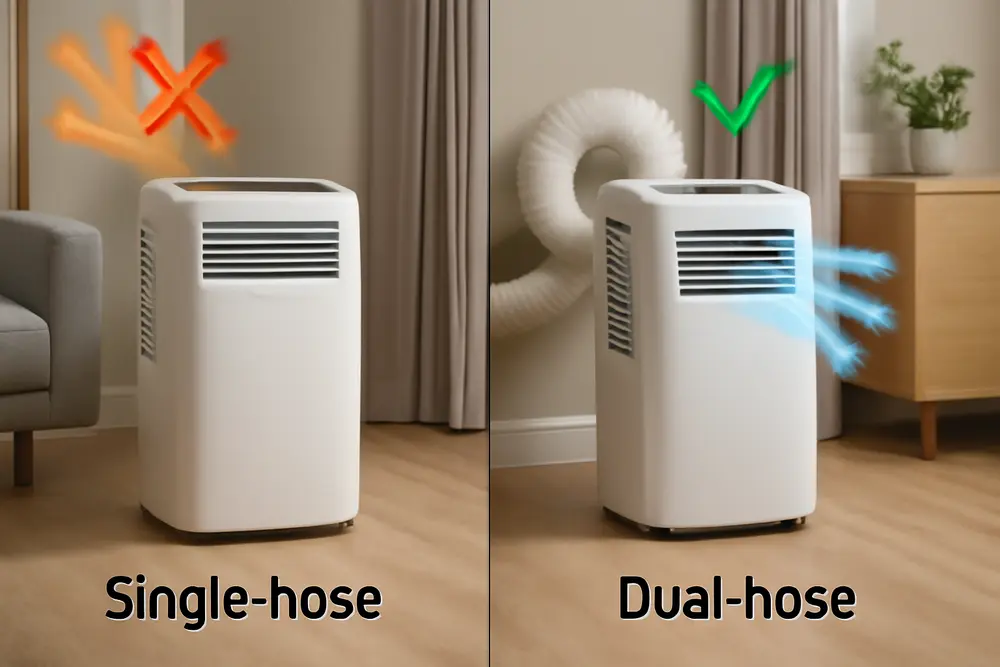
If your single-hose portable AC could talk, it would say something like: “I cool your room while I quietly suck in muggy air from everywhere else.” Cute. Also how you end up with condensation on window sills, clammy rooms, and mold doing a hostile takeover behind your couch. I inspect homes every week where this exact setup turned a short heat wave into a long remediation bill. Here’s how single-hose units jack up indoor humidity, how to spot trouble early, what quick fixes actually help, and why the smart move is swapping to a dual-hose portable AC or an inverter model that does not turn your room into a vacuum for outdoor moisture.
How Single-Hose ACs Play With Pressure
Single-hose portable ACs exhaust hot air outside through one hose. That hose does two things at once: it kicks heat out, and it pulls replacement air from the room to cool the condenser. When you eject air from a sealed space without bringing an equal amount back in, you create negative pressure. That pressure difference will pull in outside air through the path of least resistance: window gaps, door undercuts, recessed lights, attic hatches, you name it. If the air outdoors or in adjacent rooms is humid, you just invited moisture to the party.
In short: your single-hose portable AC steals cooled, dehumidified indoor air and blows it outside. Then it drags in a fresh supply of warm, moist air that your unit has to cool again. It is like running a treadmill while someone keeps turning up the incline.
Negative pressure and makeup air are not opinions. This is how these units are designed to work, which is why they are cheaper and often less efficient than dual-hose models. See clear diagrams and explanations from Forbes and HVAC Base that break down the airflow and pressure dynamics.
Now layer on condensation physics. Warm humid air meets cold surfaces, and moisture drops out. Window glass, exterior walls, the back of a dresser against a north wall, that uninsulated rim joist in the basement – all fair game. If those surfaces stay damp for 24 to 48 hours, you are in mold country. We have a straight-shooting primer on this with steps to stop window sill mold right here: Howard Environmental.
Why Mold Risk Shoots Up
Single-hose portable ACs set the stage for mold in a few overlapping ways:
They raise indoor relative humidity. As the unit exhausts and pulls in outside or adjacent-room air, your space gets a steady stream of moisture. Your AC now works harder and longer just to maintain setpoint. Long runtimes with warm, humid makeup air push indoor RH into the 60 to 70 percent range. That is above the 30 to 50 percent band we target for mold control, and above the ~55 percent zone where condensation on cool surfaces becomes routine.
They struggle with condensate management. Many single-hose models are “auto-evaporative.” They atomize some condensate and send it out with the exhaust. Sounds tidy until the exhaust hose pools water in a sag or the air is so humid that the pan fills anyway. Tanks get full, float switches fail, or slow drips soak baseboards. Basic maintenance like clearing the path and ensuring a steady slope is often skipped. See the simple drain tips at HVAC Base.
They create cold-condensation hotspots. You know the suspects: single-pane or metal-framed windows, uninsulated basement walls, supply registers aimed straight at drywall, or a portable AC blowing right at a closet door. Those chilled surfaces plus high RH is the mold equivalent of all-you-can-eat brunch.
Once a spot stays damp for 24 to 48 hours, spores wake up and stick around. After that, it does not take much to spread from sills to trim to drywall paper. If you have questions on how mold migrates through rooms and belongings, see our plain-English explainer: How Mold Spreads.
Early Warning Signs To Watch
Smell it first. A musty odor in the morning after running the unit overnight is classic. It can be faint. Trust your nose.
Look where cold meets warm. Window sills, metal window frames, the lower 2 feet of exterior walls, and behind tightly packed furniture. Watch for speckles, gray-green shading, soft paint, or paint peeling. On wood, look for slight darkening along the grain that grows instead of fading.
Track RH, not just temperature. Buy two inexpensive digital hygrometers and park them in opposite corners of the room. If RH hangs above 55 to 60 percent for hours, that is a red flag. Our target is 30 to 50 percent, as outlined in our condensation guide.
Check the AC itself. Pop the filter and look behind it for dust mats or fuzz. Check the condensate tray or tank for slime. Shine a light into the supply louvers – any dark patches should be inspected. If you see standing water in the bottom pan or smell funk near the unit, fix that immediately.
Scan the hose and window kit. A leaky window panel or loose hose collar leaks hot outdoor air into your room while the unit is trying to cool. That means more runtime and more moisture pulled in through other gaps. Also make sure the exhaust hose is not running hotter than a cheap toaster. If it is, you are basically heating the room you are trying to cool.
Quick Fixes If You’re Stuck With One
Ideally, you swap to a dual-hose portable AC. If you cannot today, you can at least make a single-hose behave less like a mold generator.
Seal the window kit hard. Use foam tape or weatherstripping around the panel edges. Caulk gaps if the kit will stay in place for the season. Tape the hose joints to stop leaks. The tighter the window kit, the less heat and humidity you leak back in.
Shorten and insulate the exhaust hose. Keep it as short and straight as possible with a steady rise to the exit. No loops or sags where condensate can collect. If the hose radiates heat, wrap it with foil-faced insulation sleeves to cut heat spillback.
Give condensate a safe exit. If your model supports continuous drain, run a short hose to a floor drain or condensate pump. Keep the drain tube sloped. If you must use the tank, empty it daily during humid weather. Clear any lint or gunk from the outlet port. For auto-evap units, ensure the exhaust path is clear so atomized water leaves instead of falling back into the hose.
Clean filters, coils, and trays. Rinse filters weekly during peak season. Wipe the condensate tray every 1 to 2 weeks with a mild detergent and water. Skip bleach on metal coils – it is corrosive. If you use a coil-cleaning spray, choose a non-acid foaming product made for HVAC coils and follow the label. Let parts dry fully before powering on.
Add targeted dehumidification. If the room RH sits above 55 percent, a small dehumidifier helps far more than you think. Set it to 45 to 50 percent and place it across the room from the AC so air circulates across the whole space. In basements, a larger dehumidifier on continuous drain is often the difference between semi-dry and sporefest.
Vent after moisture events. Showers, boiling pasta, and mopping floors spike RH. Use bath and kitchen exhaust fans for 20 to 30 minutes after use. Keep lids on pots. Dry towels in a dryer vented outdoors – not on a rack in the AC room.
Control airflow paths. Close windows fully. Use door sweeps and weatherstripping to block direct outdoor infiltration, especially on the window with the kit. If you must crack a door, crack one to a conditioned area of the home, not a damp garage or humid porch.
Dual-Hose Portable ACs Are Better
Dual-hose portable ACs use one hose to pull outside air across the condenser and a second hose to exhaust it back out. Room air stays in the room. That largely eliminates the negative pressure problem that drags in humidity.
The real-world benefits show up fast:
Less infiltration penalty. Because you are not ejecting conditioned room air, the unit wastes far less energy fighting the warm-humid loop that plagues single-hose units. Some testing shows energy use can drop 20 to 30 percent compared to a similar-capacity single-hose. See comparisons at HVAC Base and Forbes.
Faster cooling and better humidity control. With less hot air leaking in, a dual-hose unit hits setpoint faster and cycles off, which also reduces surface condensation. Your hygrometer readings tell the story in a day or two.
Inverter portable ACs are a strong pick. Inverter-driven models modulate compressor speed to match load. That means fewer temperature swings, steadier dew point control, and less short cycling. If you cannot locate a dual-hose model you like, a high-quality inverter unit is the next best thing.
For a quick look at how single vs dual hoses work internally, GE’s product support also sketches the mechanics of negative pressure in one-hose designs: GE Appliances Support.
| Feature | Single-Hose Portable AC | Dual-Hose Portable AC |
|---|---|---|
| Pressure In Room | Negative – draws in humid air | Near neutral – room air stays inside |
| Humidity Control | Often struggles at 55 percent+ | More stable in the 40 to 50 percent range |
| Cooling Speed | Slower under humid load | Faster – less infiltration penalty |
| Energy Use | Higher for same feel | Lower in many setups |
| Mold Risk | Elevated if mismanaged | Lower with proper operation |
When To Add Dehumidification Or Ventilation
Basements and garden units. Any below-grade space is a moisture magnet. If your hygrometer shows 60 percent or higher RH for more than a day, add a dehumidifier sized for the square footage. Continuous drain to a floor drain or a pump is best.
High-humidity seasons. In many regions, outdoor dew points above 60 degrees signal a sticky day. Your single-hose unit will pull that moisture indoors. A portable dehumidifier or a dual-hose AC keeps indoor RH in the target band so condensation does not linger.
After repairs or leaks. If you had a plumbing leak or window flashing fix, get aggressive with dehumidification while materials dry. Wet drywall and trim are mold’s favorite buffet.
Vent smart, not random. Use bath and kitchen exhaust fans that vent outdoors. If you install mechanical ventilation, pick the right tool: in hot-humid climates, an ERV helps manage moisture better than simple supply-only fans. In cold seasons, an HRV can balance fresh air with heat recovery. Do not run a fan that pulls outdoor swamp air into your conditioned space without a plan.
Key Numbers You Should Hit
For mold control and general comfort, we coach clients on a few simple targets:
Indoor RH: 30 to 50 percent. This is the sweet spot for comfort and mold prevention. Once you cross ~55 percent for hours at a time, expect condensation on cold surfaces and faster mold growth. We expand on this in our window condensation guide.
Condensation timer: 24 to 48 hours. If a surface stays damp beyond that, assume mold is coloring in the lines. Dry surfaces quickly with airflow and dehumidification. Do not wait for the weekend.
Temperature swings: keep them small. Huge drops at night followed by daytime reheats cause surfaces to pass in and out of dew point repeatedly. Set a steady temperature and let a dehumidifier or an inverter AC do the heavy lifting on moisture.
Air changes by infiltration: minimize them. Sealing the window kit and hose joints is an easy win. The less uncontrolled outdoor air your single-hose AC drags in, the better your humidity control.
FAQ: Portable ACs and Mold
Why does my room feel clammy even when the single-hose portable AC is running?
Negative pressure pulls humid air indoors as fast as the AC cools it. You feel cooler but sticky because RH stays high. Your unit also short cycles on temperature, not humidity, so it may not run long enough to wring out moisture.
Can I run a dehumidifier with a single-hose portable AC?
Yes, and in humid climates you should. Set the dehumidifier to 45 to 50 percent RH and let the AC focus on temperature. Place the dehumidifier away from the AC so air mixes across the room.
Is a dual-hose portable AC always better?
When set up right, yes for humidity control and speed. It avoids the negative pressure tax that hammers single-hose units. An inverter single-hose can still be decent, but dual-hose or inverter dual-hose usually wins.
Do portable ACs grow mold inside?
They can. Any wet pan, dirty filter, or cold-damp coil is prime real estate. Clean filters weekly in peak season, wipe trays, and confirm the drain works. If you see dark growth, unplug the unit and clean per the manual or replace it if growth is extensive.
Should I crack a window to relieve negative pressure?
Cracking a window in a humid climate invites more moisture. If you must relieve pressure temporarily, crack a door to a conditioned area instead and keep the window kit as airtight as possible. Better yet, upgrade to dual-hose.
What RH is too high for safety?
We aim for 30 to 50 percent. Above ~55 percent for long periods is trouble for condensation and mold. If your hygrometer shows high RH while the AC runs, add dehumidification or switch equipment.
What To Do Next
If you are stuck with a single-hose portable AC for now, seal the window kit, shorten and insulate the hose, manage condensate with a proper drain, clean the unit, and run a dehumidifier to keep RH under 50 percent. If you want the problem to go away without a daily babysitting routine, get a dual-hose portable AC or an inverter model designed for steady-state control. And if you are already spotting mold on sills, baseboards, or furniture backs, skip the guessing. Book a mold inspection and air testing, fix the moisture setup, and stop funding the fungus retirement plan.
Want help sorting out whether you have a humidity quirk or a hidden mold issue? We test, we verify, and we give you a plain-English plan that does not involve five gadgets buzzing in one room. If the goal is cool, dry, and clean, a dual-hose portable AC and tight moisture control get you there without the mold subplot.