
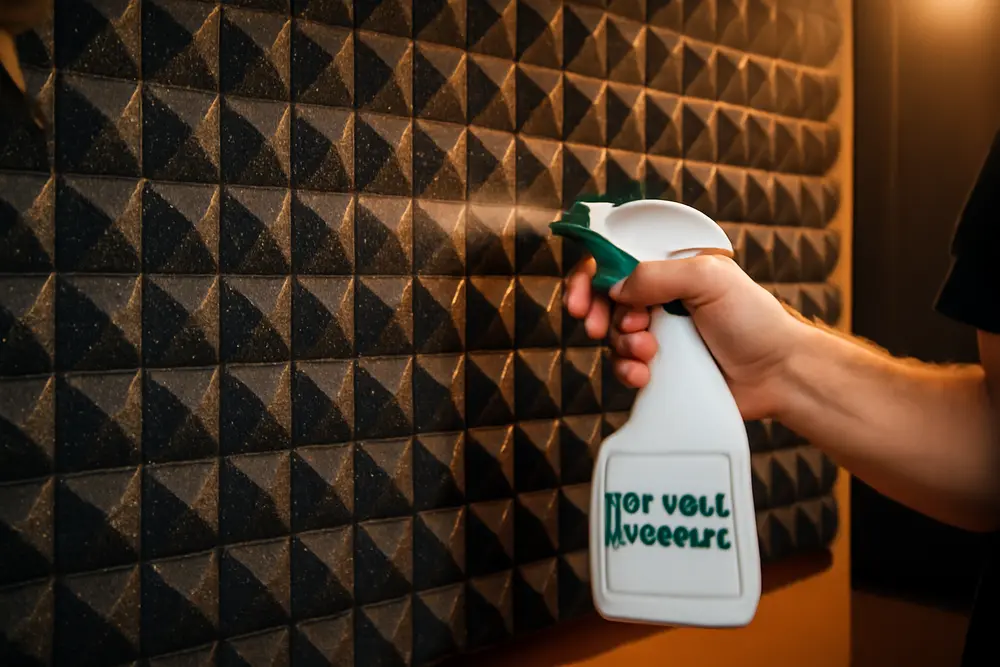
Your studio is a sonic fortress, which is great for kick drums and terrible for humidity. Seal up a room tight enough to keep out traffic noise and you’ll also keep in the moisture from sweaty sessions, breath, spilled coffee, and that tropical plant you swear helps you write. Then you stick porous acoustic foam, bass traps, and carpets on cold walls and in muggy corners. Congrats, you just built a timeshare for mold. Let’s flip the script. Here’s how to keep your acoustic foam and soundproof room dry, clean, and ready to record without trashing your acoustics.
Why Mold Grows in Soundproof Studios
Soundproof studios are like thermoses with XLR jacks. You’ve got tight seals, heavy doors, and decoupled construction. That isolation traps moisture. Without steady fresh air, hygge turns into humid. Porous materials such as acoustic foam, fabric-wrapped panels, bass traps, rugs, and even mic windscreens hang onto that moisture and give mold exactly what it wants: a damp, still microclimate. Mold can begin colonizing damp materials in as little as 24 to 48 hours, so every spill, sweaty session, or rainy week is a window of opportunity.
There’s also the cold-wall problem. Exterior walls run cooler, especially in winter or in air-conditioned rooms. Mount foam directly on a cold surface and you can trap a film of condensation behind it. That hidden damp spot becomes a mold nursery you can’t see until you smell it, or until the wall paint starts getting weird. If your studio has panels tight to exterior walls or crammed into corners where air barely moves, you’re asking for trouble.
Bottom line: sealed room plus moisture plus porous surfaces equals mold risk. Good news: with a little airflow, humidity control, and smarter mounting, you can keep the mix clean and the foam mold-free.
Ventilation For Soundproof Studios
Your ears want isolation. Your lungs want fresh air. You can have both. The trick is controlled ventilation that won’t blow your noise floor. Energy recovery ventilators and heat recovery ventilators bring in filtered outside air and exhaust stale air while exchanging heat, so you don’t sabotage your HVAC or your studio climate. These boxes are studio-friendly because they deliver the fresh air your body needs without torching your acoustic isolation.
A simple rule of thumb is 15 CFM of fresh air per person. A duo in a tight booth needs roughly 30 CFM, and a bigger control room with four people should land around 60 CFM. Sizing an ERV or HRV to those numbers keeps carbon dioxide in check and combats humidity from breath and sweat. If you run long sessions, that steady fresh air is the difference between crisp takes and the nap monster.
Noise control is about duct velocity and layout. Aim to keep airspeed under roughly 300 FPM inside the ducts feeding your studio. Lower speed means less turbulence noise. Use larger diameter ducts and long, lined duct runs to act as mufflers. Add a few gentle turns rather than sharp elbows, and use flexible connectors to decouple from the structure. Put supply grills where people actually are and gives returns a real path back to the ERV or HVAC, not a tiny slot that wheezes like a kazoo. The goal is slow and steady airflow that your mics can’t hear but your hygrometer loves.
If you can’t install an ERV right now, a quieter stopgap is a timed fresh-air purge when you’re not recording. Crack a secondary door, run a box fan through a baffled, lined duct tunnel you build with moving blankets, then shut it down before you hit record. It’s not elegant, but it beats stale air and foggy windows.
Humidity Control For Studios
Soundproof room or not, humidity is your mold thermostat. Keep studio relative humidity between 30 and 50 percent all year. If you see your gauges creeping past 50 percent for days, you’re tempting mold. Below 30 percent, your throat gets crunchy and instruments get cranky. Locking in that 30 to 50 percent band is the easiest mold insurance you’ll ever buy.
Use a good dehumidifier, preferably ENERGY STAR rated, with a built-in humidistat so it cycles instead of running like a jet engine 24/7. Drain it to a condensate pump or a floor drain so you don’t have to babysit buckets. If the studio is split into a control room and live room, consider two smaller units set to the same humidity target instead of one oversized beast. Smaller units placed strategically will be quieter and more even.
Humidity spikes during sessions. People breathe, sing, and glisten. Drums and amps warm the air. If your dehumidifier is set to 45 percent, it will knock down those spikes quickly after the session while your ERV replaces stale air. That combo keeps the studio from marinating overnight, which is when mold takes its victory lap.
Get hands-on with the foam. Once a month, pull a few panels off cold walls and feel the backing and wall surface. If it’s clammy, you’ve got a condensation pattern. Address the moisture, not just the symptom. That might mean adding a thin thermal break behind the panel, moving the panel to an interior wall, or increasing airflow in that area.
If you want more background on eco-minded humidity control, we’ve got a practical guide to greener moisture management and air quality here: Eco-Friendly Mold Prevention Tips for a Healthier Home.
Materials And Install That Resist Mold
Studios are a cocktail of materials. Choose the ones mold hates. Non-organic framing like metal studs is less mold-friendly than raw wood. If you’re using wood, borate-treated lumber is a tougher target for fungi. For insulation, closed-cell spray foam resists moisture migration better than fluffy stuff, and it can stop condensation if applied correctly. Selecting mold-resistant paints and primers in the studio is also a smart move where panels meet walls.
How you mount acoustic materials matters as much as what they are. Avoid gluing foam flat against a cold exterior wall. Give panels a small air gap to promote airflow behind them. French cleats, Z-clips, and shallow frames let air move, which prevents that sneaky condensation film from staying put. Freestanding bass traps are even better. They deliver performance while staying off cold surfaces. If you must mount in corners, leave a bit of space against each wall so air can circulate around the trap.
If you’re building or renovating a studio, pick the right materials from the start. We covered mold-resistant choices for damp or sealed environments here: Mold-Resistant Materials for Healthier Buildings. The right substrate can be the difference between studio therapy and studio triage.
On adhesives and fabrics, think breathable and removable. Use mounting systems you can undo without ripping off drywall. If you wrap panels in fabric, choose acoustically transparent, breathable textiles that don’t trap moisture. Avoid plastic-backed coverings that act like vapor barriers right where you want drying.
Cleaning Foam Without Wrecking It
Acoustic foam is fussy. Treat it like a vintage ribbon mic, not a kitchen sponge. Routine upkeep is simple: light dusting or vacuuming with a soft brush and low suction. Heavy suction can deform the foam texture, turning your fancy wedge pattern into a sad marshmallow. Dust isn’t just ugly. It’s a food source for mold and it clogs pores, which reduces absorption performance.
For stains or small mold spots, spot-clean off the wall, not on it. Mix mild soap with water or dilute isopropyl alcohol and test on a hidden corner first. You want the lightest touch that works. Do not oversoak. Foam holds water like it holds your snare ring. If you soak it, you’ll wait forever for it to dry and you might deform it. Bleach can discolor and degrade foam and fabrics, so if you use a diluted solution on a non-porous surface nearby, keep it off the foam and off metal components that can corrode. When in doubt, replace the foam instead of risking your lungs for a twenty dollar panel.
Deep cleans should be rare and surgical. Take panels down, clean them gently in a well-ventilated area, and air-dry completely before reinstallation. Use fans to speed drying but keep heat low. A hair dryer on high is a one-way ticket to warping. If a piece of foam smells musty after cleaning and drying or sheds dust like confetti, retire it. Your studio is not a museum of questionable sponges.
Monitoring And Early Warnings
You can’t manage what you don’t measure. Place digital hygrometers in the room at multiple heights. One at ear level near your mix position, one low near floor-level foam or rugs, and one near corners where bass traps live. Corners run cooler and are humidity magnets. Those meters will tell you whether your dehumidifier and ERV settings are actually doing the job, and whether your room has microclimates that need love.
Get used to a quick inspection rhythm. Once a week, walk the room and sniff. Musty odor is not a vibe. Check for fogged windows, damp carpets near doors, and slow-drying drink spills. Once a month, pull a few panels and touch the wall backing. Are there cold spots or condensation rings? Seasonally, look for warped baseboards, bubbled paint, or rust on fasteners. These little tells point to hidden leaks or condensation paths you can fix before mold sets up shop.
If you spot ongoing moisture or mystery damp spots, a moisture meter or a quick thermal imaging survey can save you from guesswork. When readings are high or the smell won’t quit, call a pro who does mold inspection and testing. That’s where we come in. We track moisture sources, test suspect areas, and give you a clear next step. You can reach us through our main site here: Howard Environmental.
Real-World Studio Tactics
Studios come in all shapes, from converted closets to floating rooms. Here’s how these principles play out when the rubber meets the room.
In a small vocal booth, the air volume is tiny, so humidity spikes quickly. An ERV with a low continuous setting plus a small, quiet dehumidifier running to 45 percent is a strong combo. Add an automatic post-session purge: the ERV bumps up for 15 minutes after the last take to replace warm, moist air with conditioned fresh air. Use a deep, lined vent muffler and keep duct velocity low so the singer isn’t dueting with a breeze.
In a larger control room packed with gear, the heat load is real. You might think you’re set because the HVAC keeps it cool, but cooling without humidity control can leave the room clammy. Make sure your HVAC cycle isn’t short-cycling. A dedicated dehumidifier set to 45 percent will level out humidity while the ERV keeps your head clear. Mount wall panels on Z-clips with a half-inch standoff and keep the thickest traps freestanding. That way, if anything feels damp, you can pull a panel in seconds rather than performing drywall surgery.
For basement studios, the ground rules are stricter. Address ground moisture before you worry about diffusion patterns. Seal foundation walls correctly, use a proper vapor barrier on floors under carpets or rugs, and consider closed-cell foam on cold concrete to stop condensation. Don’t lay thick rugs on cold slabs without a thermal break. That’s a mold mat waiting to happen.
Soundproof Studio Ventilation Without Noise
Let’s talk noise control details for the ventilation nerds. Keep duct runs long and lined. More surface area means more attenuation. Use plenum boxes to slow and distribute air before it hits the room, and size supply and return grills generously to keep face velocity low. If you need turns, use radius elbows instead of hard ninety-degree angles. Isolate the ERV or HRV from the structure with vibration mounts, and build it a quiet closet with absorption on the inside. The machine can hum away while your preamps listen for ghosts.
For the truly silent crowd, install a return path that’s more than a door undercut. A lined transfer duct between the live room and a quiet hallway prevents pressure buildup and reduces whistling at doors. With ERVs, pick a model that lets you balance intake and exhaust precisely. Unbalanced flow can pressurize or depressurize the room, which pulls air through tiny gaps and drags in dust and moisture you didn’t plan for.
Acoustic Foam Mold Prevention Myths
Myth one: foam is synthetic so mold can’t grow on it. Not quite. Mold doesn’t have to eat the foam to live on it. Dust, skin cells, fabric dye residues, and ambient gunk are an all-you-can-eat buffet. If the foam is damp and dirty, mold will move in. Clean and dry beats chemistry in a sealed room.
Myth two: a space heater will dry everything out. It might raise temperature, but if humidity is still high, you just created a cozy sauna for spores. Temperature without humidity control isn’t a fix.
Myth three: bleach fixes mold on everything. Bleach has its uses on hard, non-porous surfaces but it isn’t a cure-all, and on foam it’s a fast path to damage or discoloration. Treat the cause and replace badly affected foam.
Installing Panels The Smarter Way
Before you go wild with adhesive sprays, consider maintenance. Panels mounted with a removable system are easier to clean, easier to inspect, and easier to upgrade. A simple wood frame with breathable fabric and mineral wool insert gives you performance and serviceability. Hang it with cleats and leave a small standoff to promote airflow. For foam tiles, use a spot-mount approach instead of full adhesive coverage. Four small, removable tabs will hold a tile but won’t seal the whole back of it to the wall.
Mind the corners. Bass traps gobble low frequencies, but corners are also where humidity hangs out. Leaving a 1 to 2 inch gap behind corner traps improves performance and drying. If you notice persistent dampness in a particular corner, reroute a small, quiet airflow path so that fresh air can reach it. You’d be amazed how much trouble a motionless corner can cause.
What If You Already Smell Mold?
If you smell a musty odor or see fuzzy spots on foam, stop recording long enough to assess. Pull suspect panels. Check behind them for condensation marks and damp paint. If the foam is only lightly affected, remove it from the room and spot-clean in a ventilated area with mild soap or diluted isopropyl alcohol. Let it air-dry completely. Clean the wall with a non-bleach cleaner that won’t damage paint and make sure the area dries quickly within 24 to 48 hours. If foam is heavily colonized or waterlogged, replace it. The health risk is not worth the salvage attempt.
Next, figure out why it happened. Was humidity above 50 percent for days? Is the panel on a cold exterior wall with no standoff? Is there a hidden plumbing issue or a window leak? Fix the source or the problem will return. If you can’t find the source, get a moisture inspection. We test, we trace, and we tell you what to fix before your studio becomes a fungal loft.
Studio Mold Prevention Plan
Here’s a simple routine that keeps your room clean and your foam happy, without turning you into a janitor:
- Install digital hygrometers at ear level and near corners. Keep RH between 30 and 50 percent.
- Use ERV or HRV for fresh air at about 15 CFM per person. Keep duct velocity under roughly 300 FPM to stay quiet.
- Run a dehumidifier with a humidistat set around 45 percent. Drain it automatically.
- Mount panels with air gaps and removable hardware. Avoid full adhesive backs on cold walls.
- Vacuum foam and fabrics weekly with a soft brush. Spot-clean off the wall only.
- Pull a few panels monthly to check for condensation. Move or modify where you find dampness.
- Seasonally inspect for leaks, warped trim, or bubbling paint. Fix issues fast.
- Replace foam that smells musty after cleaning or looks degraded. Don’t gamble with your lungs.
FAQs
Can Mold Damage The Sound-Absorbing Quality Of Foam?
Yes. Dust and mold on the surface block pores and reduce absorption. If mold penetrates or the foam stays damp, it can deform, crumble, or permanently stink. Once foam is waterlogged or visibly colonized, performance and hygiene take a hit.
Is It Better To Clean Moldy Foam Panels Or Replace Them?
Light, surface spotting can sometimes be cleaned off the wall with gentle products, dried completely, and returned. Heavily moldy, water-stained, or smelly foam should be replaced. You’re working in a small, sealed room. Don’t put compromised material back where you live and breathe.
Are Some Acoustic Materials More Mold-Resistant Than Others?
Yes. Closed-cell foams, mineral wool in breathable fabric frames, and non-organic backing boards resist mold better when kept dry. The real advantage comes from the combo: moisture management plus breathable fabrics plus removable mounting. See our guide to smart material choices here: Mold-Resistant Materials for Healthier Buildings.
How Often Should I Check Behind Panels?
Monthly is a good baseline in sealed studios, and more often during season changes or after long, sweaty sessions. If you’ve had a spill, a rainy week, or a humidity spike, pull a few panels sooner. Finding condensation rings early lets you fix mounting or airflow before mold rolls in.
What Fresh-Air Rate Should I Use In A Soundproof Room?
Plan for about 15 CFM per person. Keep duct speeds under roughly 300 FPM for quiet operation, and use lined ducts, longer runs, and isolation for noise control. ERVs or HRVs let you bring in outside air without wrecking your climate.
When To Bring In A Pro
If your hygrometers say you’re fine but your nose says otherwise, or if you’re seeing recurring dampness behind panels, it’s time for a professional mold inspection and moisture assessment. We use targeted testing, moisture meters, and thermal imaging to find the leak or condensation pattern that’s messing with your room. We also give you a practical plan that doesn’t wreck your acoustic design. Get in touch with us here: Howard Environmental. You keep making great tracks. We’ll make sure your foam lives to hear them.