
Your fire is cozy. Your air should be, too. If your living room smells like a campground after a rainstorm, there’s a good chance your firewood is doing more than fueling ambiance. Damp logs leak moisture and hitchhiking spores, which can nudge indoor humidity into the mold-friendly zone and dust your floors with bark confetti. The fix is not complicated, but it is specific. Dry the wood right, stack it so air moves like it pays rent, bring in only what you’ll burn soon, and clean up the debris. Do that, and your fireplace will stop auditioning as a mold machine.
Why Firewood Grows Mold
Mold is not picky. Give it moisture, a food source, and time, and it throws a party. Firewood checks two of those boxes on day one: it’s cellulose-rich food and it has time. That means the only lever you truly control is moisture. Freshly cut wood can hold 40 to 60 percent moisture. Under bark, moisture lingers even longer because bark is nature’s raincoat. Stack wood on bare ground or cram it tight against a fence, and you trap humidity. That trapped moisture keeps wood wet, spores colonize the surface, and every time you carry a few logs inside, you import a musty problem. We see it in mold inspections all the time. A great fire starts outside with how you season and store your wood, not when you strike the match.
What Is Firewood Seasoning?
Firewood seasoning means drying split wood until its internal moisture content drops to a burn-friendly level. The sweet spot is typically under 20 percent. Below that, fires light easier, burn hotter, create less smoke, and leave less creosote in your chimney. Above that, you get steam, sour smoke, and a slow smolder that coats flues and can kick up indoor humidity. Softwoods like pine can reach target dryness in about 6 months if split and stacked with good airflow. Dense hardwoods like oak and hickory usually need 9 to 12 months, sometimes a bit more if you live in a shady, damp climate. Seasoning is not guesswork. A simple pin-type moisture meter gives you the truth in seconds.
Seasoning Timelines That Work
Different species, different clocks. Softwoods dry faster because their cells are less dense and have more resin channels. Hardwoods reward patience with longer, hotter burns, but they need time for the water locked in their dense fibers to escape. Split logs to a practical size, stack with air gaps, and place the pile in sun and breeze. Then let physics do the heavy lifting. If you’re seasoning in a wetter climate, expect the longer end of the range.
| Wood Type | Typical Seasoning Time | Target Moisture | Notes |
|---|---|---|---|
| Softwoods (pine, spruce, fir) | About 6 months | Under 20 percent | Good for kindling and quick heat |
| Hardwoods (oak, hickory, maple) | 9 to 12 months, sometimes longer | Under 20 percent | Hotter, longer burns when fully seasoned |
Build A Rack That Breathes
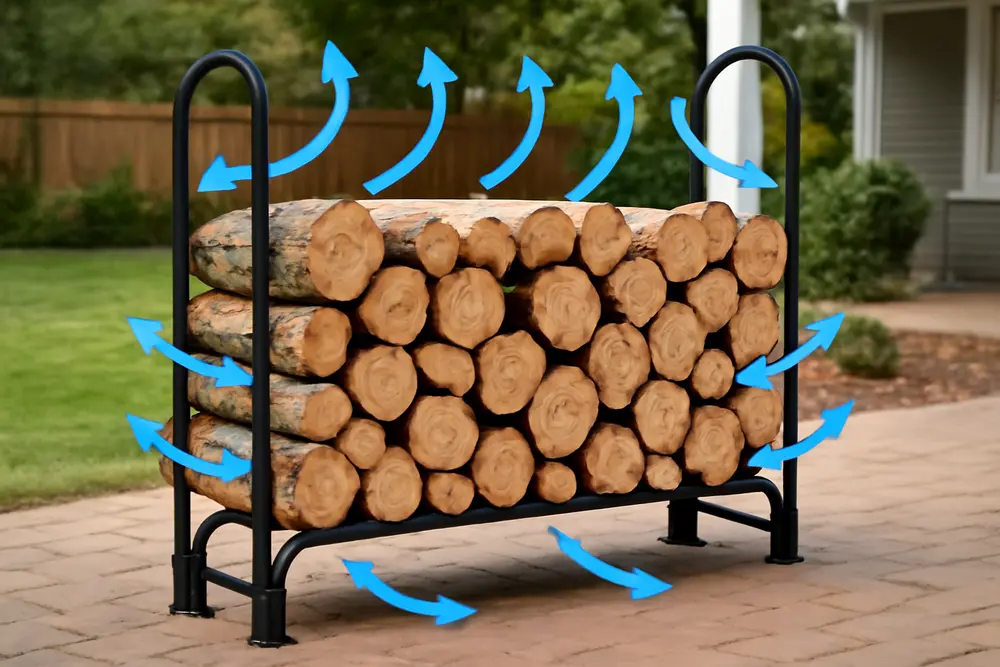
Log rack airflow is the secret sauce. Wood stacked right on soil pulls moisture like a sponge and invites insects. Elevate your stack 4 to 8 inches with a metal rack, pallets, or concrete blocks. A rack with open sides and minimal solid surfaces lets wind move through the pile. Think of your stack like a radiator that needs air moving through it, not a coffin that suffocates it. Keep the design simple: two sturdy end posts, raised rails, and an open bottom. If your rack traps leaves, fix that. Leaves equal trapped moisture, and trapped moisture equals mold auditions.
Where To Put Your Pile
Sun plus breeze beats mold, every time. Put your rack where it gets a daily dose of direct sun and faces prevailing winds. Keep it at least 3 to 5 feet from your house or shed to avoid transferring moisture and pests. Do not line up a wood wall right against an exterior wall. That’s just gifting your siding a mildew spa. If you live where snow drifts, leave enough space to walk around the rack and clear snow so the bottom row does not stew in meltwater. If you have a sloped yard, use the higher, drier spot. Water runs downhill, and so do moldy regrets.
Smart Stacking And Covering
Split wood dries faster than rounds because it exposes more surface area. Split to 3 to 6 inches across for most stoves. Stack in single rows whenever you can. Double rows cut airflow in half and keep centers damp. Cross-stack the ends for stability and to create corner vents. When it comes to covering, protect the top, not the sides. A roof panel, rigid cover, or tarp that only covers the top third of the pile keeps rain and snow off while letting wind strip moisture from the sides. Fully tarped piles sweat inside and grow fuzz. If your wood sits under trees, add a bit of pitch to the top cover so water sheds away and does not pool on bark.
What To Bring Indoors And When
Bringing in a week’s worth of wood sounds efficient until your indoor humidity creeps up and every corner hosts bark crumbs. Keep a small indoor rack, bring in only what you’ll burn in 12 to 24 hours, and rotate. Do not haul in unseasoned or damp wood to dry by the stove. That moisture has to go somewhere, and spoiler alert, it goes into your indoor air. Before you bring a log inside, knock it together outdoors to shake off loose bark, brush it with a stiff hand broom, and check for obvious mold patches. A quick wipe of the indoor rack’s catch pan and a vacuum pass with a HEPA filter keeps spores from taking a tour of your rugs.
Keep Indoor Humidity In Check
Indoor relative humidity needs to live in the 30 to 50 percent zone. Once you creep above about 60 percent, mold starts ordering snacks. Use a hygrometer that logs daily highs. If humidity runs high on burn nights, crack a nearby window slightly while the stove is pulling a strong draft, run a bath fan for 20 minutes after showers, and use a dehumidifier if you have a tight house. Wet boots, simmer pots, fishtanks without lids, and big houseplants all contribute. Your fireplace is not the problem by itself, but damp wood plus everyday moisture sources can push you over the line. The EPA’s guidance tracks with what we see in the field: steady 30 to 50 percent keeps most homes mold-free, while peaks over 60 percent for long periods invite growth.
If You Spot Mold On A Log
Not every spot is a crisis. Surface mold can look white, green, or black and usually brushes off when the wood is dry. If a log has a light dusting, knock it with another log to flake it off, brush it, and leave it in the sun and wind for a day or two. If it smells sour and the wood feels spongy or has soft rot, skip it. Punky wood does not burn well and can spit spores when you disturb it. Do not bleach logs you plan to burn. You do not want chlorine fumes in your living room. Do not bake wood in your oven unless you like the smell of a lumber yard in your kitchen. Just cull the worst pieces, improve log rack airflow, and let time and sunshine do their thing.
Cleanup That Keeps Spores Outside
Firewood brings debris. The trick is to stop it at the door. Place a stiff mat at the entry you use to bring wood inside. Brush and knock logs just outside, not in the mudroom. Line your wood box with a removable tray you can dump weekly. Vacuum weekly with a HEPA-filtered vacuum instead of sweeping dust into the air. If you have sensitive noses at home, wear a simple dust mask while you clean up the bark bits. Keep kindling in a covered tote to avoid a confetti explosion every time you reach in.
Tools That Make It Easier
Two inexpensive gadgets change the whole game. A pin-type moisture meter tells you when you’ve actually hit that 20 percent mark. Test a few splits from the middle of the stack, not just the top row. Split a log and test the fresh face for accuracy. A digital hygrometer shows you if your burn nights bump humidity or if a hot shower turned your bathroom into a rainforest. If the numbers creep, fix the cause: drier wood, more ventilation, or a dehumidifier cycle. Add a decent log rack with open ends and you just upgraded your wood program from moldy mayhem to smooth operator.
Common Mistakes To Avoid
Stacking wood right on the ground is mistake number one. It wicks moisture, invites termites, and turns the bottom row into compost. Stacking against your house is mistake number two. Siding stays wet, insects move in, and you feed mildew on the blind side of your exterior wall. Third is tarping a pile from top to bottom. It traps humidity. Fourth is hauling in a month’s worth of wood. Your indoor air should not be a humidifier with splinters. Fifth is assuming a fireplace can dry green wood. It cannot. It will smoke and smolder while your air quality dips. Fix those five, and you’re ahead of most folks.
How Much Wood Should You Split?
Split smart, not heroic. Pieces 3 to 6 inches across season well and burn predictably. Huge rounds look impressive, but they dry poorly and burn like stubborn boulders. Split awkward shapes into wedges that stack with little air gaps between faces. The goal is a stable rack that breathes. If your species tends to hold bark tight, stack with bark up on the top row to shed rain. If your bark peels easily and tends to trap water, bark down works better. Either way, keep the sides open so wind can do wind things.
What About Pests?
Dry wood is less interesting to bugs. Elevated racks and distance from the home cut pest pressure. Do not spray firewood with pesticides if you plan to burn it indoors. If you spot carpenter ants or termites in a piece, don’t bring it inside. Re-home that log to the far end of your yard and burn it outside at your next bonfire. Rotate your stacks season by season so no pile sits untouched long enough to become an ant condo.
How To Tell If Wood Is Ready
Beyond the moisture meter, there are simple cues. Seasoned pieces are lighter for their size, ends are checked with small cracks, and two pieces knocked together sound crisp instead of dull. When you split a seasoned log, the fresh face looks dry instead of glassy. If a piece hisses in the fire, it was not ready. That hiss is steam, and your chimney will not send a thank-you note for the extra creosote. Use those cues plus the meter and you will burn cleaner right away.
Better Burns Mean Better Air
Seasoned wood produces a hotter, cleaner flame. Cleaner burns mean fewer particles, less smoke odor, and less residue that can redeposit inside your home. If your glass door blackens fast or your flue cap is coated with tar, your wood is probably wet. Pair seasoned fuel with a properly sized stove, a fully open air control at startup, and a hot kindling base. Let the fire establish a strong draft before you throttle back. You’ll feel more heat at lower wood usage, and your indoor air will thank you by not smelling like a wet campfire.
Tiny Habits That Add Up
Stack in single rows. Keep the rack raised. Cover only the top. Face the stack toward wind. Brush each log before it crosses the threshold. Bring in a small batch, then refill tomorrow. Check your hygrometer at night. Empty the wood box weekly. These are small moves that keep spores outside and humidity where it belongs. Do not underestimate how much water a pile of firewood can release if you bring the whole forest into your living room. A tidy rack and tidy habits keep the cozy vibe without the musty side effects.
When To Call For Help
If your walls or windows sweat when you burn, if you see fuzzy patches on baseboards near your hearth, or if your nose says musty even with seasoned wood and decent housekeeping, it is time for a real inspection. We check moisture sources, sample air when needed, and find the weak links that let dampness win. Firewood is only one part of the moisture puzzle. Leaky bath fans, unvented dryers, crawlspace humidity, and foundation seepage all pile on. If you want a trained set of eyes and instruments, our mold inspection page breaks down what an assessment includes. Curious how changing weather patterns are messing with home humidity? We talk about that on our climate and mold post too.
Firewood And Mold FAQ
Is a little mold on firewood dangerous?
A small amount of surface mold on a dry log is common and usually brushes off. If a log is heavily covered, soft, or smells sour, skip it. Burning moldy wood can release extra particulates and odors that bug sensitive folks. It’s better to cull and improve your log rack airflow than to gamble with smelly fires.
Can I store firewood in my basement?
Short answer: please don’t. Basements are often humid and poorly ventilated, which is perfect for mold and insects. Keep your main supply outside on a raised rack and bring in only a small daily batch to a dry, conditioned space.
Do kiln-dried bundles solve the problem?
They help. Kiln-dried wood is dry from day one, but it can still pick up moisture if you stack it poorly. Treat it right, keep it off the ground, cover the top, and you’ll enjoy a very clean burn. Treat it wrong and you’re back to square one.
Will a dehumidifier fix wet wood?
No. A dehumidifier manages indoor air moisture, not log moisture. Wet wood needs time, airflow, and sun outside. Use the dehumidifier to keep indoor humidity between 30 and 50 percent while you burn properly seasoned fuel.
How far from the house should I keep the rack?
At least 3 to 5 feet is a good starting point, more if space allows. That gap reduces pest transfers and keeps siding out of the splash zone when it rains. If you can give it 10 feet and still reach it in a snowstorm, even better.
A Field Tip From The Inspection Trenches
We see the same pattern in homes with fireplace funk. A gorgeous stack jammed along a shady fence, completely tarped, bottom row sitting on dirt. Inside, a heap of logs next to the hearth like a sculpture. The fix that works every time is simple. Move the pile to sun and breeze, raise it, top-cover only, open the sides, brush logs outside, and bring in a small batch. Pair that with a hygrometer and a moisture meter, and you turn guesswork into control. You’ll get hotter fires, less soot, and a living room that smells like wood smoke in a good way, not like a damp sock.