
You’re looking at a lab report from your Austin property, and the total spore count seems like it should deliver a simple verdict: safe or contaminated. It can’t. No universal mold test threshold defines a safe indoor mold count, so that number only becomes useful when you compare it with moisture evidence and building conditions.
Federal Limits Don’t Exist
The EPA states that no federal limits have been established for mold or mold spores. That means a laboratory result can’t be checked against a federal pass-fail concentration. Any chart claiming that every building is safe below a certain number is using an unofficial rule, even if the chart looks impressively technical.
The difference between a laboratory reporting limit and a health standard also causes confusion. A reporting limit describes what the test method can detect or quantify. It doesn’t tell you that people will remain symptom-free below that level. The CDC’s National Institute for Occupational Safety and Health confirms that no health-based indoor-air standards exist for mold.
This doesn’t make mold testing in Austin pointless. Testing may help identify indoor patterns or support a focused investigation. The mistake is treating one laboratory total as a safety certificate.
An Air Sample Is a Snapshot
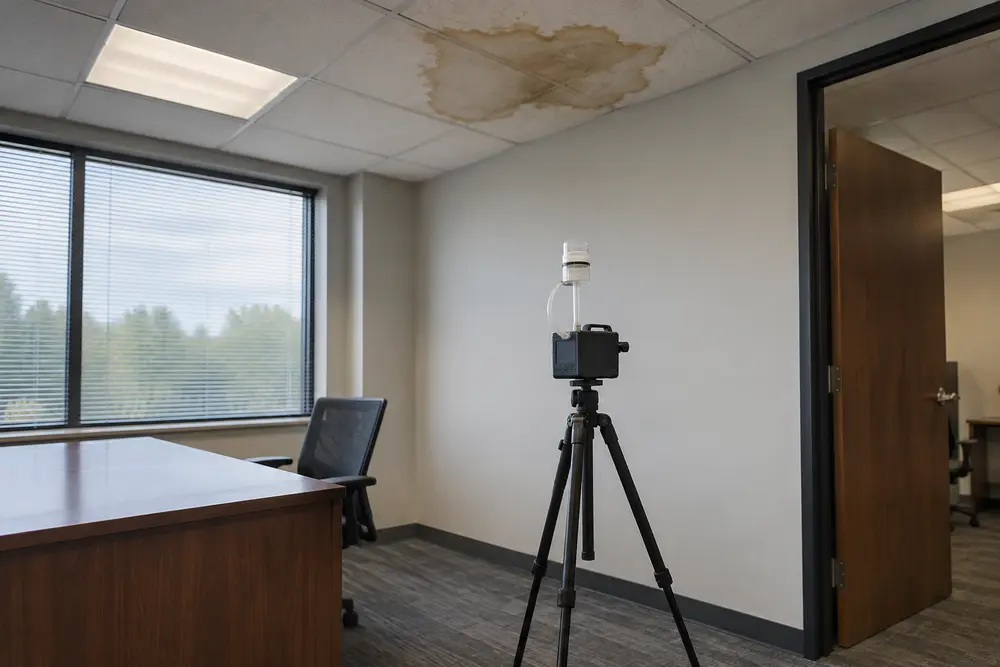
A spore-trap sample measures what passed through the device during a limited collection period. It doesn’t continuously monitor your house, and it can’t report conditions inside every wall or cabinet. NIOSH specifically cautions that short-term air samples can’t be interpreted as direct measurements of health risk.
Say you collect a sample in the living room while the HVAC system is off and the windows are closed. A sample collected later with the system running may capture a different mix of airborne particles. Neither result automatically represents other rooms or concealed spaces.
Recent cleaning can temporarily reduce airborne particles. Walking across dusty carpet may stir them up. A concealed fungal colony may release few spores during the sampling window, especially when the affected material is enclosed. The number is real for the sample collected, but its reach is limited.
A low result also doesn’t erase water stains or a musty odor. If drywall stayed wet after a plumbing leak, that history still deserves investigation. A thorough mold inspection in Austin examines the building conditions that a short air sample can miss.
Occupant susceptibility adds another reason to distrust universal cutoffs. People with asthma or compromised immune systems may have concerns that a laboratory total can’t resolve. Your medical provider should address symptoms and individual risk, while the building assessment determines whether a moisture-supported source is present.
Outdoor Context Changes the Meaning
Mold spores occur naturally outdoors and enter during normal use of a building. An indoor finding isn’t automatically evidence of indoor growth. The useful question is whether the indoor sample resembles expected outdoor entry or shows a pattern suggesting an indoor source.
A properly collected outdoor control gives you local context for the sampling period. A broad Austin mold report can’t serve the same function because conditions at another location may differ from those around your building. Local outdoor conditions can also affect what appears in the air.
Indoor and outdoor totals still don’t create a mechanical formula. An indoor total below the outdoor total doesn’t clear a water-damaged room. An indoor result above the outdoor number may justify closer investigation, but it doesn’t identify the source by itself.
The EPA’s sampling guidance supports comparing indoor findings with outdoor air while emphasizing qualified interpretation. We look at the spore types and their relative distribution, then check whether moisture conditions make an indoor source plausible. The comparison is evidence, not a verdict.
Moisture Evidence Carries More Weight
The central building question is straightforward: has unwanted moisture caused or supported indoor mold growth? That question leads to corrective action. A stand-alone count rarely tells you where water entered or how far the damage extends.
A bathroom can produce a low air count on sampling day while the cabinet base remains swollen from a slow drain leak. Before the leak, the material was intact. Repeated wetting can cause deterioration that points toward a concealed problem even when few spores happen to be airborne.
During an assessment, the evidence worth examining includes:
- Active leaks and previous water intrusion
- Water-stained or deteriorated building materials
- Condensation around HVAC equipment or cool surfaces
- Musty odors that suggest concealed growth
- Visible suspect growth and its location
- The sampling plan and outdoor control
NIOSH’s Dampness and Mold Assessment Tool focuses on observable conditions such as moisture damage and mold. These clues can reveal a building problem even without a dramatic airborne count. Frankly, ignoring a wet wall because a brief sample came back low is backward.
Lab findings work best when they test a specific theory developed during the inspection. If moisture readings and staining point toward one area, targeted sampling may help evaluate that concern. Collecting samples everywhere without a reason often produces more numbers and no clearer answer.
Zero Spores Are the Wrong Goal
A zero-spore building isn’t a realistic target for normal occupancy. The EPA explains that eliminating every indoor mold spore is impractical because spores are part of the natural environment. The sensible objective is to stop the moisture source and address unwanted growth.
A laboratory report can identify spores observed in the collected sample and show differences among sampled locations. It can’t locate every concealed source or diagnose the cause of symptoms. Claims that stretch beyond those limits deserve skepticism.
Texas post-remediation clearance has a narrower purpose. Under the Texas mold assessment and remediation rules, a regulated project may use an assessment protocol with defined clearance criteria. Meeting those project criteria shows whether the work satisfied its protocol. It doesn’t create a universal health guarantee for every occupant or building.
After remediation, we want evidence that the moisture source was corrected and the specified work was completed. A visual inspection may contribute to that decision. Chasing an absolute zero can waste your money without making the building meaningfully drier.
Common Questions About Mold Counts
What Is Considered a Safe Indoor Mold Count?
No federal agency has established one concentration that protects every person in every building. Counts may also be reported using different sample volumes or calculation methods, so you should confirm the units before comparing two reports.
Does Below Outdoor Mean the Building Is Safe?
No. A useful comparison typically relies on indoor and outdoor samples collected close together with compatible methods. Even then, an unusual indoor spore pattern may justify further investigation.
Can a Low Count Rule Out Hidden Mold?
A low count can’t rule out growth inside a wall or beneath flooring. Moisture readings and targeted visual access may provide stronger evidence when the suspected source is concealed.
Should a Mold Test Threshold Decide Clearance?
No universal mold test threshold determines clearance. Your decision should follow the assessment protocol, including its requirements for completed work and current moisture conditions. Laboratory data can support that evaluation, but it shouldn’t replace it.
References
- Mold Testing or Sampling (epa.gov)
- Mold, Testing, and Remediation (cdc.gov)
- Mold Course Chapter 3: (epa.gov)
- Dampness and Mold Assessment Tool (cdc.gov)
- A Brief Guide to Mold, Moisture and Your Home (epa.gov)