
If mold had a dating profile, it would say: I like long walks on damp drywall, steamy summers, and your poorly balanced ventilation system. If you want to keep that clingy bio-sponge out of your walls and lungs, you need the right kind of fresh air machine working with your climate, not against it. That is where the HRV vs ERV decision comes in. Pick the right one and you keep indoor humidity in the mold-safe zone of 30 to 50 percent. Pick the wrong one and you just volunteered your home for a fungal block party. Let’s match the right technology to your weather, set it up properly, and keep your indoor air clean enough to roast a chicken without fogging the windows.
What HRVs And ERVs Actually Do
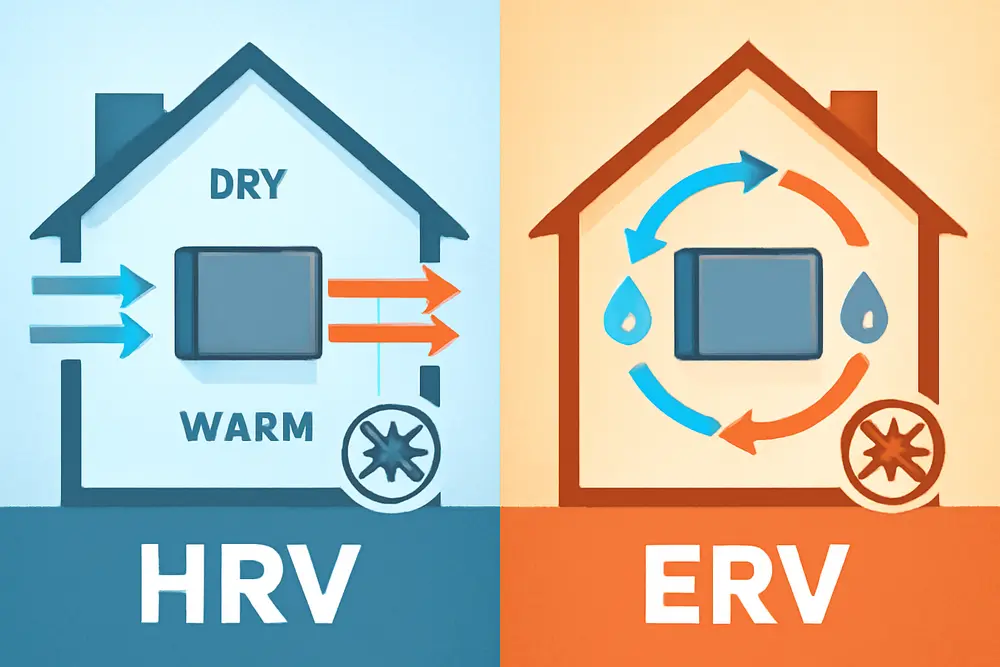
HRV stands for heat recovery ventilator. ERV stands for energy recovery ventilator. Both are balanced ventilation systems that bring in outdoor air and send out indoor air at the same time using a heat-exchange core so you are not throwing energy out the window. The key difference is moisture.
An HRV trades temperature through the core but not moisture. If you exhaust warm, humid indoor air in winter, that moisture goes out and the cold, dry outdoor air comes in with heat recovered from the outgoing stream. Great for winter dryness control and for stopping condensation on cold surfaces. Less great if your outdoor air is a steam bath in July.
An ERV trades both temperature and moisture through a special membrane. Some of the humidity from the more humid air stream passes to the drier air stream. That means an ERV can limit how much moisture you drag inside on hot-humid days and can also help you hold onto a little moisture in bone-dry weather. In short, HRVs manage temperature only, ERVs manage temperature plus moisture.
Why Moisture, Not Just Heat, Decides Mold
Mold is not impressed by your thermostat setting. It cares about liquid water and high humidity. High indoor relative humidity feeds mold, helps dust mites thrive, and condenses on cold surfaces like window glass, rim joists, attic nails, and the back of that dresser you never move. Keep your relative humidity between 30 and 50 percent and mold has a hard time getting traction. Cross that 50 percent line for extended periods and the spore squad punches in for overtime.
Moisture sneaks into buildings four ways: leaks, capillary wicking, vapor diffusion, and air movement. Ventilation is supposed to control the air movement part while managing energy. In winter, air that touches cold surfaces can hit its dew point and deposit water. In summer, outdoor air with a high dew point brings a heavy moisture load that your air conditioner has to remove. An HRV or ERV that matches your climate helps prevent both of those scenarios from turning into stains, odors, or that mysterious fuzzy constellation behind your baseboard.
Which One Fits Your Climate?
Cold-Dry Winters
If you live where your eyelashes freeze and outdoor humidity is basically a rumor, your main problem is too much indoor humidity in winter causing condensation on cold surfaces and at wall penetrations. You want to exhaust that moisture while keeping as much heat as possible. That is an HRV’s wheelhouse. An HRV in a cold-dry climate helps push humid air out, warms the incoming air, and lowers the risk of window sweat and closet spots. It also sidesteps the freeze-up risk that some ERV cores face when temperatures dive. Look for models with frost control and proper condensate handling, and you will keep humidity in the mold-unsafe zone for mold but safe for your skin and furniture, typically 30 to 40 percent in deep winter.
Hot-Humid Summers
If your summers feel like wearing a warm towel as a shirt, the air outside is already overloaded with water. Bringing that in through an HRV will increase the latent load on your air conditioner, which may never catch up, especially during part-load conditions. An ERV is usually the right pick here because it allows some of the incoming moisture to pass back into the outgoing air stream, trimming how much water vapor you import. That means your AC does less moisture removal and is more likely to keep your indoor RH below 50 to 55 percent when it counts. Walls, attics, and ducts get less sweaty. Your nose gets less musty. Your drywall keeps its dignity.
Mixed Or Humid-Cold Regions
Plenty of places get soggy summers and cool, damp winters. Think mid-Atlantic, the Pacific Northwest, and interior zones that swing between seasons. In these mixed climates, an ERV is often the better year-round compromise because it smooths humidity swings. If your winters are truly brutal, some installers still prefer HRVs for the coldest months due to freeze potential in certain ERV cores. Many modern ERVs handle cold with defrost strategies, so look at the manufacturer’s operating temperature range, defrost features, and your actual winter lows. If you spend two-thirds of the year fighting humidity, an ERV likely wins. If your winter is a six-month freezer, an HRV may be safer, possibly with seasonal mode adjustments.
Quick Climate-Pick Table
| Climate | Main Moisture Problem | Best Pick | How It Helps Mold Control |
|---|---|---|---|
| Cold-dry | Condensation on cold surfaces from indoor moisture | HRV | Exhausts indoor humidity and preserves heat, lowering condensation risk |
| Hot-humid | High outdoor moisture drives indoor RH up | ERV | Limits incoming moisture and reduces AC latent load |
| Mixed or humid-cold | Seasonal humidity swings and cool, damp spells | Often ERV | Balances humidity year-round, with defrost features if winters are harsh |
Sizing So You Do Not Wreck RH
A perfectly sized HRV or ERV is like a good barista. It quietly does its job in the background and never floods your cup. Oversize it and you risk over-ventilating. In cold weather, that can over-dry your place and suck more moisture onto cold surfaces when you cook or shower. In hot-humid weather, too much fresh air can push RH up and make the AC work overtime. Undersize it and pollutants linger and bathrooms stay muggy, which is great for mold and terrible for you.
Use continuous, balanced ventilation that meets code and occupancy. A common target from ASHRAE 62.2 is based on square footage plus occupants. The goal is steady, low airflow that turns the indoor air slowly while your HVAC handles temperature and most of the dehumidification. If you need a rule-of-thumb example, a 2,000 square foot home with three bedrooms typically needs a continuous rate in the dozens of cubic feet per minute, not hundreds. Your exact number depends on local code, tightness of the home, and how you live. Bigger is not always better. Bigger can be wetter.
Check the unit’s rated airflow against your required CFM at the external static pressure you will actually have after ducting and filters. Balance the supply and exhaust so the home is not pressurized or depressurized. Pressurizing can drive moist air into walls in some seasons. Depressurizing can suck humid air in from crawlspaces and garages. If your home is already leaky, sometimes the right answer is to air-seal first, then size the HRV or ERV to provide controlled, predictable fresh air.
Setup Details That Make Or Break It
Location matters. Put the unit in a conditioned or semi-conditioned space like a utility room or basement. Attic installations tend to run hotter or colder than recommended and are harder to service. If you have no choice, insulate the case and ductwork and plan for safe access. Use short, straight duct runs with smooth interiors and sealed joints. Insulate outdoor-air and exhaust ducts to avoid condensation. Slope condensate lines to a trapped and drained location and test them. A plugged drain is a mold machine with a monthly subscription plan.
In cold climates, pick models with built-in frost control. Options include pre-heaters, timed recirculation, and defrost cycles that protect the core. HRVs must manage condensate that forms as the warm exhaust air gives up moisture inside the unit. ERVs can avoid some condensate by moving moisture through the membrane, but in very cold weather the moisture transfer path can freeze. If your winters often drop below 20 to 25 degrees Fahrenheit, look closely at defrost features and the recommended operating temperature window. Performance curves are not marketing decor. Read them.
Commissioning is not optional. After install, measure airflow on both supply and exhaust branches and use balancing dampers to match them. Confirm the unit actually hits the design CFM with filters in place and bath-kitchen boosts enabled. Check for cross-leaks in the core with a smoke test or according to manufacturer procedure. Label the controls with plain-English language so you do not forget which button does what six months from now.
Controls And Set-Points That Work
Static ventilation is old news. Use humidity-aware controls so the system adapts to seasons and activities. In hot-humid weather, an ERV may need to slow or pause if outdoor dew point is higher than what your indoor set-point can handle. Some controls use outdoor humidity or enthalpy lockouts to avoid dragging in swamp-air during peak hours. In cold weather, allow enough ventilation to control pollutants while avoiding bone-dry conditions below 30 percent RH, which can crack woodwork and annoy your sinuses.
Set your indoor target to the mold-safe 30 to 50 percent range year-round. Use bath fans or a timed boost on the HRV or ERV during showers and cooking. In homes with central HVAC, integrate ventilation with the air handler only if the controls prevent short cycling that adds moisture to ducts. If you add a dedicated whole-home dehumidifier, coordinate its controls with the ERV so they are not fighting. If your ERV is running full blast while your dehumidifier cries for help, you have built a humidity treadmill.
Maintenance You Will Actually Do
Filters are not decorations. Clean or replace them every 3 to 6 months or per the manufacturer. Dirty filters choke airflow, unbalance supply and exhaust, and can spike humidity in the wrong season. Rinse the core per instructions once a year. Some cores come out like a dishwasher rack. Others need gentle soaking. Do not invent your own chemistry set. Clear and sanitize the condensate tray and trap. Check for slime. Slime is a lifestyle for microbes, not for you.
Look over duct seals and insulation annually. If you see moisture on exterior duct jackets or staining around the unit, find the thermal bridge or air leak and fix it. Confirm that frost control still works if you live in a cold region. Track indoor RH with a reliable hygrometer on each floor. If your numbers drift past 50 percent in summer or below 30 percent in winter for weeks at a time, adjust controls or call someone who can. Maintenance is cheaper than drywall surgery and way less gross.
Austin And Central Texas Notes
Here in the Austin area, summers are hot-humid for real parts of the season, and shoulder months can keep RH high even when temperatures are milder. Winters are usually short but can get cold enough for occasional condensation if indoor humidity climbs. For most homes, an ERV is the right pick because it trims the incoming moisture load in summer and smooths indoor humidity during spring and fall. Pairing an ERV with a properly set thermostat, longer AC runtimes at lower fan speeds, and a dedicated dehumidifier in tighter homes takes you from sticky to steady. If you have a vented attic, do not pull your ERV intake from there. That is like ordering fresh sushi from a parking lot in August.
We see a lot of mold trouble spots locally in bathrooms without boost ventilation, laundry rooms that vent into garages, and supply registers blasting cold air at exterior corners where walls are cooler. Even with an ERV, you still need bathroom fans that exhaust to the outdoors, kitchen hoods that actually vent, and a habit of running them long enough to clear moisture. Keep RH between 30 and 50 percent and you make mold work for its meals. If you already smell musty, fix bulk water first. No ventilation system beats a leak.
Smart Add-Ons Worth Considering
If you like your ventilation with a side of data, add sensors that track RH and temperature on each level and near known trouble spots like basements, crawlspaces, and north-facing corners. Some systems can modulate ERV or HRV airflow or switch modes based on these readings. If you have frequent power outages or you are away often, a small whole-home dehumidifier can save the day during shoulder seasons when AC runtimes are short but moisture is still high. In cold climates, a pre-heater on the incoming air can stop nuisance frost cycles and improve comfort.
Common Setup Mistakes To Avoid
Do not tie bathroom exhausts directly into the ERV or HRV core without following the manufacturer’s guidance. Overloading one side can unbalance the whole system. Avoid long, flexy duct spaghetti that cuts airflow in half. Do not bury the unit behind a water heater or jam it in an attic knee wall where nobody will ever change a filter. Skip outdoor intakes near dryer vents, gas meters, or places where moisture fog and lawn equipment fumes like to party. Finally, do not vent your clothes dryer indoors unless you want to invite fuzz monsters and give mold a weekly buffet.
Signs Your Ventilation Is Winning
Windows are clear while you simmer chili. Bathrooms dry out in under 30 minutes. Your indoor RH sits between 30 and 50 percent most days. There is no musty smell when you open closets. The attic sheathing is not turning polka-dotted by August. Your energy bills look normal for your home and season. And your dog stops staring at the baseboard corner like it whispers secrets at night. That last one might still be the cat.
FAQ
Is An HRV Or ERV Better For Mold?
Neither gadget kills mold by itself. The winner is the one that keeps your indoor RH in the mold-unsafe zone for mold and safe for you. In cold-dry climates, that is usually an HRV. In hot-humid climates, that is usually an ERV. In mixed regions, an ERV often balances the year.
Can An HRV Over-Dry My House?
Yes, if it is oversized, unbalanced, or run too hard in a cold-dry season. Over-drying can crack trim and make you miserable. Set it for continuous low airflow that meets code and use humidity-aware controls to avoid dropping under 30 percent RH.
Can An ERV Replace A Dehumidifier?
No. An ERV limits how much new moisture comes in from outdoors, which helps a lot in hot-humid seasons. But it does not actively pull extra moisture out of your indoor air the way a dehumidifier does. In tight homes or during shoulder seasons with little AC runtime, a dehumidifier is often the missing piece.
Should I Run Bath Fans If I Have An HRV Or ERV?
Yes. Use a timed boost on the HRV or ERV during showers, plus dedicated bath fans that vent outdoors. Moisture sources are spiky. Boosts handle spikes better than constant low flow alone.
How Do I Know If My Unit Is Sized Right?
Check the design CFM against ASHRAE 62.2 targets and verify with on-site airflow measurements after install. Then watch indoor RH. If it floats in the 30 to 50 percent range across seasons without huge swings, you are likely close. If not, adjust controls or consult a pro.
Where Should The Fresh Air Intake Go?
Place it away from dryer vents, gas exhausts, standing water, and areas with heavy vegetation or vehicle idling. Keep it shaded if possible and above grade. Screen it well. Critters have opinions about indoor air, too.
Want Help Matching HRV vs ERV By Climate?
If you are choosing between HRV vs ERV and trying to keep mold on the outside of your house where it belongs, start with your climate and your actual humidity readings, not a brochure. Size it right, install it clean, control it smart, and maintain it. If you would rather not become a ventilation engineer this week, we can spec, install, or sanity-check your setup and test your humidity levels. We also inspect and test for mold if you suspect you already have a growth industry happening behind the paint. Your air should be boring. We will help you get it there.