
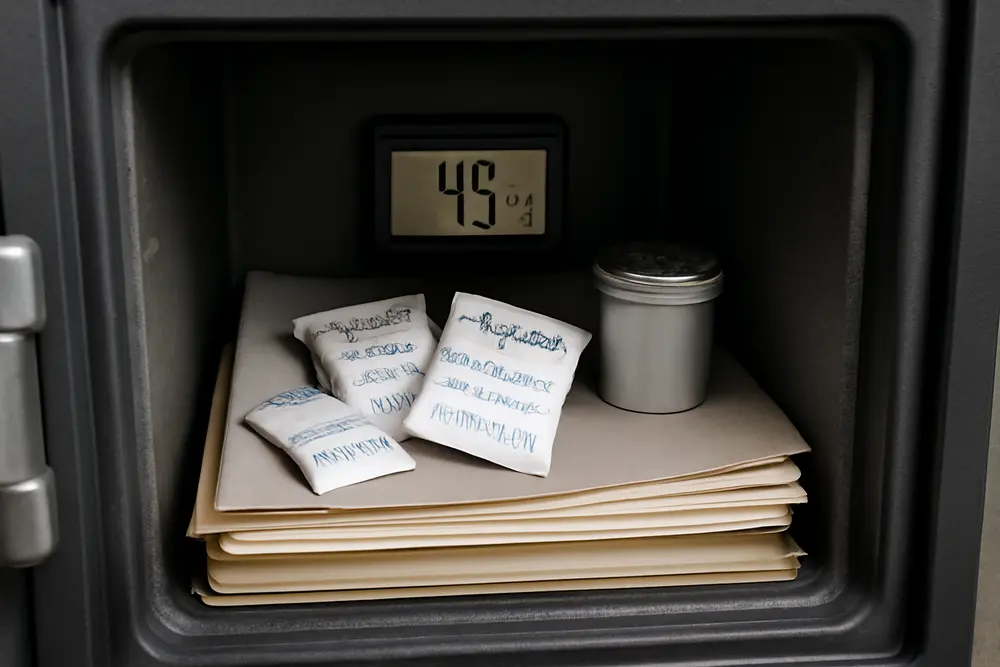
If you think your fireproof safe is a dry, heroic fortress, I’ve got news: it’s also a tiny spa for moisture. Those dense walls and tight gaskets that keep flames out also keep humidity in, which is why your birth certificate sometimes smells like a basement that took a gap year. The fix is simple: control fireproof safe humidity with a few smart add-ins, hit the right RH targets for paper and photos, and stop mold before it auditions across your heirlooms.
Why Do Fireproof Safes Get Damp?
Fireproof safes are basically thermoses with a superiority complex. The insulation is dense, the door gasket swells in heat, and the design blocks fresh air exchange. That near-airtight build is excellent for fire, but it means any moisture that gets in during a humid week or when you open the door tends to linger like an awkward coworker at happy hour. Many fireproof linings are hygroscopic, which means they soak up moisture when the air is humid and then release it later. So even when you think the box is sealed, it can still feed its own humidity.
Once relative humidity creeps above roughly 55 to 60 percent, mold spores wake up, paper ripples, adhesives let go, photos spot, and metal items can start a very unfun rust project. If your safe lives in a basement or an exterior room that runs cool and damp, the risk goes up. The good news: you can manage it without compromising the safe’s fire rating.
What RH Should You Target?
Paper and photos like consistent, moderate conditions. Aim for a humidity range that stops mold while keeping materials stable. Keep temperature sane too, because hot plus humid is the worst combo for organic materials and metal finishes.
| Storage Goal | Target RH | Target Temperature |
|---|---|---|
| Documents and photos | 30 to 50 percent | 55 to 70 F (13 to 21 C) |
| Mixed storage with metals | 35 to 45 percent | 55 to 70 F (13 to 21 C) |
What Gear Actually Helps?
Mini Hygrometers
You cannot control what you do not measure. Drop in a small digital hygrometer with plus or minus 2 to 3 percent accuracy and a clear display. Models with a cabled probe let you read the numbers without cracking the door every time. Park the sensor mid-height, a few inches off any wall, and not right next to a heater rod so you don’t chase fake microclimates. Calibrate it once or twice a year with a simple salt test so you know your readings are legit.
Rechargeable Desiccant
Silica gel canisters or packets are the low-drama workhorses for fireproof safe humidity. They sit quietly, grab moisture, and then recharge when you bake them in the oven or snap them onto a plug-in base. Use multiple units for larger safes and follow the maker’s recharge intervals. In sticky summers you might recharge every few weeks. In drier seasons, monthly or longer often works. Indicating silica that changes color takes the guesswork out of it.
Rod Heaters
GoldenRod-style heater rods are small, low-watt heaters that gently warm the interior air. Warmer air holds more moisture without condensing, which lowers effective RH and evens out conditions. Mount the rod low so warm air rises, match wattage to the safe’s cubic footage, and never bury the rod under papers or touch cords to sharp edges. If your safe offers a factory cord port, use it. Do not drill new holes that could affect the fire rating.
Archival Sleeves
Protect originals inside archival, acid-free, lignin-free sleeves or envelopes. Rigid polypropylene or archival-quality boxes add structure so paper and photos do not curl every time humidity swings. Toss a tiny indicating silica packet inside each box to create a protective micro-climate around your most sensitive items. Label the boxes so you can access what you need without a full excavation.
Setup That Works Long Term
Layer your defenses, especially in big safes or humid climates. A rod heater handles day-to-day moisture swings while rechargeable desiccant mops up the rest. Keep hygrometers where you can read them at a glance and only open the safe when you actually need to. Check the door gasket twice a year for compression set or tears, since a tired seal is basically a welcome mat for damp air. If the safe sits in a basement, lift it on a stand or solid blocks and add an insulating pad underneath to reduce cold-floor condensation. Avoid parking the safe against an exterior wall that sweats during seasonal shifts.
Maintenance And Calibration
Make humidity checks part of your adulting calendar. Log RH and temperature once a month so you spot seasonal trends early. Recharge desiccant whenever the indicator says so or when RH drifts above target. If you use a heater rod, vacuum dust bunnies that collect around it and verify you still have a clear airflow path. For hygrometer calibration, run a quick salt test: place the hygrometer in a sealed container with a bottle-cap of damp table salt for 8 to 12 hours, then note that the air should read close to 75 percent RH. Adjust if your model allows or record the offset so you know how to interpret the readings.
If the safe ever gets a big moisture hit, like a minor flood, steam event, or roof leak, evacuate everything. Dry the interior fully, replace any wet foam or shelf liners, recharge or replace desiccants, and then restock only when readings are back in range.
Mistakes To Skip
Skipping maintenance is how heirlooms turn into compost. Avoid these classics: letting a giant desiccant brick saturate in silence, parking a heater rod right up against paper albums, using calcium chloride buckets that liquefy into salty brine, and trusting an uncalibrated analog gauge that is more decorative than accurate. Measurement matters, and so does placement.
Fast Start Checklist
- Put a calibrated mini hygrometer at mid-height and check it weekly for the first month.
- Add rechargeable desiccant sized for your safe and set a recharge reminder.
- Install a correctly sized heater rod if your climate is humid or the safe is large.
- Move papers and photos into archival sleeves or boxes with a tiny indicating silica packet inside.
- Keep RH between 30 and 50 percent, or 35 to 45 percent if metals share the space.
- Keep temperature around 55 to 70 F and avoid exterior walls or cold floors.
FAQ
Can I Over-Dry A Fireproof Safe?
Yes. Going much below 30 percent RH can make some papers and adhesives brittle over time. Stick to the targets listed and avoid turning your safe into the Mojave.
Is A Heater Rod Safe For Paper And Photos?
Yes, if it is sized and placed correctly. Mount it low, keep it clear of paper by a few inches, and use it with rechargeable desiccant to reduce how hard the rod needs to work.
Do I Need Both A Heater Rod And Desiccant?
In damp climates or bigger safes, yes. The combo covers daily RH swings and long-term moisture load. In small safes in dry climates, rechargeable desiccant plus monitoring may be enough.
What If My Safe Has No Power Access?
Skip the rod and lean on rechargeable desiccant and airtight archival enclosures with small indicating packets inside. Monitor with a battery hygrometer and recharge more often during humid months.