
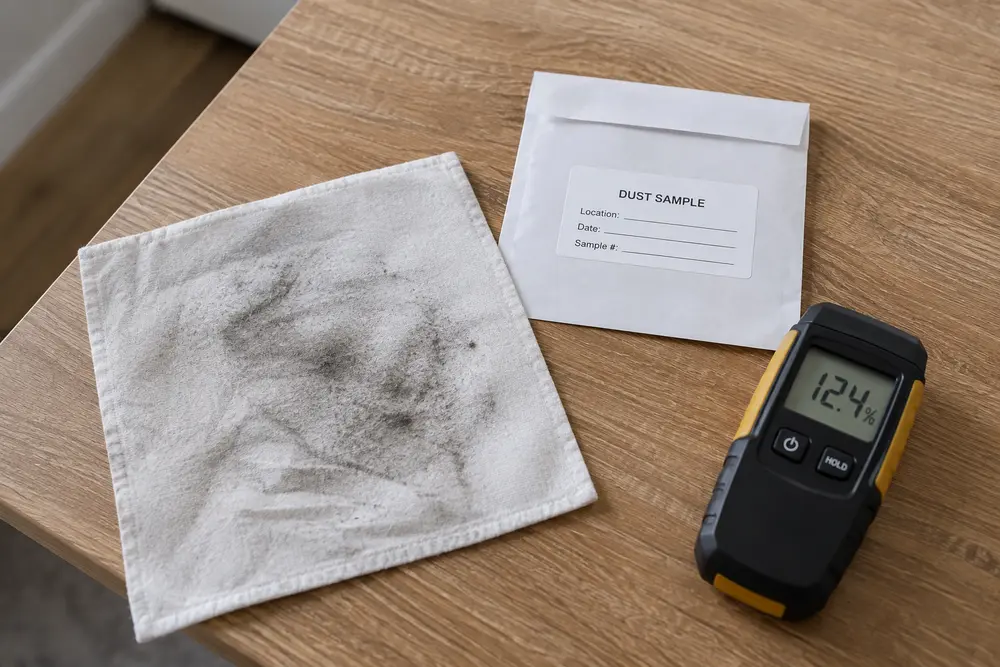
Are you trying to learn what mold has collected in your home, or are you trying to find the leak behind a changing wall stain? That distinction should drive your choice between ERMI testing versus mold inspection.
Our view is straightforward: if your concern involves an active odor, recurring staining, or suspected water entry, start with an on-site inspection. A dust result can add information, but it can’t trace water through a wall or show why your flooring keeps swelling.
ERMI mold dust testing measures selected mold DNA in settled dust. Because dust accumulates, the sample may include material deposited over time, although nobody can assign it a reliable look-back period.
During an inspection, the inspector examines conditions that are visible or measurable during the visit. Moisture readings and building evidence can connect a concern to a particular room or accessible assembly.
Neither option answers every mold question, so you’re choosing between a molecular profile of one dust sample and a direct investigation of your home’s moisture conditions.
What ERMI Mold Dust Testing Measures
ERMI uses mold-specific quantitative PCR to measure DNA from a defined panel of molds. The published ERMI method measures 36 targets. It places 26 in Group 1 and 10 in Group 2.
The calculation compares the summed logarithmic concentrations of those groups. That produces a relative research index. It doesn’t measure every mold in your home, and it doesn’t prove that detected material is alive or growing now.
The sales pitch often gets ahead of the science. The EPA describes ERMI as a research tool and doesn’t recommend its routine use outside research. Treating one score as a federal pass-or-fail standard gives the number authority it doesn’t have.
Collection details matter with any mold testing. Dust gathered from an entry rug may contain outdoor material tracked inside, while dust from a seldom-cleaned bedroom can represent a different accumulation history. The laboratory can analyze what reaches the sample container. It can’t reconstruct everything that happened before collection.
What an On-Site Inspection Can Establish
On site, the inspector looks for a building explanation. The EPA’s mold investigation guidance identifies visual inspection as the key initial step, with attention to water damage and possible moisture sources. Moisture meters can then help determine whether accessible materials are currently damp.
A stain that grows after heavy rain points the investigation toward exterior water entry. Dampness below a sink directs attention toward plumbing. Those patterns provide location and cause information that settled-dust DNA can’t supply.
Even a thorough on-site mold inspection has limits because a leak may be dry on the appointment day, and finished surfaces can conceal damage. Thermal imaging can reveal temperature patterns worth checking, but the camera doesn’t see mold and doesn’t prove that a dark pattern contains moisture.
Their Evidence Windows Are Different
Settled dust can preserve DNA from recent activity and older events. That broader window is useful when your exact question concerns the selected DNA represented in the collected dust.
The window has no fixed length. Frequent cleaning may remove older material. Renovation can redistribute dust that was previously trapped inside an assembly. Flooring and sample location also influence what gets collected.
The inspection concentrates on conditions present during the visit. A moisture meter may document damp drywall today, while visible deterioration may support a longer history of water exposure.
Physical evidence can extend the investigation beyond a pure snapshot. Dried staining beneath a window may remain after the rain stops, and warped trim can persist after a plumbing leak has been repaired. Your inspector can compare those clues with current readings and the building’s history.
Neither method precisely dates mold growth. Dust isn’t time-stamped, and an old stain doesn’t reveal the day water first entered. Be skeptical when someone assigns an exact timeline without supporting records or repeat observations.
ERMI Testing Versus Mold Inspection
Choose ERMI when your defined question is: “What selected mold DNA appears in this settled-dust sample, and how does the calculated profile compare with the ERMI research framework?” That’s a narrow laboratory question. It isn’t the same as asking whether your home has an active leak or which room contains a source.
Choose an inspection when you need to know whether moisture is present, where it may be entering, or which accessible materials appear affected. An inspection is usually the better fit when an odor becomes stronger near one cabinet, a ceiling stain changes after rain, or flooring repeatedly cups during cooling season.
Where Each Method Falls Short
Dust Data Without a Source
DNA in dust doesn’t establish where the material originated. A detected target could reflect an old leak, outdoor material, or dust moved from another room. The result also can’t tell you whether the source remains active.
An elevated number can trigger expensive work without showing workers where to look. Opening walls throughout your home because of one dust score is usually overkill. Additional investigation should follow a specific clue or a defensible hypothesis.
Building Findings With Access Limits
Timing can cause an inspection to miss an intermittent condition. A roof leak may appear only during wind-driven rain, while an air-conditioning drain problem may show up under a particular operating load.
Access matters too. Cabinets can block a wall, and insulation can hide the underside of roof decking. A careful report should separate observed findings from suspected conditions. When selective access is justified, the reason should be clear before anyone starts cutting.
Why Moisture Context Matters
Mold growth in a building requires suitable moisture, so controlling water is central to correcting the condition. The EPA’s moisture-control guidance focuses on liquid water and condensation because unresolved moisture allows damage to continue.
A laboratory number can’t repair a failed window seal, identify a slow supply-line leak, or declare your home safe or unsafe. The EPA notes that no federal limits exist for mold or mold spores, so environmental sampling doesn’t produce a regulatory compliance result.
Both methods can play a role when each has a defined job. The inspection supplies location and moisture context. A dust sample may answer a separate specialist-directed question. Paying for both without knowing what decision each result will change is a good way to buy data you can’t use.
What to Watch for Next
Your next step should match the pattern you’re seeing. If an odor appears after the air conditioner runs, note which rooms are affected and how long the odor lasts. If staining changes after rain, photograph the area under similar lighting so you can compare it over time.
Seasonal timing can expose intermittent moisture that a dry-day visit misses. Spring storms may reveal exterior water entry. Long cooling cycles can expose condensation around cold surfaces or drainage components.
Watch materials for physical change. Soft drywall suggests a different condition than an old, firm stain. New swelling along a cabinet edge also deserves attention because movement can indicate recurring moisture.
After any repair, keep watching the original warning sign. A stain that remains unchanged may simply be cosmetic, while a growing edge suggests water is still reaching the material. Odors that return under the same weather conditions also justify another look.
Before ordering mold dust testing or scheduling a return inspection, write down the exact question you still can’t answer. If the question concerns selected DNA in accumulated dust, a laboratory method may fit. If it concerns water location or active building damage, wait for the conditions that reveal the pattern and investigate the moisture pathway directly.