
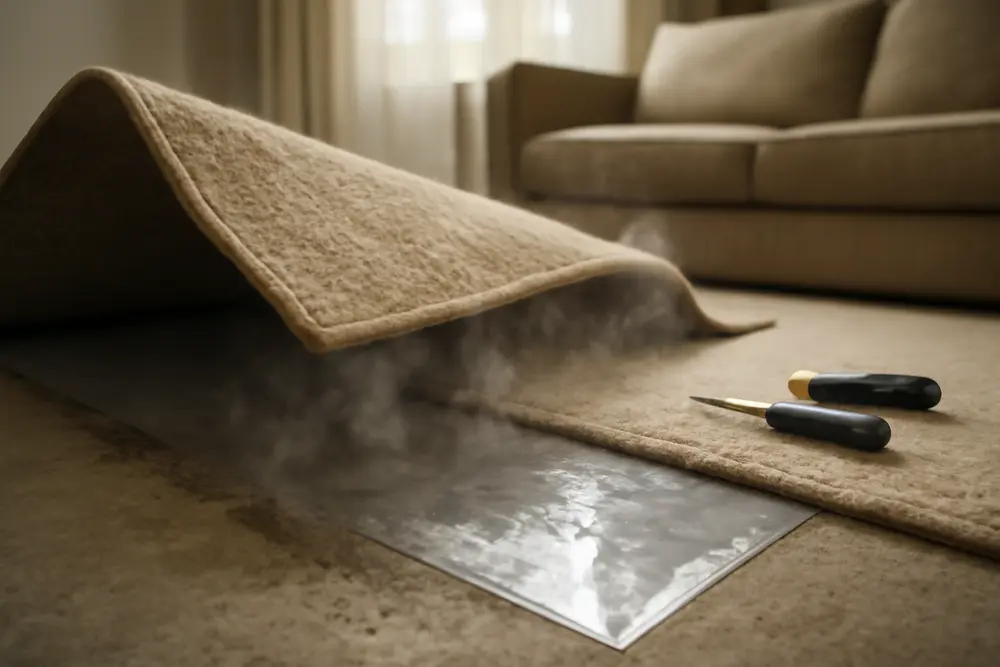
Area rugs make a concrete floor feel less like a parking garage and more like a home. The problem is that concrete is a sneaky humidifier with delusions of grandeur. Moisture moves out of slabs all the time, and when that vapor gets trapped under a rug or foam pad, you end up nurturing a tiny indoor swamp. That swamp throws a musty tantrum, your rug starts to smell like a high school locker room, and if you ignore it long enough, mold shows up to the party. I run a mold inspection company, and I can tell you exactly how to keep rugs fresh and floors dry without turning your living room into a science experiment. Here’s how to beat concrete vapor emission under rugs using quick slab tests, the right breathable rug pad, smart airflow gaps, and humidity control that actually works.
Why Concrete Creates Odors And Mold
Concrete is porous, and it never really stops releasing moisture. Groundwater and ambient humidity drive vapor up through the slab surface where it tries to escape into your room. That process is called concrete vapor emission, and it’s normal. What isn’t normal is trapping that moisture under a rug sandwich made of non-breathable backing and a closed-cell foam pad. That setup slows evaporation so water accumulates, the slab’s alkaline salts can concentrate, and you get the perfect petri dish for mildew and that classic musty odor.
If you have a basement, a slab-on-grade room, or a garage conversion, expect higher moisture drive than an upstairs room. Add summer humidity, a spill that was “totally dry by morning,” or a pet accident, and you’ve got a moisture cocktail that feeds odor-causing microbes long before you ever see fuzzy growth.
Quick Slab Moisture Checks
You don’t need a full-blown flooring lab to make smarter choices. Start with a couple of simple checks, then decide if you need pro-grade testing before you lay rugs.
The quick-and-dirty plastic test: tape a 2 ft by 2 ft sheet of clear plastic tightly to bare concrete. Seal all four edges. Wait 24 to 48 hours. If you see condensation on the underside of the plastic or the concrete darkens, your slab is actively releasing moisture at the surface. That doesn’t mean no rugs allowed, but it means you need a breathable rug pad, airflow, and humidity control or you’ll be sniffing that must the second your HVAC takes a day off.
Handheld meter snapshot: if you’ve got a pinless moisture meter, scan the slab and compare readings in the middle of the room vs along exterior walls. Higher readings at the perimeter are common. If your meter screams everywhere, hit pause on the rug plan and consider deeper testing.
Pro-level tests used in flooring installs: these are worth it if you’ve had odor problems or a recent slab repair, or you want to cover a large area with a big rug.
- ASTM F2170 in-situ RH test measures internal slab relative humidity. Typical product limits for many floor coverings and adhesives fall between about 75 and 85 percent RH in the slab, though some systems allow higher. Rugs are more forgiving than glued floors, but high internal RH still increases odor and mold risk under rugs.
- ASTM F1869 calcium chloride test measures moisture vapor emission rate, or MVER, at the slab surface. Common thresholds for many materials are around 3 to 5 pounds per 1000 square feet per 24 hours. Again, rugs aren’t glued luxury vinyl, but if your MVER is high, treat the slab like a humidity factory.
If that sounds like alphabet soup, hire a local flooring tester or mold inspector to run the numbers. On our side, we use the same principles when advising clients. Concrete will always breathe a little. You just have to stop sandwiching that breath under a plastic poncho.
For more on slab moisture behavior from our flooring perspective, check out our guide on stopping mold under laminate and vinyl plank installs here.
Pick A Breathable Rug Pad
Breathe is the magic word. A breathable rug pad lets water vapor pass through and dissipate instead of trapping it. That doesn’t mean flimsy. It means open structure and materials that do not act like a shower cap on your slab. Here’s how the usual suspects stack up and what I actually recommend.
| Pad Type | Breathability | Grip | Risk Under Concrete |
|---|---|---|---|
| Needle-punched felt or recycled felt | High if not laminated with film | Moderate with rug weight | Low if kept dry and lifted periodically |
| Waffle natural rubber with open grid | High – air channels allow drying | High without melting to floor | Low if true natural rubber and cleaned |
| PVC foam or solid latex foam | Low to very low – often closed cell | High at first, can off-gas and stick | Higher – traps moisture and can leave residue |
| Memory foam or dense polyurethane | Very low – acts like a vapor barrier | High cushion, poor airflow | High – frequent odor and mildew complaints |
My short list: open-felt pads without a plastic film, or an open-grid natural rubber pad designed to grip while letting air move. If you need grip plus cushion, stack smart: a thin open-grid rubber pad under a breathable felt pad is better than a thick slab of foam.
How to spot a non-breathable imposter: if you can’t blow air through it, moisture can’t either. If it looks like a yoga mat, treat it like a vapor blocker. If it says PVC and has that new-shower-curtain smell, it’s a no under rugs on concrete. Avoid laminated felt pads that have a slick film on one side. That film is basically a tiny tarp that holds moisture against the slab.
What About The Rug’s Backing?
Rug backings matter as much as the pad. Natural fiber backings like jute and cotton can breathe but will hold onto moisture if air can’t circulate. Synthetic backings range from breathable woven polypropylene to non-breathable latex coatings. A thin latex dot pattern is usually fine because there are plenty of gaps. A thick continuous latex layer is a moisture trap. If you find a rug with a peel-and-stick layer advertised as not needing a pad, think twice on a concrete slab. You need airflow more than marketing magic.
Install For Airflow
The perfect breathable rug pad still needs a layout that lets air do its thing. Treat the rug like a vented sandwich, not a sealed burrito. Give the perimeter breathing room. Leave a 1 to 2 inch gap between the rug edge and any walls, cabinets, or built-ins. That small shadow line looks intentional and creates a pressure relief pathway so vapor can move out instead of stagnating.
Avoid wall-to-wall rugs on a slab unless you are prepared to lift and air them regularly. Skip stacking multiple pads. Every extra layer is another speed bump that slows evaporation. Heavy furniture sitting on the rug can squash pad texture and close off airflow. Use furniture sliders or coasters that raise legs slightly and occasionally shift the layout so the rug and pad can rebound.
Do not put plastic sheeting under a rug to “protect” the floor. You’re just trapping moisture on the warm side, which is the exact opposite of what you want. If you have a known spill zone, use a breathable pad and commit to a rinse-and-dry routine rather than a waterproof layer that creates funk city.
Control Room Humidity
Even the best breathable setup will struggle if the room is swampy. Keep indoor relative humidity near 35 to 50 percent most of the year. In basements and slab-on-grade rooms, a dehumidifier is often mandatory in summer or any damp season. Size it for the space, set it to 45 to 50 percent, and give it good airflow. If the room feels muggy, your slab is getting a free ride to push more vapor up. Shut that down by pulling moisture out of the air.
HVAC tips that help: run the fan on auto so coils actually remove moisture instead of just stirring it. If your system has a dedicated dehumidification mode, use it. In shoulder seasons when AC is off but humidity is high, a standalone dehumidifier is your friend. If you cook, shower, or run a ventless appliance nearby, exhaust that moisture outside. And please, do not marathon the humidifier in winter right next to a concrete slab. Your sinuses might like it. Your rug will not.
We have a practical guide to moisture control and dehumidifier sizing logic for crawl spaces that translates well to slab spaces too. The goal is the same – keep RH under roughly 50 percent. You can read it here.
Keep It Clean And Dry
Rugs live hard lives. They catch spills, pet surprises, and more foot traffic than your welcome mat. The routine that keeps odors away is simple. Lift and air rugs on a schedule that matches your climate. In humid seasons, lift monthly. In drier seasons, quarterly is fine. When you lift, check the slab for damp spots, salt crystals, or darkening. Quick clean the slab with a HEPA vacuum to remove dust that feeds microbes. If you see any light residue, wipe with a mild detergent solution, rinse with clean water, and dry fast using a fan.
For spills, react like a pro. Blot the rug top, then lift it entirely if the spill was more than a splash. Clean both sides of the rug per the maker’s instructions. Clean and dry the pad as well. The slab should be dried with moving air immediately. Do not lay anything back down until the concrete and the rug are both dry to the touch. If the rug is thick wool or has a dense jute backing and it got saturated, call a professional rug cleaner. Wall washing is optional. Panic is not.
Signs You Already Have A Problem
Your nose is a pretty good moisture meter. A musty smell that gets stronger when the room is closed up is a red flag. Other clues are yellow or brown stains bleeding through a rug, powdery white deposits on the slab called efflorescence, or a pad that has stuck to the floor like a grilled cheese. If you peel things up and see visible mold on the pad or the underside of the rug, treat that material as suspect and decide if it’s salvageable. Thin synthetic pads can often be replaced. Natural fiber rugs with deep contamination are tough to clean completely and may require professional treatment or retirement.
Before you reinstall anything, deal with the source. Reduce indoor RH, switch to a breathable rug pad, and consider a quick slab moisture test to confirm your baseline. If odors return within a week of a deep clean and a pad swap, the slab conditions are still too wet or airflow is still restricted.
Rugs Over Radiant Or New Concrete
Fresh slabs and radiant heat change the game. New concrete releases a lot more moisture for months after placement. If your slab is less than 6 months old, assume higher emission and go extra conservative with smaller rugs, very breathable pads, and frequent lift-and-air sessions. Radiant heat accelerates evaporation but also drives more humidity through the rug layers. Combine radiant floors with a non-breathable pad and you get steamed-rug special. If you must have cushion, stick to an open-grid natural rubber pad and plan for regular checks.
How Professionals Investigate
When we’re called to an odor complaint where rugs are the suspects, we do three things right away. First, we use moisture meters on the slab and the rug layers to see where moisture is accumulating. Second, we measure indoor RH and temperature at different heights to understand if the room is trapping humidity. Third, we inspect the slab surface for salts, adhesive residue, and previous finishes that could be slowing drying. If we find visible growth or unusual dusting, we document with photos and sometimes perform surface sampling as part of a defined scope. The goal is not to scare anyone. It’s to quantify what the slab is doing so the fix is simple and permanent.
If you need help sorting out a persistent musty odor that laughs at candle collections, reach out. We do practical, instrumented inspections and we’re pretty good at sniffing out which layer is causing trouble without turning your living room into a cautionary tale.
Quick Action Checklist
Here’s the short version you can stick on the fridge. Test the slab if you suspect dampness. Choose a breathable rug pad like open felt or open-grid natural rubber. Leave 1 to 2 inch airflow gaps at rug edges. Keep indoor RH near 35 to 50 percent and use a dehumidifier in damp seasons. Lift and air rugs on a schedule. Clean spills on the slab and both rug sides, then dry fast. If musty odors return quickly or you see visible growth, hit pause and call in a pro for moisture mapping.
FAQ
Can I Put A Rug Directly On Concrete?
You can, but you probably should not. A rug without any pad will telegraph slab moisture straight into the rug fibers and backing. Use a breathable rug pad to create micro-air channels so moisture can dissipate instead of camping out under your rug.
What Humidity Should I Keep Indoors?
Most homes do best near 35 to 50 percent RH. Under 50 percent keeps mildew at bay and reduces concrete vapor emission into the room. If your slab room climbs past 55 percent for long stretches, expect musty odors under rugs.
How Often Should I Lift And Air Rugs?
In humid climates or basements, lift monthly in warm seasons and every 2 to 3 months in cooler seasons. In drier climates upstairs, quarterly is fine. Any time you notice a stronger smell after the room is closed up for a weekend, take a peek sooner.
Is A Vapor Barrier Under The Rug A Good Idea?
No. Vapor barriers belong under the slab or as part of a designed flooring system, not between concrete and a rug. A plastic sheet under a rug traps moisture where you do not want it and accelerates odors and microbial growth.
Which Rug Pad Materials Are Safest On Concrete?
Open felt and open-grid natural rubber are usually the best choices. They are breathable, they grip well, and they do not act like a vapor lid. Avoid thick foam pads, closed-cell products, and PVC pads that can off-gas and stick to the slab.
What If My Rug Already Smells Musty?
Lift it, inspect both sides, and check the pad. Clean the slab, dry everything fast, and swap to a breathable rug pad. Control indoor RH. If the odor returns quickly or you find visible growth, get a professional inspection so you’re not chasing symptoms.