
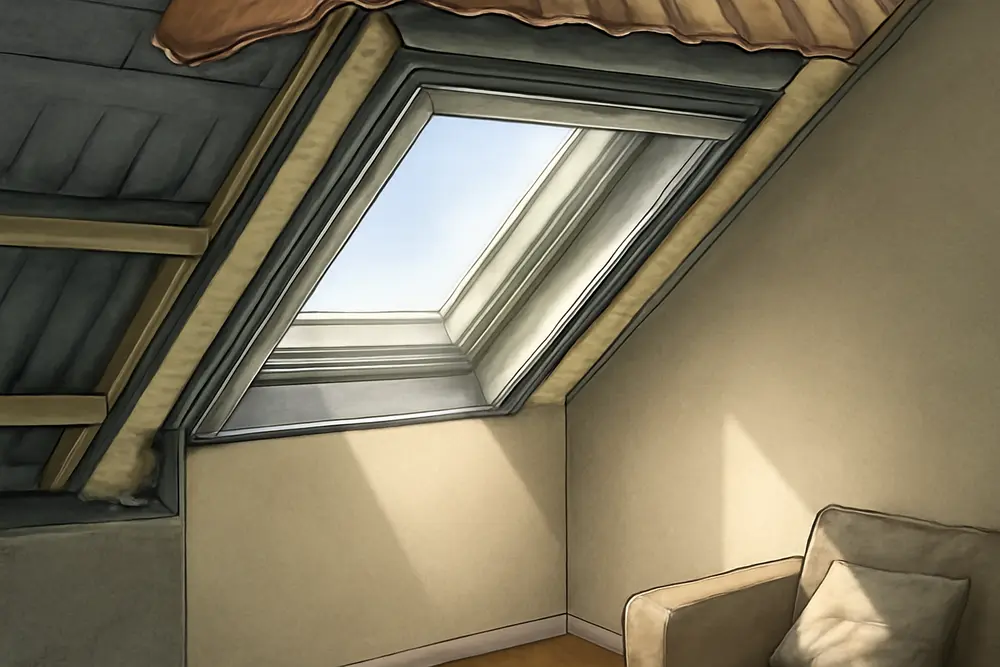
If your skylight is “sweating,” it’s not dramatic lighting or moody ambiance. It’s physics dragging a humid finger across your drywall. Cue the drips, stains, and mold blooms that keep my mold inspectors busier than a dehumidifier in July. The fix is not a miracle spray or a new shade that promises to “breathe,” it’s skylight air sealing and light well insulation done correctly, with vapor control and a little targeted ventilation. Here’s how to keep your light wells dry, your frames mold-free, and your mornings blissfully dripless.
Why Skylights Sweat
Condensation is what happens when warm, moist indoor air meets a cold surface and falls below its dew point. With skylights, there are several prime suspects. The glass is colder than room air on winter mornings. The frame or curb can act like a heat sink if it’s not thermally broken. And the light well, also called the skylight shaft, often has skimpy or sagging insulation that turns the whole tunnel into a cold trap. When that moist air touches any of those surfaces, it condenses and you get water beads, streaks, and eventually those charming coffee-brown stains and little black mold polka dots.
Air leaks make it worse. Any unsealed gap between the skylight frame and the roof framing, between the shaft and attic, or around the ceiling opening becomes a highway for humid indoor air. Warm air rises. Give it a crack and it will sprint straight into the coldest nook of your skylight assembly. That jet of moisture-laden air will condense even if your overall relative humidity is not outrageous. If you can feel a draft at the ceiling trim on a windy day, or see fuzzy insulation peeking into the shaft, that’s your sign.
Finally, thermal bridging turns parts of the assembly into mini refrigerators. Metal frames without thermal breaks, bare wood curbs, or drywall returns touching cold attic air will chill down faster than everything around them. Those cold stripes and corners are exactly where you’ll see first sweat, then stains, then mold.
Codes and Best Practice
Building science is boring until your ceiling starts crying. Then it’s gospel. Best practice for skylight shafts is simple: treat them like any other exterior boundary. That means the shaft walls should be insulated to the same R-value as your attic or exterior walls, and enclosed on the attic side with a continuous air barrier. In many U.S. climates that means R-38 to R-49 for a shaft that passes through an unconditioned attic, depending on your local code cycle and climate zone. Always check local requirements, but the rule of thumb is to match the surrounding ceiling or roof insulation levels.
Vapor control belongs on the warm-in-winter side of the assembly. In most heating-dominated climates, that means a kraft-faced batt or an interior smart vapor retarder behind the drywall, with seams sealed. The insulation must be in full contact with the shaft surfaces so it cannot slump away and leave cold voids. Every seam, joint, and penetration on the attic side should be sealed so indoor air cannot sneak into the shaft cavities. The goal is a continuous, aligned air barrier with the insulation. That combo is what keeps moisture out of the structure and heat where it belongs.
Fix It: Skylight Air Sealing
Air leaks are the accelerant on your condensation fire. Shut them down first. Start at the top and work your way to the ceiling opening. Where the skylight frame meets the roof deck or curb, use high quality sealants or low-expansion foam to close visible gaps. Under the curb, seal the corners and the sheathing joints before any insulation goes on. If your shaft framing has top and bottom plates, seal all six sides: both faces of the top plate, both faces of the bottom plate, and the vertical edges where studs meet plates. It’s tedious. It also works.
Inside at the ceiling, the joint where drywall returns meet the shaft or trim is notorious. Even tiny cracks at the perimeter of the ceiling opening pull moist air up like a straw. Remove trim carefully, foam the gap between the drywall and framing, and reinstall. If the shaft is finished with drywall, caulk and repaint those inside corners. Use acrylic latex caulk for paintable joints and a flexible sealant where seasonal movement is likely.
For materials, canned low-expansion spray foam is your friend for bigger cracks and irregular gaps. Use high quality sealants at seams and corners. Closed-cell foam tape can help where parts move a bit. If your attic side is accessible, sheath the exterior of the shaft with taped rigid foam or housewrap to create a continuous air barrier, then seal that layer to adjacent air barriers like roof sheathing or attic air control layers. Your aim is a continuous, airtight box around the well.
Light Well Insulation That Works
A chilly light well is a condensation magnet. The fix is to match or exceed surrounding insulation levels and keep that insulation in direct contact with the shaft surfaces. If your shaft walls are 2×6, fill them completely. Closed-cell spray foam gives the best combo of R-value, air sealing, and cavity fill. Rigid foam board on the attic side, installed continuously and taped, also works very well when combined with batt insulation in the stud bays. If you insist on fiberglass batts alone, at least cap the attic side of the well with a rigid, sealed layer so the batts cannot sag or get wind-washed. Batts in an open shaft are basically a suggestion to cold air, not a barrier.
For splayed wells or angled light tunnels, treat the assembly like a miniature roof. Keep insulation continuous across transitions. Cut and fit rigid foam to the slope, tape the seams, and seal the edges to framing. If you use spray foam, watch for shrinkage on long runs and ensure complete coverage at corners. Any exposed wood or metal on the attic side should be covered and tied into the air barrier so you do not create cold stripes that drip come January.
Do not forget the backside of drywall corners and the return surfaces near the glass. Those small areas often sit just cold enough to condense first. Wrapping the shaft exterior with a continuous 1 to 2 inches of rigid foam, seams taped, is a tidy way to kill those sneaky cold spots and stock up R-value in one move.
Break the Thermal Bridge
The frame and curb are often the coldest parts of a skylight. A metal frame without a thermal break is a sweat machine. If you are upgrading or replacing a skylight, choose a thermally broken frame and high-performance glazing. If you have a curb-mount unit, insulate the curb. Bare wood curbs are easy to wrap with rigid foam on the exterior and interior faces before finishing. Seal the foam to the roof deck air barrier and to the shaft sheathing so it is not just insulation, but part of the airtight assembly.
If your curb is short or sits in a windy attic, consider adding closed-cell spray foam to the interior curb faces and to the immediate shaft corners. Keep foam out of weep paths and manufacturer-required drainage channels, obviously. The point is to interrupt the conductive highway from glass to drywall. That temperature jump around the frame should become a gentle ramp, not a cliff. If you can feel a cold ring around your skylight on a winter morning, that is the bridge you need to break.
Vapor Control That Keeps Cavities Dry
Vapor barriers are not fashion accessories. Put them on the wrong side and you trap moisture where you do not want it. In heating climates, the vapor control layer belongs on the warm-in-winter side of the shaft assembly, just behind the drywall. Kraft-faced batts with the kraft facing the room are fine when the seams are tight. Better yet, use a smart vapor retarder that is low-perm in winter and more open in summer. Tape and seal the seams, and seal the edges to framing so humid indoor air cannot bypass it. If you are in a cooling-dominated climate, talk to a building pro who understands local conditions before you start stapling plastic everywhere. The short version is to keep warm, wet air from entering cold cavities, whichever side that warmth lives on most of the year.
Avoid double vapor barriers. If you already have a polyethylene layer behind the drywall, do not add another low-perm layer on the attic side of the shaft. Use vapor-open air barriers like taped housewrap or foil-faced foam only where the perm rating and climate make sense. You want the assembly to dry to at least one side. Air sealing is your first defense; vapor control is your traffic cop, not your bouncer.
Ventilation and Humidity
Even the tightest, best-insulated skylight will sweat if your indoor humidity is sky high. Target 30 to 50 percent RH in winter, and try not to exceed 50 to 55 percent in shoulder seasons. Use a hygrometer so you are not guessing. Exhaust fans in bathrooms and over ranges should actually exhaust to the outdoors, not to the attic. Run them during and after showers and cooking. If your windows are fogging, your skylight will not be far behind.
Let air move around the interior face of the skylight. Heavy shades pressed tight to the glass can trap cold air and condensation on the wrong side. Use shades with a small stand-off or crack them slightly when temperatures drop. If a specific skylight still collects condensation in extreme cold snaps, a removable insulating insert for a week or two of arctic weather can help, but do not make it your everyday plan. Fix the root causes first: air leaks, low R-value, and bad vapor control.
Skip indoor clothes drying without ventilation, aquariums without lids, and jungle-level plant clusters during winter. Those are moisture factories. Fix little roof leaks promptly. Water intrusion plus high humidity is how you get mushrooms where paint should be.
Mistakes That Keep Me in Business
Most of the skylight mold calls we see share the same greatest hits, and none of them are glamorous. People stuff fiberglass batts into a shaft and call it a day. The batts slump, cold air pours around them, and the shaft sweats. Homeowners seal the exterior flashing but ignore the interior trim joints, so humid air still rockets into the well. Builders set a gorgeous skylight on a bare wood curb with an unbroken aluminum frame, then act surprised when the frame weeps every cold morning. And plenty of folks chase gadgets while ignoring humidity control. If you are always showering in a steam room, cooking like a restaurant, and never running fans, your skylight is going to wear that moisture.
DIY or Call a Pro?
You can handle a lot of skylight air sealing yourself if you are handy and not afraid of a little attic dust. Sealing the ceiling trim perimeter, foaming small gaps, and adding a taped rigid foam wrap to the shaft exterior are realistic weekend projects. Swapping in spray foam in tight cavities, correcting vapor control layers, insulating curbs, or addressing questionable roof flashing typically belongs to pros. If you already see mold spots larger than a handprint, stains that keep expanding, or soft drywall, stop guessing and call someone who can inspect for hidden wet areas and test for mold growth where you cannot see it.
One more tip from the trenches: if occupants are asthma-prone or immune-compromised, do not sand or disturb stained drywall or trim yourself. You do not want to aerosolize spores. Get an inspection first, then a scoped plan. Dry is the goal; clean air is the result.
Action Checklist
Here is the fast track to a dry, mold-free skylight well. Grab a pencil and bully these items into submission.
- Seal gaps at the skylight frame-to-deck and curb corners with low-expansion foam or sealant.
- Foam or caulk the ceiling opening perimeter behind the trim and the drywall-to-shaft joints.
- Sheath the attic side of the shaft with taped rigid foam or an air barrier and seal it to adjacent surfaces.
- Upgrade shaft insulation to match the attic R-value, with full-depth, void-free coverage.
- Wrap or spray the curb so the frame does not sit on a cold bridge of bare wood or metal.
- Install vapor control on the warm side of the shaft and seal seams.
- Monitor indoor RH and use fans or a dehumidifier to keep winter RH near 30 to 50 percent.
- If problems persist, evaluate the frame and glazing performance and consider a thermally broken upgrade.
Skylight Condensation FAQ
Why Does My Skylight Drip In Winter Mornings?
Overnight, the skylight glass, frame, and shaft cool down. Warm indoor air carries moisture that condenses on those cold surfaces as the room warms up. If your shaft is under-insulated or leaky, it gets even colder, which boosts the drip rate. Air sealing and light well insulation reduce that temperature drop and starve the cavity of moist air.
How Do I Tell Condensation From a Roof Leak?
Condensation usually shows up as beads or fog on the glass or frame, with streaks appearing after cold nights and drying after daybreak. Leaks show up after rain or during snowmelt and often leave localized brown rings or wet spots away from the glass. If it happens in dry weather or follows a cold snap, think condensation. If it tracks with storms, inspect flashing and roof details.
Do I Need a Vapor Barrier In My Skylight Shaft?
In heating-dominated climates, yes, you need vapor control on the warm side, right behind the interior drywall. Kraft-faced batts or a smart vapor retarder are common solutions. Seal the seams and edges. Do not install a low-perm layer on both sides of the shaft, which can trap moisture. In cooling-dominated zones, placement can vary, so confirm with a local pro.
Will A New Shade Or Film Stop Condensation?
Shades can slightly improve interior surface temperatures, but they can also trap cold air and grow condensation if pressed tight to the glass. They are not a fix for air leaks or poor insulation. Solve air sealing, light well insulation, and thermal bridging first. Then use shades as comfort accessories, not life support.
What Relative Humidity Should I Aim For?
Target 30 to 50 percent RH in winter. If you are over 50 percent and it is below freezing outside, expect condensation on your coldest surfaces. Use a reliable hygrometer, run bath and kitchen exhausts to the outdoors, and consider a dehumidifier if your house holds moisture like a sponge.
Is Spray Foam The Only Way To Fix A Skylight Shaft?
No. Spray foam is great because it insulates and air seals in one pass, but you can build an excellent shaft with batt insulation in the cavities and a continuous layer of taped rigid foam on the attic side. The secret sauce is continuity and air tightness, not any single product.
Should I Replace The Skylight To Stop Condensation?
If the frame is uninsulated metal with no thermal break, or the glazing is ancient and underperforming, replacement can help. But many sweaty skylights stop sweating after proper air sealing, curb insulation, and shaft upgrades. Start with the building science basics, then decide if a new unit is worth it.
Where To Seal And What To Use
Here is a quick reference to target the worst leaks and bridges with the right materials.
| Frame to roof deck or curb | Low-expansion spray foam or high quality sealant at all sides |
| Shaft plates and stud joints | Caulk seams, foam larger gaps, seal all six sides |
| Ceiling opening perimeter | Foam behind trim, acrylic caulk at finished joints |
| Attic side of shaft | Taped rigid foam as an air barrier, sealed to roof/attic air layers |
| Curb faces | Rigid foam wrap or closed-cell spray foam, keep drainage paths clear |
Field Notes From A Mold Inspector
If you see fuzzy gray or black spotting on the interior corners of the light well, that is not “just dust.” It is mold snacking on cellulose where condensation lingers. Clean it with appropriate methods and correct the moisture pathway the same day. We test plenty of homes where the only mold source is a sweaty skylight shaft that dripped all winter. The fix list rarely changes: air seal, insulate, add a proper vapor control layer, and manage humidity. When those four show up, the stains stop showing up.
One last nerd note before I get off my soapbox. Thermal imaging cameras make skylight diagnostics oddly fun. If you scan the shaft and see cold vertical stripes at studs, glowing hot edges, and a dark blue halo around the frame, that is your map. Fill the gaps, cover the bridges, and make that thermal image as boring as possible. Boring images, dry ceilings, happy lungs. That is the good stuff.