
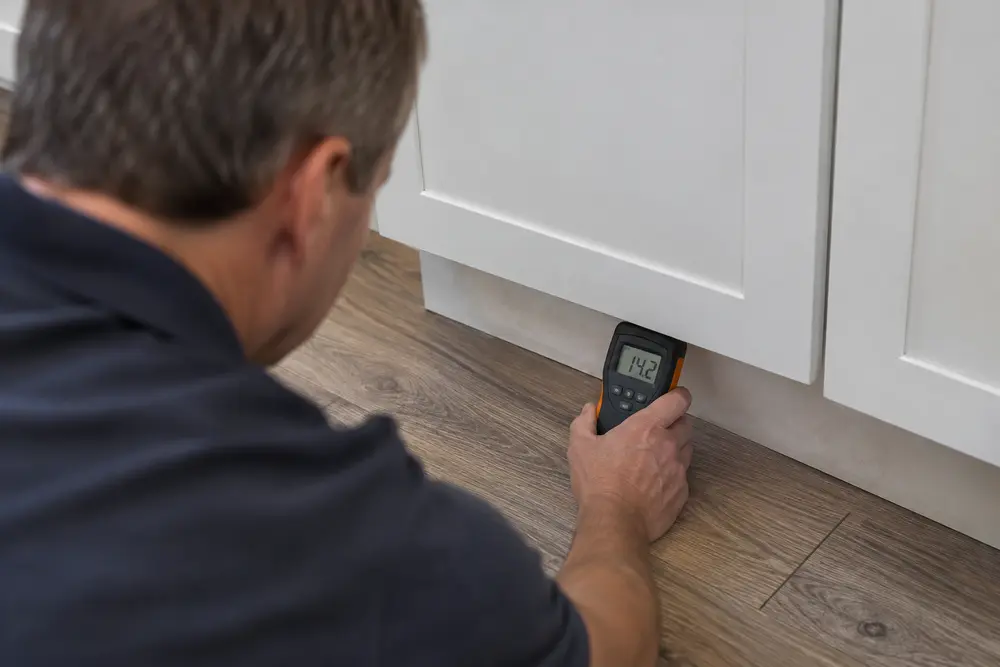
Toe kicks can conceal far more than you expect. After your dishwasher supply or drain leaks, the visible kitchen floor may look dry while water remains beneath the cabinet run, where you can’t see it and normal room airflow can’t reach it.
Your search for mold under kitchen cabinets starts with the route the water took. It may enter the dishwasher recess, move behind your toe-kick panel, and soak exposed cabinet edges, or it can follow flooring seams into the sink base without leaving you an obvious puddle.
An open-room air sample won’t show you which cabinet substrate is wet or whether the back of your toe kick has visible growth. It captures airborne material during a short period, so your result can shift with HVAC operation, recent cleaning, an open door, or someone walking through the kitchen.
Dishwasher leak mold isn’t a special category of mold in your home. The concern is prolonged dampness in materials that can support growth. The EPA’s guidance on mold and moisture recommends that you dry wet materials within 24 to 48 hours when possible, but that clock doesn’t prove growth has or hasn’t occurred.
A useful inspection should follow the water in a logical order: document the leak, map moisture, open safe visual barriers, and then decide whether sampling would resolve a question that direct inspection couldn’t answer.
Start With Leak History and Safety
Your inspection begins with what happened before anyone reaches for a meter. You need to know when the leak was discovered, whether your dishwasher continued running, and how the cleanup was handled because wiping the floor is different from directing drying air into your concealed cabinet void.
The source you report helps establish the likely water path. A failed supply connection may release clean water under pressure, while your drain hose can discharge used wash water containing food residue, and you should have the plumbing problem corrected before the environmental investigation moves forward. A mold inspector isn’t there to certify the repair.
Photographs taken before anything is moved preserve useful context about your kitchen, so the dishwasher front, flooring, and cabinet run should be documented before panels are removed. Swollen seams or separated laminate deserve your attention because those changes can point toward absorbed moisture even when the surface feels dry.
Electrical risk should determine how you approach access around the appliance. Your wet dishwasher recess contains an appliance and wiring, so pulling the unit forward isn’t a casual do-it-yourself experiment, and drain water deserves cautious handling too. OSHA’s mold guidance discusses protective measures for investigating damp materials and concealed growth.
If you’re arranging this kind of mold inspection in Austin, ask Howard Environmental to investigate the water path first. We’ll confirm that you authorize access before a detachable toe kick or attached component is removed, since randomly cutting your cabinets is usually overkill when a removable panel can expose the same area with less disruption.
Map Moisture Before Opening the Void
An initial moisture map gives you a record of conditions before anything is disturbed. Readings near your dishwasher should be compared with similar materials in an area believed to be unaffected, and that material comparison matters because you can’t interpret a reading on wood flooring the same way as one on drywall.
Your first checks will usually cover the flooring in front of the appliance and the adjacent cabinet side panels, while the sink-base floor deserves attention when your drain or disposal connection is involved. Each reading should be identified by material and location, not reduced to one mysterious number in your report.
No universal moisture threshold will work for every cabinet in your kitchen because meter type, operating mode, and the construction of the material being checked all affect the reading. Infrared imaging can help you identify unusual temperature patterns, but an infrared camera doesn’t detect mold, so a suspicious pattern still needs confirmation through direct access or an appropriate moisture meter.
Open the Toe Kick and Trace the Water
Your toe-kick face should come off early once the undisturbed condition has been documented. This means removing a safely detachable skin or access panel, not launching into cabinet demolition, because the goal is to show you the concealed route with the least disturbance needed.
The newly exposed void may show you water tracks or damp debris. Rusted fasteners can support a history of repeated wetting, while swollen particleboard indicates that moisture reached your cabinet substrate; a musty odor that becomes stronger after the panel comes off is useful evidence too, though odor alone doesn’t identify the material producing it.
Dark discoloration in your cabinet void calls for precise, disciplined language. An inspector can document water staining or suspected microbial growth without telling you that every black mark is mold, especially since grease, adhesive, and construction dust can all look suspicious in a cramped cavity. A confident guess is still a guess.
Your dishwasher recess may require another point of access before the inspection is complete. When it’s safe and you’ve authorized the work, an appropriate contractor can pull the appliance forward so the floor and rear wall are visible, and your inspection should include the transition into the toe-kick void because that opening often explains how water reached cabinets beyond the machine.
Water from your dishwasher won’t stop at a cabinet boundary. Elevated readings beside the appliance call for checks farther along your cabinet run until observations return to a credible unaffected condition, which may require checking your sink base and accessible flooring near the far end of the cabinets.
Particleboard swelling deserves your particular attention because exposed edges absorb water more readily than decorative faces suggest. A laminate surface can look respectable while the core beneath it has expanded or softened, so a cabinet that appears intact before access may tell you a very different story after the toe kick comes off and exposes the damaged lower edge.
Taking off one panel won’t expose every surface that water may have affected because moisture may continue beneath your finished flooring or behind fixed cabinet partitions. When the observed path points into another concealed assembly, your report should identify that limitation and recommend the next useful access point. Claiming that no mold exists behind surfaces that weren’t inspected would be nonsense.
When Does Targeted Sampling Help?
Sampling earns its place in your inspection when it answers a defined question. If one discoloration might be fungal growth and identification would change your work scope, a tape lift or swab may help, while a material sample can sometimes clarify whether a concealed cabinet component is colonized, provided the result will influence what you do next.
Sampling can’t tell you whether your cabinet is still wet or confirm that the plumbing repair worked; you answer those questions through moisture mapping and repair verification.
Visible growth usually doesn’t require species identification before you correct the moisture problem because the material condition and extent of the affected area generally matter more to you than a Latin name on a laboratory report. Testing obvious growth simply to make your report thicker is often money poorly spent.
Open-room air testing is weaker as your first step because a low result can’t prove that an inaccessible surface is clean, while an elevated result doesn’t identify the source for you on its own. NIOSH guidance on damp buildings explains that short-term air measurements may not represent building conditions reliably.
There are no federal pass-or-fail limits you can apply to indoor mold spores, according to the EPA’s mold sampling guidance. Air sampling can still be useful when you have a defined HVAC question or a project protocol requires it, but for a localized dishwasher leak, targeted mold testing should follow physical evidence and a clear reason for collecting the sample.
Your final documentation should separate observations from laboratory identification, tell you which surfaces were accessible, and show where moisture readings were taken. If additional access is needed, you should know exactly what question that access is meant to answer.
Common Questions About Dishwasher Leaks
Must Cabinets Come Out After a Dishwasher Leak?
The need to remove your cabinets depends on how far the water traveled and whether the substrate remains structurally sound. A detachable toe kick may give you enough access for inspection and drying, while cabinets with softened bases or extensive concealed impact may require more removal. Replacing your entire run before tracing the water is premature.
Can a Fan Dry Water Under Fixed Cabinets?
A fan will only help you if air reaches the wet surfaces, so blowing air across your kitchen floor does little for moisture trapped behind a sealed toe kick. Effective drying needs an airflow path, followed by meter readings showing that the material is returning toward the condition of an unaffected comparison area.
How Long Does the Inspection Take?
Your inspection time depends on access and the length of the water path. A localized leak with a removable panel can be evaluated faster than one that continues beneath your flooring, and any inspector promising you an exact duration before seeing the cabinet construction is working from optimism, not evidence.
Does a Musty Smell Prove Mold Is Present?
A musty odor gives you a reason to investigate further, but it doesn’t prove what material is affected or where the source sits. Odor that intensifies after you open the toe kick can help narrow the search, though you may still need direct observation or a targeted sample to identify a questionable surface.
References
- A Brief Guide to Mold, Moisture and Your Home (epa.gov)
- Mold – Overview (osha.gov)
- NIOSH guidance on damp buildings (cdc.gov)
- Mold Testing or Sampling (epa.gov)