
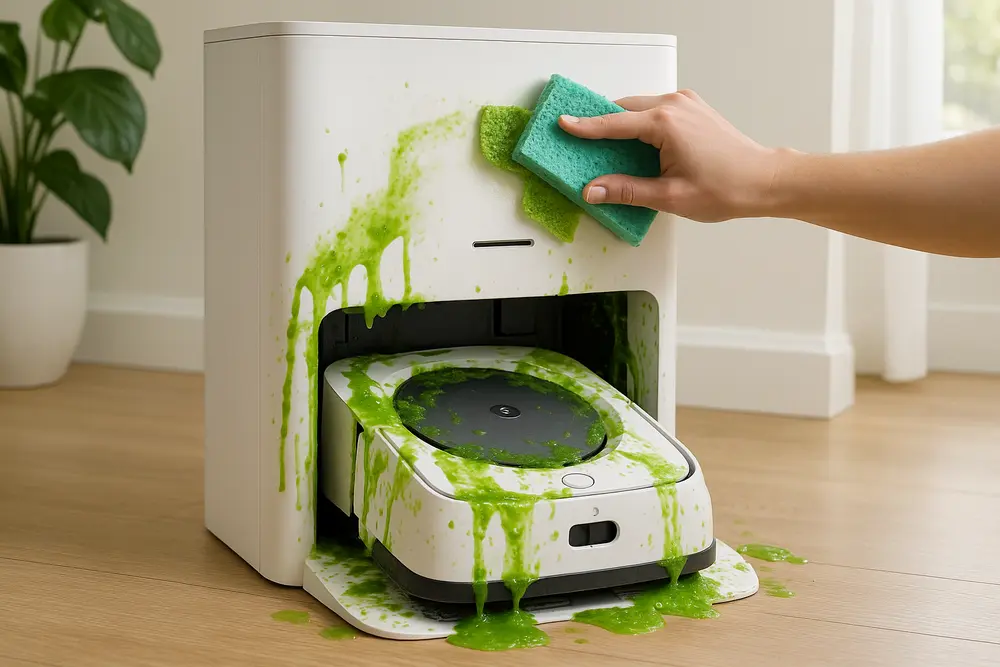
Good robot mop station hygiene starts with controlling the water your machine leaves behind. Dirty tanks, wet trays, and damp pads can support odor-producing microbes and slippery biofilm. Fortunately, practical biofilm prevention tips can keep the dock fresher without turning your laundry room into an amateur chemistry lab.
Robot vacuum mop docks are wonderfully convenient, but they aren’t self-cleaning in the fullest sense of the term. A station may rinse its own pads and pump out dirty water, yet that dirty water still has to go somewhere. It often sits in a closed tank with food residue, soil, pet debris, skin cells, and whatever else the robot collected from the floor. That’s less of a sparkling-clean appliance and more of a tiny wastewater holding tank.
Why Robot Mop Stations Get Slimy
A robot mop dock brings together the three things microbes appreciate most: moisture, residue, and time. Water can linger in tank corners, tubing, dock trays, filter screens, gaskets, and other low spots. Poor airflow inside closed tanks slows drying, while dirty recovery water supplies plenty of material on which microorganisms can feed.
The dirty-water tank deserves the most attention because it receives both water and floor debris. If that mixture sits between several cleaning cycles, sediment settles and residue begins coating the tank walls. Simply dumping it later may remove the liquid, but it won’t necessarily remove material that’s attached to the plastic.
The clean-water tank can develop trouble too. Water stored for long periods may leave mineral deposits or support a film, especially if the tank becomes contaminated through handling or backflow. Clean water isn’t sterile water, and a tank labeled “clean” doesn’t receive diplomatic immunity from maintenance.
Damp mop pads add another layer to the problem. Their porous fibers hold water, soil, cleaning-product residue, and microbes collected from the floor. A used pad left attached to the robot or enclosed in a poorly ventilated station may stay damp for hours. The U.S. Environmental Protection Agency identifies moisture control and prompt drying as central parts of mold prevention. That guidance isn’t a model-specific robot maintenance schedule, but the underlying lesson applies: materials that don’t remain wet are less accommodating to growth.
Is It Mold, Biofilm, or Buildup?
Finding something unpleasant in a tank doesn’t automatically mean you’ve found mold. Slime is often a bacterial or mixed-microbe biofilm. A CDC-published scientific review describes biofilms as communities of microorganisms attached to surfaces and surrounded by a self-produced matrix. In household terms, that matrix is one reason a slippery coating can cling to tank walls after the water has been replaced.
Biofilm may appear as a slick layer, discoloration around a gasket, or residue that quickly returns after a light rinse. Sour, musty, or dirty-water odors are also warning signs, although odor can’t identify a specific organism or establish a health risk.
Mold-like growth is more likely to look spotty, fuzzy, powdery, or embedded in a porous pad or accumulated debris. Mineral scale is usually chalky or crusty and is often white or pale. Detergent residue can also feel slick without being microbial. Color isn’t a reliable shortcut. Pink, orange, green, or black material can’t be identified accurately just by looking at it.
If you’re curious about exactly what’s growing inside a dirty tank, the honest answer is that appearance alone won’t tell you. The useful question isn’t whether the slime has an impressive scientific name. It’s whether you can remove the residue, dry the parts, and stop it from returning.
Robot Mop Station Hygiene After Each Run
The best cleaning routine is the one that’s easy enough to repeat. Start by turning off or unplugging the dock before manually cleaning it. Keep water and cleaning products away from charging contacts, motors, sensors, and other electrical components.
Empty the dirty-water tank after a cleaning session or at the end of the day. Don’t let several loads of dirty recovery water become a long-term tenant. Rinse out loose sediment before it dries onto the tank walls, and check the lid, float, gasket, and corners for trapped debris.
Remove the mop pad when the dock doesn’t dry it completely. Wash it according to its care instructions, then let it dry fully before storage or reinstallation. An automatic drying feature can help, but it isn’t useful if the heater or fan isn’t working correctly, the airflow is blocked, or the pad still feels damp long after the cycle ends.
Wipe standing water and visible debris from the removable dock tray. Hair, crumbs, and sludge can obstruct drains and keep small pockets wet. If you won’t use the robot again soon, empty the clean-water tank instead of storing water indefinitely, unless your model’s instructions say otherwise.
| When | What to Check | What to Do |
|---|---|---|
| After a run or at day’s end | Dirty-water tank, pad, and tray | Empty, rinse, remove debris, and dry |
| Weekly | Tanks, lids, floats, seals, screens, and attachments | Wash and gently scrub approved removable parts |
| Periodically | Ports, filters, tubing entrances, pads, and drying system | Inspect for residue, damage, blockage, and recurring odor |
This timing is a practical starting point, not a universal law. Daily use, pets, warm temperatures, high indoor humidity, and heavily soiled floors may call for more frequent attention. Your owner’s manual takes priority over general advice.
Weekly Biofilm Prevention Tips
A weekly rinse is helpful, but a slippery film usually needs physical contact. Wash removable tanks with warm water and a mild, manufacturer-approved detergent. Use a soft bottle brush, cloth, or nonabrasive brush to reach tank walls and corners without scratching them. Scratches can trap residue and make future cleaning harder.
Pay attention to the unglamorous parts. Tank lids, floats, gaskets, filter screens, tray drains, intake openings, and textured plastic are common collection points. Remove hair and compacted debris, rinse away loosened material, and leave washable parts open to air-dry. A closed, freshly rinsed tank can still remain damp for a surprisingly long time.
Cleaning and disinfecting aren’t interchangeable terms. Cleaning physically removes soil and much of the microbial material. Disinfecting uses a labeled chemical to kill specified organisms under defined conditions. The CDC’s household hygiene guidance explains that surfaces should generally be cleaned before disinfection and that routine disinfection isn’t always necessary.
If your manufacturer permits disinfection, clean the surface first and use a product approved for that material. Follow the label’s dilution, wet-contact time, rinsing, and ventilation directions. A quick spray followed by an immediate wipe may smell productive, but it may not meet the product’s requirements for disinfection.
Complete drying is one of the simplest biofilm prevention tips because it changes the condition that allowed the growth to persist. Fragrance doesn’t do that. If a tank smells like swamp water wearing perfume, the underlying sanitation problem is still there.
What Not to Pour Into the Tank
Don’t pour bleach, vinegar, essential oils, disinfectant, dish soap, or general floor cleaner into a robot’s tank unless the manufacturer explicitly approves that product and use. An unapproved liquid can foam, corrode internal parts, damage seals, clog tubing, confuse sensors, leave floor residue, or create warranty problems. “Natural” doesn’t mean appliance-compatible.
Never mix bleach with ammonia, acids, vinegar, toilet cleaner, or other cleaning products. These combinations can release hazardous gases. Poison Control provides guidance on bleach exposure and chemical-mixing risks. If an accident occurs, leave the affected area, get fresh air when safe to do so, and contact Poison Control or emergency services as appropriate.
Don’t spray cleaning chemicals directly into electrical areas. Apply an approved product to a removable component or cleaning cloth as directed, and avoid soaking charging contacts or electronic housings. Descale the machine only when the manual permits it and only with the recommended product or procedure.
Signs the Dock Needs Attention
A dirty-water tank that feels slippery after rinsing needs more than another refill. Other warning signs include a pad that stays damp, cloudiness or floating material in the clean-water tank, residue around seals and floats, and sour or sewage-like odors that persist after routine cleaning.
Spots or fuzzy material on a pad or gasket deserve prompt attention. So does slime that returns shortly after the tank is scrubbed. Repeated buildup may mean a section of the tank isn’t being reached, a filter is holding residue, drainage is obstructed, or the automatic washing and drying system isn’t functioning correctly.
An odor can indicate retained debris or microbial activity, but it doesn’t prove that dangerous mold is present. There’s evidence that persistent moisture supports biofilm and mold growth, but comparatively little published research measuring health risks from residential robot mop docks specifically. There’s no need for panic, and there’s certainly no need to declare the robot a toxic-mold cannon.
When Parts Need Replacement
Some components become more trouble than they’re worth. Replace a porous mop pad when it remains musty or visibly contaminated after proper laundering and complete drying. A filter that can’t be thoroughly cleaned, cracked gasket that retains residue, or damaged tank that can’t be reached with a brush may also need replacement.
Mold-like growth embedded in foam or another absorbent material can be difficult to remove fully. EPA mold-cleanup guidance notes that porous materials may need to be discarded when they can’t be adequately cleaned and dried. Follow your robot manufacturer’s instructions for approved replacement parts rather than relying on an arbitrary calendar schedule.
Recurring contamination can also point to a mechanical issue. If the dock isn’t draining, washing, emptying, or drying as designed, replacing pads over and over won’t correct the cause. Check for obstructions and consumable wear, then contact the manufacturer or a qualified repair provider if performance has declined.
When the Problem Isn’t Just the Dock
A dirty robot station is usually a sanitation, odor, and maintenance problem. Still, take a wider look when musty odors persist after the appliance has been cleaned or when visible growth appears on nearby baseboards, flooring, cabinets, or walls. The dock may be sitting near a plumbing leak, condensation problem, damp flooring layer, or area of elevated humidity.
People with asthma, mold allergies, chronic respiratory disease, or weakened immune systems may prefer not to handle visible growth directly. Gloves can reduce skin contact, and cleaning should be done with reasonable ventilation while avoiding splashing. Symptoms can’t be diagnosed from the appearance of a tank, so health concerns belong with a medical professional.
If moisture, odors, or visible growth extend beyond the appliance, Howard Environmental can help evaluate the broader indoor environment. Good robot mop station hygiene still comes down to an uncomplicated routine: empty dirty water, scrub attached residue, rinse removable parts, let them dry completely, and follow the model-specific manual. Those habits aren’t flashy, but they’re far more useful than pouring mystery chemicals into an expensive robot and hoping for the best.